
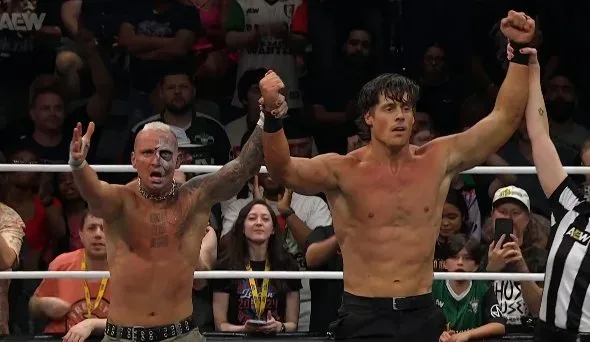
Steven Borden is not ruling out using face paint in the future, but he is making it clear that he does not want his early AEW run to be defined by recreating the presentation of his father, Sting.
During an interview with Trent Osborne of 1010XL, Borden and Darby Allin were asked about the possibility of Borden eventually painting his face while competing in the ring. The visual association is an obvious one. Sting’s face paint, trench coat, and baseball bat became some of the most recognizable elements of his decades-long career, and those images remain deeply connected to the legacy he left behind in AEW.
Allin, who was Sting’s final tag team partner before Sting retired, offered a lighthearted response when the subject came up. Rather than pushing for Borden to adopt the familiar look, Allin argued that Borden is doing just fine without it.
“Look how sexy he is. He doesn’t need it.”
For more background on this topic, read Darby Allin Says Staying True to Himself Is His Defining Goal in AEW.
The comment drew attention to an important part of the discussion: Borden is not simply being positioned as a repeat of Sting. His connection to one of wrestling’s most famous performers is unavoidable, but his approach so far has been centered on establishing himself before leaning too heavily into the imagery that made his father a legend.
Borden said that arriving in AEW immediately dressed in the full Sting-inspired presentation could have worked against him. In his view, using the paint, coat, and bat from the outset may have made fans feel that he was relying on familiar nostalgia rather than giving them a reason to invest in him as his own performer.
“Yeah. The last thing I want to do is be playing the greatest hits. I think you can do callbacks when it makes sense at the right time. But I think if I were to have come out with face paint and a trench coat and a bat, I probably could have been booed out of the building in the beginning, and I’m still in the beginning right now. So kind of taking it week by week.”
That answer leaves room for the possibility of a future callback without making a promise that it will happen. Borden did not say he will never wear face paint, nor did he set a timetable for doing so. Instead, he described a patient approach, one that treats any potential nod to Sting as something that should be earned by the right situation rather than used as a shortcut.
Building an Identity Beyond a Famous Name
For second-generation wrestlers, balancing family legacy with personal identity can be one of the most difficult parts of entering the business. A recognizable name can create immediate interest, but it can also lead to comparisons before a newer performer has had the chance to define their own voice, style, or connection with an audience.
Borden’s comments acknowledge that challenge directly. He understands the appeal of the classic Sting presentation, especially for viewers who remember Sting’s many eras in professional wrestling. Yet he also recognizes that repeating those visuals without a larger reason could be interpreted as imitation rather than tribute.
The phrase “playing the greatest hits” is especially telling. Wrestling thrives on callbacks, reunions, signature gear, and references to the past. Those moments can be powerful because fans understand the history behind them. But their impact often depends on timing. If every aspect of a newer act is immediately built around a predecessor’s best-known material, the audience may have less opportunity to see what makes the new performer distinct.
Borden’s week-by-week mindset reflects the fact that he still views himself as being at the beginning of that process. He is not presenting himself as someone who has already arrived with every answer in place. Instead, he is allowing his AEW role and audience response to develop over time.
That measured strategy also fits the setting around him. Allin knows better than most what Sting’s presentation meant in AEW. The two became regular partners during the latter stage of Sting’s in-ring career, and their pairing gave Allin a direct connection to one of the industry’s most enduring names. With Sting now retired, Allin’s presence alongside Borden naturally creates another bridge between past and present.
Still, Allin’s joking endorsement of Borden not needing face paint carries a practical message beneath the humor. There is no requirement for Borden to look exactly like Sting in order to be accepted. The relationship to Sting is part of the story, but it does not have to be the entire story.
A Callback Could Mean More When the Time Is Right
Borden did leave the door open for selective references to Sting’s legacy. He said callbacks can work when they make sense and when the timing is right. That distinction matters because it frames face paint as a potential storytelling tool rather than a permanent default.
If Borden were to use paint at some point, the value would likely come from context. A special moment, a meaningful match, or an occasion tied to an important chapter in his own career could give the visual a purpose beyond simple recognition. For now, though, Borden’s focus is on avoiding the impression that he is trying to recreate a finished character from another era.
There is also a difference between honoring a legacy and inheriting every aspect of it. Sting’s career included multiple looks and personas across different periods, from colorful face paint to the darker presentation that became especially synonymous with his later years. Trying to reproduce all of that immediately would be an enormous burden for any wrestler, particularly someone still finding their footing on a major roster.
Borden appears aware of that pressure. His comments were not dismissive of Sting’s look or the fans who cherish it. Rather, he explained why he believes restraint is the stronger choice at this stage. Fans can still recognize the family connection without seeing a direct visual reproduction every time he appears.
That restraint may also preserve the possibility that a future tribute lands with greater emotional weight. In wrestling, scarcity often helps make a particular entrance, item of gear, gesture, or visual transformation feel important. By not making face paint part of his standard presentation from day one, Borden has ensured that any decision to use it later would carry additional attention.
Darby Allin’s Perspective on Authenticity
The face-paint conversation came as Allin also discussed his desire to inspire the next generation of wrestlers to remain themselves. That broader idea aligns closely with Borden’s comments about not immediately adopting Sting’s signature attire.
Allin has long stood out through a distinctly personal presentation, both in and out of the ring. His point about future wrestlers staying true to themselves speaks to a wider reality in professional wrestling: successful performers often draw from influences while still creating something audiences identify as uniquely theirs.
For Borden, that may mean acknowledging Sting’s influence without allowing it to overwhelm every aspect of his own presentation. His father’s legacy will always be part of the conversation, particularly in AEW given Sting’s close association with Allin before retirement. But Borden’s comments suggest he wants the connection to be a foundation, not a substitute for growth.
Allin’s response was comedic, but it also supported that direction. He did not suggest that Borden needed to prove himself by wearing the paint. He suggested the opposite: Borden can stand on his own without it.
As Borden continues his AEW journey, the question of face paint will likely remain a point of interest for fans. The answer, however, is not currently a firm yes or no. Borden’s position is that a callback could be appropriate when it serves the moment, while the immediate priority is continuing to develop week by week.
For now, the recognizable Sting imagery remains part of wrestling history rather than part of Borden’s regular look. And with Allin in his corner, Borden has at least received a memorable vote of confidence that he does not need the paint to make an impression.

Darryl Polo
Darryl Polo is a passionate wrestling fan covering WWE, AEW, TNA and beyond. He loves great rivalries, breakout stars and the moments that keep fans talking long after the bell. How we work.