
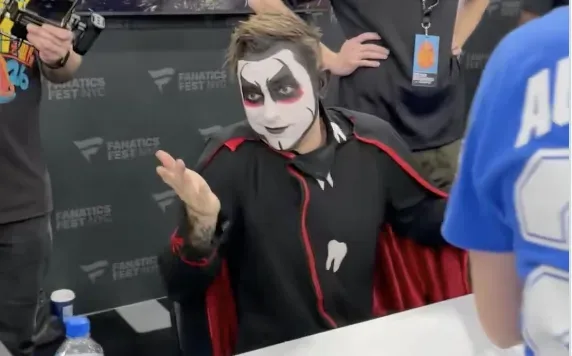
Danhausen’s black-and-white face paint may be one of the most immediately recognizable elements of his “Very Nice, Very Evil” persona, but the WWE star says the process behind that look is far less time-consuming than fans might expect.
In a new interview, Danhausen was asked how long it takes him to apply the paint each time. His answer was brief, characteristically playful, and revealing about how familiar he has become with the routine.
“Probably about five minutes or so. It’s not too long anymore. Danhausen’s gotten quite good at putting on human makeups. Down, down pat. Got to do it so often now, when in public, that Danhausen doesn’t want to be bombarded by Fanhausens because I’m such a celebrity now.”
Five minutes is a notably efficient turnaround for a look that has become inseparable from Danhausen’s presentation. The paint is not simply an accessory added for television entrances. It is part of the visual language of the character, helping establish the unusual blend of horror-influenced imagery, comedy, menace and self-important celebrity that has defined Danhausen’s appeal.
For more background on this topic, read Danhausen Calls a Simpsons Treehouse of Horror Cameo a ‘Dream Come True’.
For a performer whose identity is so closely connected to a distinct appearance, speed matters. WWE schedules can involve travel, media appearances, promotional obligations, arena arrivals and live television preparation, all while a talent still needs to be ready for whatever role they may have on a given show. Being able to complete a signature makeup look in a matter of minutes gives Danhausen the flexibility to maintain that presentation without turning it into an extended backstage process.
A Look That Has Become Part of the Character
Danhausen has been a regular presence on WWE programming since debuting earlier this year at WWE Elimination Chamber. His arrival introduced a personality who does not fit neatly into a traditional wrestling template. He speaks in his own distinctive cadence, refers to himself in the third person, promises curses, and balances theatrical villainy with intentionally absurd humor.
The face paint gives those elements an immediate visual foundation. Even before Danhausen speaks, the presentation tells viewers that he is different from the rest of the roster. The sharp contrast of the makeup supports the sinister side of “Very Nice, Very Evil,” while the exaggerated nature of the design matches the character’s comic unpredictability.
That visual consistency is particularly valuable for a performer working across several settings. Wrestling audiences may see Danhausen on television, at live events, in interviews, during public appearances or through crossover opportunities outside the ring. A recognizable appearance helps maintain the same identity in each environment. His comment that he applies the makeup in public so he is not “bombarded by Fanhausens” was delivered in the same tongue-in-cheek voice he brings to the screen, but it also reflects how closely the paint is tied to his public-facing image.
For many wrestlers, gear, entrance music and ring mannerisms create the first impression. Danhausen’s face paint belongs in that same category. It is a key part of the package rather than an occasional special-event detail. The fact that he has reduced the application to roughly five minutes suggests the look has become second nature.
Practice Has Made the Process Faster
Danhausen made clear that the current five-minute estimate is the result of doing it repeatedly. “It’s not too long anymore,” he said, adding that he has become “quite good” at applying what he called “human makeups.”
That distinction is important because elaborate looks often appear much more difficult to produce than they are once a performer has developed a repeatable method. The design needs to be precise enough to remain recognizable, especially on television and in photographs, but repetition allows an artist or performer to refine placement, timing and the order in which each part is completed.
Danhausen’s answer did not go into the specific products or techniques involved, and there is no need to overstate the preparation behind it. What he did establish is that it no longer represents a lengthy obstacle in his day. The performer has a system, knows the character’s visual requirements and can carry out the task quickly.
That practicality is useful for a WWE talent whose presentation has increasingly reached beyond a single match or a single show. Danhausen has been visible since his Elimination Chamber debut and has crossed into other areas through the character’s curse-based antics, including his association with the New York Knicks. The wider the character’s reach becomes, the more important it is to preserve a look that audiences instantly identify.
His remarks also underline an often-overlooked aspect of wrestling presentation: performers are frequently responsible for maintaining details that fans may take for granted. A distinctive appearance can feel effortless to viewers because it is consistently present. The work becomes most visible only when a wrestler comments on the process, as Danhausen did here.
“Very Nice, Very Evil” Remains Instantly Identifiable
The speed of the application does not make the presentation any less effective. If anything, it shows how fully Danhausen has inhabited the character. The makeup, the manner of speaking, the curse threats and the “Fanhausen” terminology all function together. Each piece reinforces the others and helps make the act understandable whether someone is watching a wrestling segment, encountering him at an appearance or seeing one of his crossover moments.
Danhausen’s ability to move between ominous imagery and intentionally ridiculous claims is central to that formula. He can present himself as a curse-wielding figure while also openly describing the inconvenience of avoiding fans because of his celebrity status. The joke works because the delivery never abandons the character’s exaggerated confidence.
That commitment has helped make Danhausen’s presentation stand out in WWE. In a roster full of athletes with highly developed personas, a clear visual identity can be invaluable. The face paint creates an immediate point of recognition, while the rest of the character gives viewers a reason to stay engaged after the initial visual impression.
Danhausen also briefly addressed the possibility of guest starring on The Simpsons in the same interview. That subject reflects the kind of broader pop-culture space his character can occupy, even though no such appearance was announced. The idea is consistent with a performer whose act is designed to be memorable outside the usual boundaries of a wrestling match.
Efficiency Helps Sustain a Full-Time Presentation
Danhausen’s estimate may seem like a small detail, but it offers a useful glimpse at the discipline behind an unusual WWE persona. A face-painted character has to account for the practical demands of appearing in public, working on camera and preserving a recognizable brand. Danhausen has apparently reached the point where those demands can be handled quickly.
There is also a difference between wearing paint as part of a one-night event and using it as an almost constant extension of a public identity. Danhausen’s comments indicate that he often feels the need to apply it when he is out in public. Whether framed as a way to escape the attention of “Fanhausens” or as another layer of his on-screen personality, it emphasizes that the look continues beyond the arena.
For WWE viewers, the takeaway is straightforward: one of Danhausen’s most distinctive trademarks requires only about five minutes of preparation now that he has mastered the routine. The efficiency allows him to keep the “Very Nice, Very Evil” image intact wherever the character appears.
As Danhausen continues building his WWE presence following his Elimination Chamber debut, the face paint will remain an essential part of the equation. It is bold, instantly recognizable and perfectly suited to a performer who has made curses, celebrity boasts and unsettling comedy into the foundation of his identity. And, as Danhausen himself put it, he has the human makeup process “down, down pat.”
Darryl Polo
Darryl Polo is a passionate wrestling fan covering WWE, AEW, TNA and beyond. He loves great rivalries, breakout stars and the moments that keep fans talking long after the bell. How we work.