
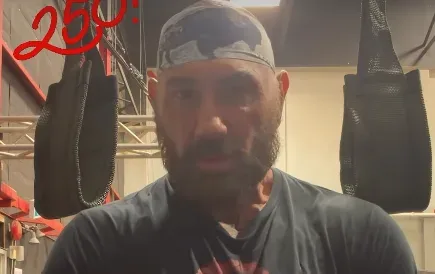
Batista’s return to a larger-than-life physical transformation has reached another significant benchmark. The former WWE star has revealed that he has crossed the 250-pound mark as he prepares to play Kratos in Amazon Prime’s forthcoming God of War television series.
The update, shared through an Instagram story on Sunday evening, reflects the considerable work Batista has undertaken since being selected for one of video gaming’s most physically imposing characters. He has reportedly added 20 pounds of muscle during his preparation for the role, rebuilding a frame that he had deliberately scaled back after moving away from full-time professional wrestling.
For much of his post-WWE acting career, Batista had reduced his overall size. The change was not simply cosmetic. Having spent years carrying the type of mass required of a main-event wrestling attraction, he had sought a healthier body composition while taking on acting roles that did not demand the extreme muscularity associated with his days as “The Animal.” The Kratos role, however, presents a very different challenge.
View the referenced post on X
Kratos is defined as much by his intimidating physical presence as by his rage, trauma, and mythological journey. The character’s towering, heavily muscled appearance has been central to the identity of the long-running God of War game franchise. Batista’s latest milestone illustrates that the production’s new lead is not approaching that visual expectation lightly.
For more background on this topic, read BRCW Cruisin’ For A Bruisin’ 4 Card Set With Six Title Matches In Miami.
A demanding turnaround for a major role
Batista was cast as Kratos in late August for the Amazon Prime adaptation. The casting followed an unexpected change in the production after Ryan Hurst, who had been announced for the role in January 2026, suffered a torn bicep while on set.
Hurst required surgery, and the injury would have pushed a restart of production into 2027. Batista was then brought in to take over the central role in the project based on the iconic PlayStation franchise.
The situation gave Batista a limited period in which to adjust physically for a part built around an exceptional level of size and strength. His update that he has now gone beyond 250 pounds offers a tangible indication of the pace of that preparation. Adding 20 pounds of muscle in the weeks since his casting is a notable undertaking, particularly for a performer who had intentionally become leaner in recent years.
While the number on the scale naturally drew attention, the broader importance is what it says about Batista’s commitment to the demands of portraying Kratos. A role like this requires more than matching a familiar silhouette. It places an actor under an enormous level of scrutiny from an audience that knows the character’s movements, voice, scars, emotional struggles, and physical presence in extraordinary detail.
Batista’s background gives him a unique foundation for that kind of pressure. Before becoming an established actor, he spent years as one of WWE’s most recognizable powerhouses. His presentation as Batista was built around explosive strength, an imposing build, and a level of intensity that made him a credible threat against any opponent.
The Animal knows what it takes to transform
WWE audiences watched Batista become one of the defining stars of his era. His run as “The Animal” included world championship success and major matches with many of the company’s biggest names. His physique was an essential part of that rise, helping establish him as a wrestler who could stand alongside the most dominant attractions in the industry.
Yet Batista’s career after wrestling has required flexibility. Acting did not ask him to remain frozen in the same body type forever, and he had openly made changes to improve his health as his professional priorities shifted. That evolution made sense for an actor handling a range of work rather than a full-time wrestler expected to maintain a colossal television-ready physique throughout the calendar year.
The Kratos casting has effectively brought a different kind of physical demand back to the forefront. Batista is not returning to WWE competition, but the assignment has called for a transformation that will be immediately familiar to fans who remember the size he carried during his peak wrestling years.
There is still a meaningful distinction between preparing for the ring and preparing for a filmed dramatic production. A wrestler must sustain a demanding travel schedule, perform live for extended periods, and work a style that combines athletic movement with physical contact. Playing Kratos will involve building a screen version of a figure whose visual identity has been refined across multiple games and generations of players.
That means size alone will not tell the entire story. Kratos is a character marked by loss, fury, parenthood, guilt, and the burden of a violent past. The role will ask Batista to balance the warrior’s immense physical intimidation with the emotional layers that have helped make the modern God of War games resonate with a broad audience.
Why the physique matters for Kratos
In the world of God of War, Kratos has always cut a distinctive figure. His muscular build, ash-covered skin, red markings, and fearsome demeanor are inseparable from the character’s legacy. Whether confronting gods, monsters, or the consequences of his own decisions, he is presented as a force of nature.
That visual legacy places special importance on Batista’s preparation. The actor will be expected to make the character believable not only in still images and promotional material, but in every scene that requires Kratos to carry authority. Reaching 250 pounds does not by itself define the final onscreen look, but it is a clear step toward the kind of physical foundation audiences associate with the role.
It also underscores the practical reality of adapting a beloved game. Fans often focus on casting decisions immediately, especially when a lead character is as recognizable as Kratos. The replacement of Hurst with Batista was already a major development for the series. Batista’s ongoing transformation provides a visible answer to one of the first questions surrounding his casting: how closely will he pursue the imposing presence of the game’s protagonist?
At this stage, Batista’s preparation is the central takeaway. His Instagram update did not provide an exhaustive breakdown of the training process or detail a final target weight. What is known is that he has crossed 250 pounds and added 20 pounds of muscle since beginning the process of preparing for Kratos.
A new chapter after an unexpected production change
The path that led Batista to the role was unusual. Hurst’s torn bicep and subsequent surgery altered the plans for a production that had already identified its Kratos. The injury created a delay that would have extended a restart into 2027, opening the door for Amazon Prime to make a major casting change.
Batista now has the responsibility of leading the project through its next phase. His history as a WWE headliner may be particularly valuable in a role carrying such enormous expectations. Pro wrestling teaches performers how to command attention instantly, connect a physical presentation to character, and convey intensity to a large audience. Those skills do not automatically solve the demands of a scripted television series, but they are highly relevant to a character like Kratos.
For WWE fans, the progress update is also a reminder of Batista’s remarkable ability to reinvent himself. He has gone from wrestling’s powerhouse ranks to an acting career that allowed him to change his body and pursue a different professional rhythm. Now, he is undertaking another major transformation for a role that calls for a return to extraordinary mass.
Crossing 250 pounds is an early but meaningful milestone on that journey. Batista has made clear through his physical progress that he is embracing the scale of the assignment. As work continues toward Amazon Prime’s God of War series, the former WWE champion’s effort to bring Kratos to life will remain one of the project’s most closely watched stories.

Darryl Polo
Darryl Polo is a passionate wrestling fan covering WWE, AEW, TNA and beyond. He loves great rivalries, breakout stars and the moments that keep fans talking long after the bell. How we work.