
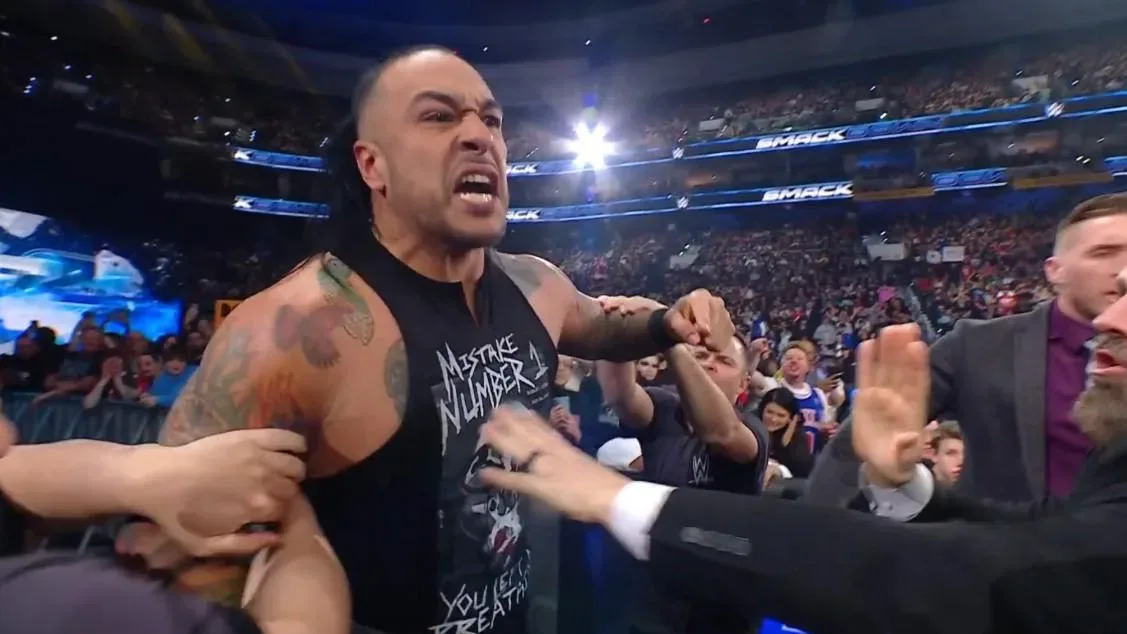
Damian Priest is used to performing in front of thousands of people under the brightest possible lights, but his work on the upcoming Steps presented a very different kind of stage.
The WWE star recently discussed his experience stepping into a voice-recording booth for the project and revealed that he threw himself so fully into the character that anyone watching from outside the room may have had reason to wonder what they were seeing. Priest said the work was enjoyable, but acknowledged that his animated approach to recording lines likely looked extreme without the finished performance and context around it.
“It was fun. I think if anybody saw footage of me actually doing it, you’d think I’m crazy. Just screaming in a little tiny booth and, you know, obviously using my hands and, you know, because I’m trying to be in it, you know, be really invested in this character and wanted, basically, I want to envision what it’s going to be like. So I’m acting it out in this booth. So it probably looked insane, but it was definitely fun because I would do it and then I’d have to stop to start laughing just because it was so crazy, but I loved it.”
Priest’s description offers a look at a side of acting that can be easy for audiences to overlook. Viewers and listeners only experience the final voice performance, often paired with animation, editing, music, sound effects, and the work of other actors. The person behind the microphone, however, must create the energy of a scene in a confined space, frequently without the physical environment that would normally help an actor establish a moment.
For more background on this topic, read Damian Priest Names The Rock as His Model for a Future Acting Career.
For Priest, that meant using his hands, raising his voice, and physically playing out the feeling of the scenes as he recorded. Rather than simply reading dialogue into a microphone, he approached the role as a full performance. His goal was to visualize how the character and situation would ultimately come across, then act it out as much as possible within the booth.
A Different Kind of Performance Space
The contrast between WWE and voice work is striking, even though both require an ability to communicate a character clearly. Inside a wrestling arena, Priest has the benefit of his entrance, his gear, his body language, the reaction of a live crowd, and the physical stakes of the match or segment in front of him. A voice booth removes nearly all of those tools. The performer instead has to make the emotion, pacing, intensity, and personality land through the voice alone.
That does not mean Priest left the physical side of his craft behind. His comments make clear that he used movement as part of the process. The booth may have been small, but his performance choices were not. Gesturing and acting out lines can help an actor find a more natural rhythm, while also giving the voice more life than a stationary read might produce.
Priest also found humor in the situation. He said there were moments when he had to stop and laugh because of how wild the process felt. That self-awareness did not take away from his commitment to the role. If anything, it underlined the unusual nature of a recording session for someone who is accustomed to performing in an environment where big motions and loud reactions are expected.
On WWE television, Priest’s intensity is meant to be seen from every angle. In voice acting, that same intensity has to be converted into a sound that conveys the right image in the audience’s mind. The methods may look different, but the underlying commitment to character remains familiar.
Priest Brings Wrestling Experience Into a New Medium
Professional wrestling has long demanded skills that can translate beyond the ring. Wrestlers regularly perform live, speak to cameras, build characters over long periods, react to shifting audience responses, and tell stories through facial expressions and movement. Voice acting is a separate discipline with its own technical demands, but Priest’s approach to Steps suggests he saw value in bringing the same level of investment to the recording booth that he brings to WWE performances.
His decision to physically embody the material is particularly notable because it reflects the way wrestlers often work. The best wrestling characters are not delivered as detached lines; they are presented through a complete performance. Priest’s explanation indicates that he wanted to make the character feel real to him in the moment, even before audiences see or hear the completed project.
That investment is also consistent with the larger demands placed on a WWE performer. A talent can be asked to deliver a promo, wrestle a lengthy match, participate in a backstage scene, and maintain a recognizable persona across multiple platforms. Each task calls for a slightly different skill set, but all of them require confidence and an understanding of how to project a character.
Voice work introduces another challenge because it strips down the performance to its most immediate element: the sound of the actor’s voice. There is no entrance music to establish the mood and no crowd reaction to guide the tempo. Priest’s answer shows that he compensated by creating that environment for himself through his own physical commitment.
Wrestlers Continue Exploring Voice Roles
Priest joins a growing list of wrestlers who have taken opportunities in voice acting. In recent years, wrestling personalities have increasingly appeared in projects that call for voice performances as well as traditional on-screen acting. CM Punk and Roman Reigns have both taken on the ZeBros roles connected to the Zootopia franchise, illustrating the range of entertainment opportunities available to major names from the industry.
Those appearances do not mean every wrestling-to-acting transition follows the same path. A live-action role and a voice role ask performers to rely on different parts of their toolkit. Voice acting can be especially revealing because the actor has to sell every beat through vocal delivery. The smallest decisions involving a pause, a raised voice, a laugh, or a change in emphasis can alter how a character is received.
Priest did not frame the experience as intimidating. Instead, he emphasized the fun of it, even when the booth environment made him feel as though he might look “insane” to an observer. That enthusiasm matters. Trying a new medium can be challenging, but Priest’s comments suggest he embraced the freedom to experiment and found the process rewarding.
There is also an obvious connection between wrestling and animated or voice-driven storytelling: both can reward heightened personalities. Wrestlers are often experts at making a character’s emotions understandable quickly and clearly. A voice role can similarly require an actor to make a character’s feelings immediately recognizable, particularly in energetic scenes where the performance must carry momentum without the actor’s face being on screen.
Looking Beyond the Ring
Priest’s work on Steps is another example of a WWE talent expanding his creative resume beyond wrestling. He has also spoken about his ambition to build an acting career comparable to the path forged by The Rock, one of the most prominent examples of a wrestler becoming a major force in entertainment outside the ring.
That is a high bar, and Priest did not present one recording session as a shortcut to reaching it. Still, taking on voice work provides experience in a format that is different from WWE television and different from conventional screen acting. It asks for preparation, adaptability, imagination, and a willingness to look a little ridiculous in private if that is what it takes to make the final performance work.
For Priest, that willingness appears to have been part of the enjoyment. He laughed at the image of himself screaming and gesturing in a small booth, but he also made clear that he loved the experience. The key detail is not that the recording process looked wild from the outside. It is that Priest cared enough about the character to put himself fully into the scene.
Fans will ultimately judge the performance when Steps arrives, but Priest’s comments have already provided a memorable picture of how seriously he approached the assignment. The setting may have been far removed from a WWE arena, yet the mindset sounded familiar: commit to the moment, bring the character to life, and give the audience something worth reacting to.
Whether he is in front of a live crowd or alone with a microphone, Priest is treating performance as performance. In the case of Steps, that meant a tiny booth, a lot of movement, plenty of volume, and a recording process he will remember fondly—even if anyone who saw it unfold might have thought he had lost his mind.

Darryl Polo
Darryl Polo is a passionate wrestling fan covering WWE, AEW, TNA and beyond. He loves great rivalries, breakout stars and the moments that keep fans talking long after the bell. How we work.