
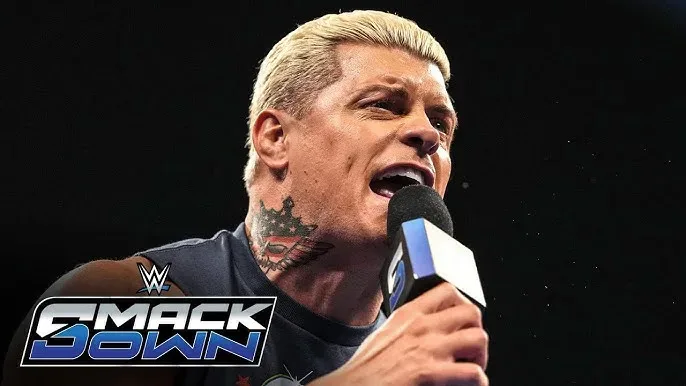
Cody Rhodes has spoken warmly about New Japan Pro-Wrestling and the style of professional wrestling the company presents, calling it a “great place to wrestle” while reflecting on his own experience in Japan.
Rhodes addressed NJPW during an appearance on the Flagrant podcast, where discussion turned to Hirooki Goto. Goto is part of the cast of Street Fighter alongside Rhodes and Roman Reigns, putting three wrestlers from different corners of the industry in the same project.
When Goto was brought up, Rhodes immediately identified him as an established name within New Japan.
“Goto wrestles for New Japan Pro Wrestling. Goto’s been one of their top stars for quite some time.”
For more background on this topic, read STRONG Openweight Tag Team Titles Set for Three-Way Defense at NJPW x CMLL Lucha Kingdom.
The conversation then moved toward where Goto fits in the larger wrestling landscape. Rhodes was asked whether Goto could be viewed as New Japan’s equivalent of a globally recognizable WWE institution such as The Undertaker or John Cena. Rhodes did not embrace that direct comparison, but he made clear that he has respect for Goto and for the kind of match Goto could bring to the ring.
“No. I feel like hardcore fans will probably not like my [response] — I actually never wrestled directly one-on-one with Goto. I would’ve liked to wrestle him and another guy named [Tomohiro] Ishii.”
That distinction is notable because Rhodes has competed in Japan and has had a meaningful connection to NJPW, yet a singles match with either Goto or Ishii never happened. Both men are closely associated with the hard-hitting, physical identity that many fans connect with New Japan, and Rhodes singled them out as two performers he would have welcomed the opportunity to face.
Rhodes did not frame his comments as a critique of Goto’s standing. Instead, he acknowledged Goto’s lengthy place near the top of NJPW while offering an honest answer about his own in-ring history. The former WWE Champion has shared rings with a wide range of international talent during his career, but he explained that he never had a direct one-on-one contest with Goto.
Rhodes highlights NJPW’s sport-first approach
Beyond the question of individual opponents, Rhodes used the discussion to explain what he appreciates about wrestling in Japan. His comments centered on presentation and the way Japanese wrestling is approached as a sporting contest.
“Japan wrestling is treated very sport heavy. Sport first. They definitely have sports entertainment and they’d understand that, but it’s very sport first. It’s a great place to wrestle, I was very thankful.”
The remarks underline a difference Rhodes sees in emphasis rather than an absolute divide between Japanese wrestling and sports entertainment. He acknowledged that sports-entertainment elements exist in Japan and that Japanese promotions understand them. However, his central point was that the athletic competition is generally placed at the forefront.
That sport-first sensibility has long been a major part of NJPW’s identity. Major matches are commonly treated as significant athletic events, while championships, tournament standings, rivalries, and the physical toll of competition are presented as core pieces of the product. That does not mean every performer or storyline is identical in tone, but it does create a distinct environment for wrestlers looking to work within a more competition-driven framework.
For Rhodes, that environment clearly left a positive impression. He described himself as thankful to have wrestled there, a sentiment that speaks to the value he places on his time outside the United States as well as the professional opportunities Japan provided.
A connection between WWE and New Japan’s worlds
Rhodes’ comments arrive as he and Reigns share Street Fighter cast billing with Goto. The project places a current WWE headliner, one of WWE’s defining modern stars, and a longtime NJPW standout in the same cast. The crossover is a reminder that wrestlers from different promotions can occupy the same broader entertainment space even when their weekly in-ring careers are centered in separate companies.
Goto’s inclusion also gives wider audiences another connection to NJPW. Rhodes’ description of him as one of the promotion’s top stars for a long period reinforces the reputation Goto has built through his sustained presence in major New Japan competition.
Rather than attempting to reduce Goto to an American equivalent, Rhodes emphasized the facts he could speak to directly: Goto’s status in NJPW, his own lack of a singles match with him, and his interest in having had that match. It was a measured response from someone who understands that comparisons between performers from different eras, promotions, and presentation styles can often oversimplify what makes each wrestler distinct.
The same applies to Ishii, whom Rhodes mentioned alongside Goto. By naming both wrestlers, Rhodes pointed to two potential singles matchups that never materialized despite his experience in Japan. For fans who enjoy imagining matchups across promotions and career paths, the comments naturally leave room for speculation about what those bouts might have looked like. Still, Rhodes was speaking about opportunities that have passed rather than suggesting that any match is currently planned.
Why the comments matter
Rhodes is a prominent WWE figure, but his career has included important stops and experiences beyond WWE. That background gives added weight to his comments on NJPW’s wrestling culture. His praise was not a promotional statement about an upcoming appearance or a teased cross-promotional development. It was a straightforward reflection on the experience of working in Japan and the differences he sees in its approach.
His answer also avoided portraying one style as inherently superior to another. Rhodes noted that Japanese wrestling has sports-entertainment components, while stressing that the sporting aspect comes first. The observation allows for both realities: pro wrestling is a performance-based medium, but different promotions can prioritize competition, character, spectacle, drama, or athletic credibility in different proportions.
That balance is particularly relevant to Rhodes’ own career. He works at the highest level of a global sports-entertainment company while also expressing appreciation for a promotion whose public identity is strongly tied to match stakes and sporting prestige. The comments suggest that those experiences are not contradictory. A wrestler can succeed in one environment and remain grateful for what another environment taught them or allowed them to do.
For NJPW fans, Rhodes’ praise is also a recognition of the company’s lasting influence. The promotion’s style, roster, and major-event atmosphere have attracted wrestlers and audiences from around the world. Rhodes’ description of Japan as “sport first” captures a quality that continues to distinguish New Japan’s presentation in a crowded wrestling landscape.
No singles meeting with Goto or Ishii
As for the potential matches Rhodes mentioned, there is no indication in his comments that a Cody Rhodes vs. Hirooki Goto or Cody Rhodes vs. Tomohiro Ishii bout is being arranged. His words were retrospective. He simply said he would have liked to wrestle both men directly in singles competition.
Even so, the hypothetical pairings are easy to understand. Goto’s long-term standing in NJPW and Ishii’s reputation for intense physical battles would have presented distinct challenges for Rhodes. Each matchup would have brought together Rhodes’ style and persona with performers shaped by New Japan’s sport-centered setting.
Ultimately, Rhodes’ discussion of Goto became a broader endorsement of NJPW and Japanese wrestling. He gave Goto credit as a longtime top name, admitted the limits of his personal in-ring history with him, and expressed appreciation for the chance to have wrestled in Japan at all.
For Rhodes, New Japan remains a place he remembers fondly: an environment where wrestling is presented with the sport at the center, and one for which he remains thankful.

Darryl Polo
Darryl Polo is a passionate wrestling fan covering WWE, AEW, TNA and beyond. He loves great rivalries, breakout stars and the moments that keep fans talking long after the bell. How we work.