
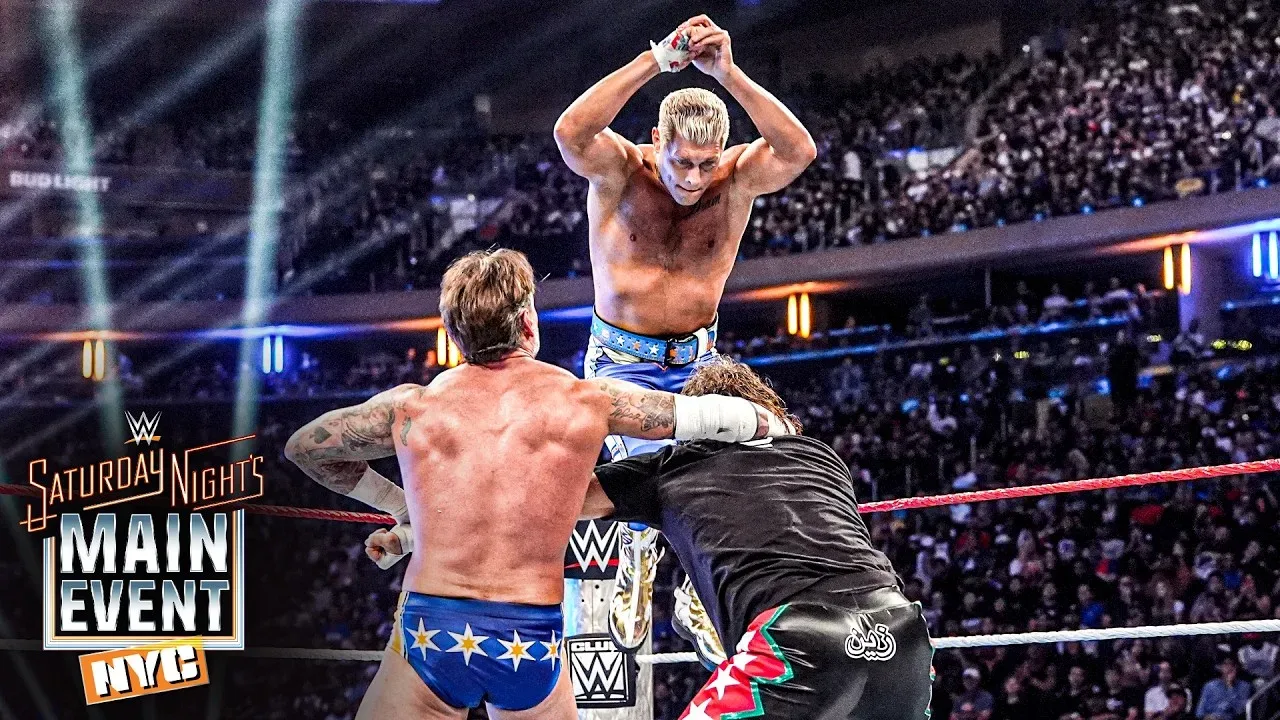
Cody Rhodes and CM Punk made a deliberate exception to one of Rhodes’ usual rules when they teamed at WWE Saturday Night’s Main Event earlier this year.
In July, Rhodes and Punk joined forces against Sami Zayn and Gunther in a tag team match that carried SummerSlam implications. Rhodes and Punk earned the victory, but the visual presentation of the pairing also drew attention: both men wore gear inspired by the New York Knicks’ colors.
Rhodes addressed the coordinated look during an appearance on Sneaker Shopping, explaining that matching attire is typically something he prefers to avoid when working in a tag team. For Rhodes, preserving the individual identity of each wrestler matters more than presenting a newly assembled unit as a conventional matching duo.
“Me and Punk did the Knicks colors, and they’re very big,” Rhodes said. “I don’t ever like to match. That’s a big thing when you team, it’s like ‘oh they’re gonna match? Are they gonna put their music together?’ Like, no, I want to be me and him be him. But that was one where I think we both thought, ‘yeah, let’s match.’ I love the Knicks gear.”
For more background on this topic, read Cody Rhodes Calls Tyrese Haliburton Part Of WWE Family, Shares His Sneaker Rule.
A Rare Presentation Choice for Rhodes
The comment offers a clear look at how Rhodes approaches temporary alliances and tag matches. WWE often uses shared colors, matching gear, combined entrance music, or other visual cues to signal that two performers are functioning as a unified team. That can be particularly useful for established duos, but it can also change the audience’s perception of stars who are normally presented as singular acts.
Rhodes’ preference is to retain that separation. His explanation that he wants “me to be me and him be him” reflects the idea that a major tag match does not necessarily need to turn two top-level singles competitors into a permanent or fully blended act. A partnership can exist because of a particular opponent, circumstance, or event without either wrestler surrendering the presentation that defines him.
That approach made the Knicks-inspired gear stand out even more. Rather than a routine case of teammates being dressed alike, it was a choice Rhodes and Punk evidently agreed suited the occasion. The shared color palette created a link between them while still allowing both wrestlers to maintain their own distinct presence.
Rhodes did not frame the look as the start of a broader shift toward matching presentations with partners. Instead, he described it as a situation where the idea simply worked. The specific appeal of the Knicks gear was enough to override his normal hesitation about coordinating with another wrestler.
Rhodes and Punk Delivered in Their July Tag Match
The Saturday Night’s Main Event bout put Rhodes and Punk opposite two formidable opponents in Zayn and Gunther. The match also came with SummerSlam implications, giving the pairing stakes beyond a one-night attraction. In the end, Rhodes and Punk secured the win.
For an alliance involving wrestlers with such defined identities, the key was balancing cooperation with individuality. Rhodes is one of WWE’s most recognizable central figures, while Punk’s return to WWE restored one of the promotion’s most distinctive voices and personalities to the roster. Neither performer needs a tag-team rebrand to be understood by the audience.
That is why their gear choice carried a little more meaning than an ordinary wardrobe detail. It suggested a shared focus for the match without blurring the traits that make Rhodes and Punk separate attractions. The Knicks colors were a visual agreement, not an attempt to erase the distinction between their established personas.
Wrestling gear often communicates more than fashion preference. Colors, logos, themes, and design choices can reinforce a wrestler’s character, acknowledge an event or location, pay tribute to an athlete or team, or establish a connection between partners. In this case, the matching colors helped Rhodes and Punk look aligned for a major match while avoiding the broader presentation changes Rhodes said he generally does not favor.
Why Individuality Matters in a Major WWE Pairing
Rhodes’ remarks also underline a practical part of WWE storytelling. When singles stars team together, the audience often immediately looks for signs of a deeper direction. Coordinated gear can invite questions about whether the team will continue, whether the wrestlers are being positioned as a regular unit, or whether a combined entrance and identity may follow.
Rhodes acknowledged that expectation directly by referencing the possibility of teammates matching and combining their music. His answer was simple: that is not usually the route he wants to take. He would rather have the partnership be understood through the match itself than through a presentation that makes the wrestlers appear less individual.
That does not mean shared looks cannot be effective. Rhodes’ own description of the Knicks attire makes clear that he liked the result. The difference is intentionality. A coordinated outfit can be memorable when it serves a particular moment, especially when it has a theme both performers embrace. It is less appealing to Rhodes when it becomes an automatic expectation attached to every tag-team appearance.
The Rhodes-Punk combination had enough star power that it did not need conventional team shorthand to establish its importance. Their opponents, Zayn and Gunther, ensured the match already had a high-profile feel, and the SummerSlam implications added another layer of relevance. The matching Knicks colors became an accent to that setting rather than the primary point of the pairing.
The Knicks-Inspired Look Was About the Moment
Rhodes’ affection for the Knicks gear was direct and uncomplicated. “I love the Knicks gear,” he said. That enthusiasm explains why he was willing to bend a personal preference in this instance.
There is an important distinction between matching exactly and working from a shared concept. Rhodes and Punk could visually complement each other through Knicks colors while remaining recognizable in their own right. The result served as a rare point of overlap between two performers who are generally best presented as self-contained stars.
It also demonstrated that a wrestler’s presentation philosophy does not have to be rigid. Rhodes has a clear preference against turning every partnership into a coordinated act, but he also recognized when a particular idea had enough appeal to be worth doing. The July match offered the right environment for that exception: a significant WWE event, a notable opponent pairing, SummerSlam stakes, and a color scheme that both men were happy to wear.
Rhodes’ comments keep the focus on that specific night rather than suggesting a standing rule for future alliances. The Knicks colors were not presented as a template for how he and Punk must look whenever they share a side of the ring. They were a choice made for one major match, one that resulted in a victory over Zayn and Gunther.
More Than a Matching Outfit
The story behind the gear ultimately fits Rhodes’ larger view of tag-team presentation. He values clear individual identities, particularly when accomplished singles wrestlers are brought together for a major situation. He does not see matching outfits or merged music as necessary proof that two competitors can function effectively on the same side.
Still, Rhodes and Punk’s Knicks-inspired attire shows that exceptions can add to a big-match atmosphere when they feel natural. The two stars did not need to become a permanently unified act to share a visual theme. They simply found an idea they both liked, used it for a meaningful Saturday Night’s Main Event contest, and left with the win.
For Rhodes, that was enough. The gear matched, the team succeeded, and the individuality of both Cody Rhodes and CM Punk remained intact.

Darryl Polo
Darryl Polo is a passionate wrestling fan covering WWE, AEW, TNA and beyond. He loves great rivalries, breakout stars and the moments that keep fans talking long after the bell. How we work.