
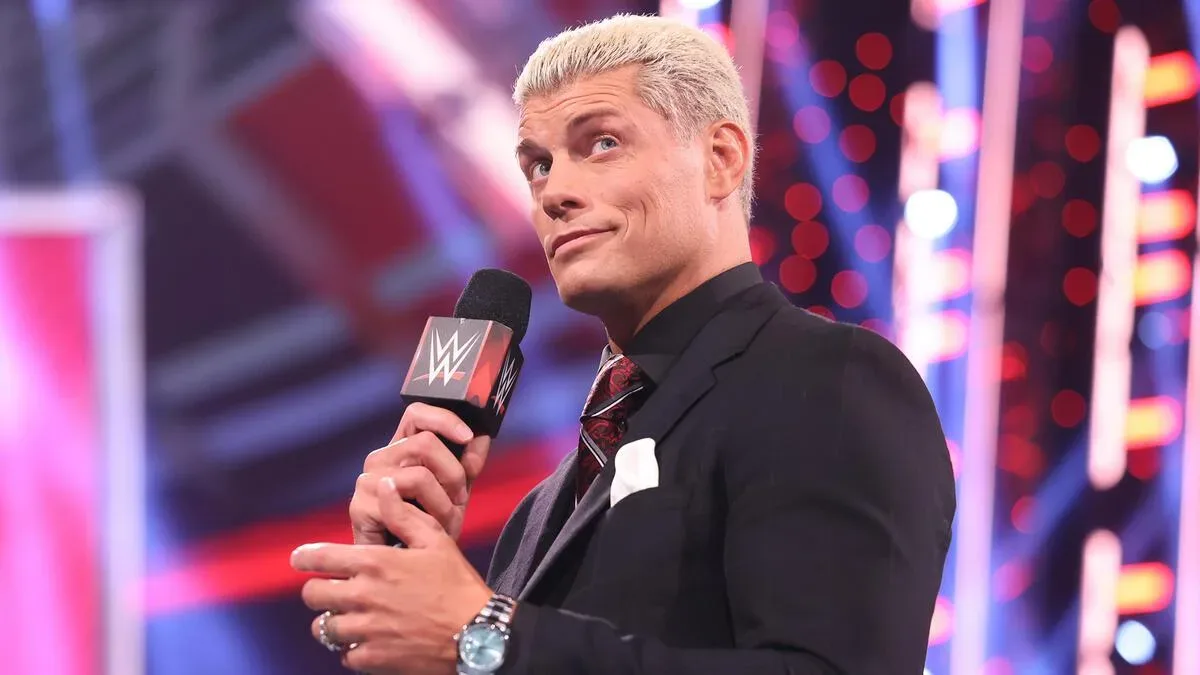
Cody Rhodes has never hidden from the fact that professional wrestling rewards a gifted storyteller. Whether he is discussing a rivalry, promoting a major match, reflecting on his career, or speaking about the industry at large, Rhodes has developed a reputation for delivering memorable claims with enough confidence to make fans stop and consider them.
During an appearance on the Flagrant podcast, Rhodes put his own label on that approach. Asked about the idea of a “Cody lie,” the WWE star explained that the key is not making something up from nothing. Instead, he said the best version of the tactic begins with reality before adding a degree of theatrical enhancement.
“A Cody lie is that it’s got to be rooted in truth, but you just wanna put a little sauce on it.”
It is a short answer, but it captures a significant part of Rhodes’ public persona. He has long been an unusually open wrestler when discussing ambition, family history, the emotional weight of his career, and his desire to occupy the biggest possible place in the business. At the same time, he understands that wrestling is not merely a sport to be recounted in plain, clinical language. It is an arena built on conviction, heightened emotions, and performers who can make an audience believe that every chapter is larger than life.
For more background on this topic, read Karl Fredericks Calls Gabe Kidd Clash His Most Important Match Since Leaving NJPW.
Why the “Cody lie” fits wrestling
Professional wrestling has always operated in the space between the literal and the dramatic. Promos regularly turn a true detail into a grander statement. A difficult road becomes an impossible journey. An important win becomes a historic changing of the guard. A personal disagreement becomes a battle for a company’s future. The audience recognizes the presentation, but that does not mean the emotion behind it is false.
Rhodes’ description draws a line between fabrication and embellishment. For him, the “truth” is the essential starting point. The added “sauce” is what makes the story more vivid, amusing, pointed, or impactful. That is a useful distinction for a wrestler whose career has often invited viewers to examine where real-life experiences end and on-screen framing begins.
Rhodes has repeatedly used his own life as material. His identity as Dusty Rhodes’ son, his pursuit of championship-level success, and his willingness to leave familiar circumstances in search of larger opportunities have all been genuine elements of his story. Those facts naturally carry emotion. In a wrestling setting, though, facts alone are rarely the finished product. A performer has to organize them into a narrative that can reach an arena crowd, connect with television viewers, and give an opponent something meaningful to fight against.
The “Cody lie,” as Rhodes describes it, is therefore less about deceiving an audience than about understanding the language of wrestling promotion. A story can be truthful in its core while still being delivered with humor, confidence, and selective exaggeration. In an industry where fans routinely debate the line between character and reality, that style can create conversation without requiring every word to be read as a formal statement.
A performer who embraces the bit
Rhodes’ willingness to acknowledge the concept publicly is part of what makes it work. Rather than present every exaggerated claim as something that must be defended with complete seriousness, he can make the exaggeration itself part of the entertainment. There is a self-awareness to the phrase “Cody lie.” It suggests that Rhodes knows fans have noticed his tendency to add a dramatic flourish, and he is comfortable turning that observation into another feature of his appeal.
That approach also reflects how modern wrestling audiences consume interviews. Fans do not only watch weekly television programs. They follow press appearances, podcasts, social-media exchanges, convention conversations, and behind-the-scenes discussions. As a result, wrestlers need to be able to speak in multiple settings without losing the qualities that make them compelling on television.
For Rhodes, that can mean discussing serious professional goals in one moment and offering a playful, self-aware line in the next. Both modes serve the same larger purpose: keeping the audience invested in the person speaking. A wrestler who sounds overly guarded can struggle to establish a bond. A wrestler who reveals too much without any sense of performance can lose mystique. Rhodes’ explanation suggests he prefers the middle ground, where the facts remain recognizable but the delivery gives them extra color.
That is especially important for a performer positioned at the center of WWE conversation. Prominent stars are expected to sell matches and events, but they are also expected to carry themselves like major figures whenever a microphone is present. The ability to tell a sharp story, even one with a deliberate flourish, is part of that responsibility.
The Bryan Danielson connection
Rhodes’ comments also arrive with a familiar piece of wrestling lore in the background. He is widely associated with the notion that he taught Bryan Danielson how enjoyable it can be to lie in wrestling. The idea has become an amusing shorthand among fans for the way small details can be reshaped into compelling tales when they pass through the filter of a great talker.
There is an obvious comedy to that association. Danielson is celebrated for his intensity, technical ability, and straightforward passion for professional wrestling. Rhodes, meanwhile, is comfortable presenting himself as someone who appreciates the value of a well-placed embellishment. The contrast makes the story memorable, while also underscoring a larger reality: even the most respected wrestlers are storytellers, and storytelling often involves choosing the most entertaining version of a true event.
Rhodes did not present the “Cody lie” as a complicated philosophy. His explanation was simple: truth first, then a little sauce. But the phrase neatly explains why such tales can succeed. If an audience recognizes the underlying reality, it has something solid to hold onto. The flourish then becomes part of the fun rather than an obstacle to belief.
Respect for wrestling beyond WWE
Elsewhere in the same interview, Rhodes spoke highly of Hirooki Goto and New Japan Pro-Wrestling. That praise is consistent with Rhodes’ long-standing awareness of the broader wrestling landscape and the performers who have made their names across different promotions and markets.
Goto has been a prominent figure in New Japan Pro-Wrestling for years, known for his toughness, physical style, and enduring place within the company’s competitive environment. Recognition from Rhodes carries particular resonance because Rhodes has experienced multiple sides of the industry himself. He has worked in WWE, built substantial momentum outside the company, and helped create major discussion around the value of wrestlers forging their own paths.
Speaking positively about Goto and New Japan also reflects the interconnected nature of modern wrestling fandom. Fans frequently follow WWE alongside promotions from Japan, Mexico, Europe, and North America. A top WWE talent discussing respected names beyond his current company can generate interest while acknowledging the depth of talent that exists throughout the industry.
It is also a reminder that Rhodes’ storytelling instincts are not limited to his own accomplishments. Great wrestling talkers are often great fans of wrestling history and wrestling culture. They know which names matter, which careers deserve appreciation, and which details will resonate with audiences who have followed the business closely.
Truth, confidence, and entertainment
Rhodes’ answer will likely endure because it gives fans a usable definition for a style they have watched from him for years. A “Cody lie” is not presented as a random falsehood. It is a piece of wrestling rhetoric: a real point, delivered with a memorable twist.
In many ways, that is what the best wrestling promos have always done. They begin with something recognizable—a frustration, a rivalry, a goal, a slight, a personal history—and elevate it until it feels urgent enough to demand an audience’s attention. The performer does not need to abandon the truth. He or she needs to find the version of the truth that makes people care.
Rhodes has clearly found a way to make that process part of his identity. By openly naming the tendency and explaining the formula behind it, he has transformed a fan observation into a compact statement about wrestling communication. The truth supplies the foundation. The sauce supplies the flavor. And for Cody Rhodes, the combination remains one of the most effective ways to keep a story moving.

Darryl Polo
Darryl Polo is a passionate wrestling fan covering WWE, AEW, TNA and beyond. He loves great rivalries, breakout stars and the moments that keep fans talking long after the bell. How we work.