
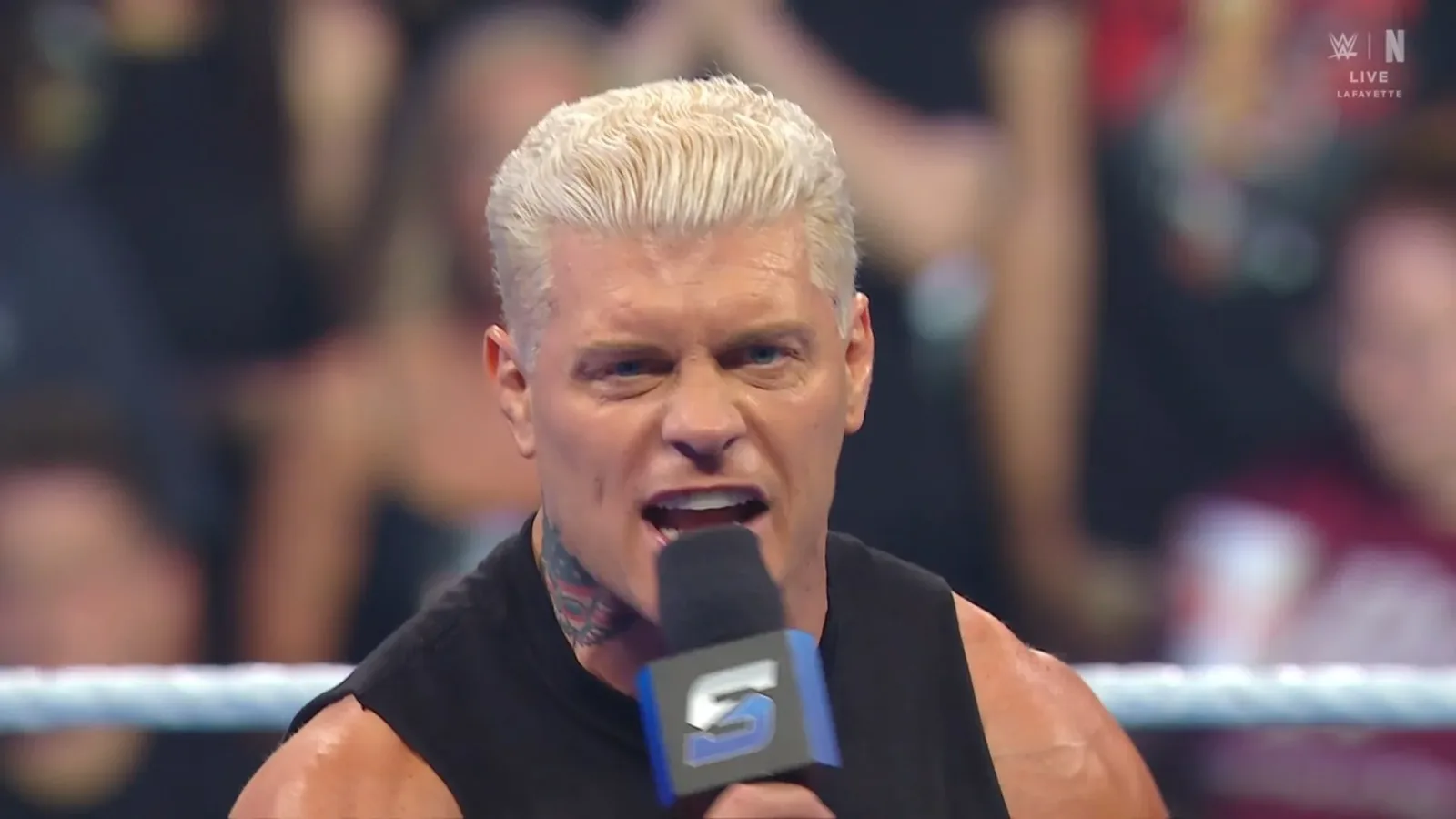
Cody Rhodes has once again addressed the persistent discussion around a potential WWE heel turn, and his latest comments offer a particularly specific picture of how he believes such a transformation should work.
Rhodes has been one of WWE’s defining heroic figures since returning at WrestleMania 38. His run has included high-profile rivalries, a WrestleMania championship journey, and a sustained position near the top of the company. At the same time, audience reactions and online discussion have repeatedly raised the question of whether a darker version of Rhodes could eventually emerge.
That conversation has intensified as Rhodes’ on-screen behavior has taken on sharper edges. After kicking Randy Orton in the head at WWE Crown Jewel and saying that he loved it, speculation surrounding his direction has continued. Rhodes did not rule out the possibility of a turn, but he made clear that he sees a major difference between simply changing his presentation and fully committing to becoming an antagonist.
Rhodes Says He Is Open to What Helps WWE Move Forward
Rhodes said he is willing to consider a heel turn if it serves a larger purpose for WWE. Rather than framing it as something he would refuse on principle, he described himself as open to any creative choice that moves the company forward.
For more background on this topic, read George Barrios Reflects On WWE Network’s Explosive Early Reception.
“I’m open to anything if it’s something that moves the ball forward for WWE. I really am open to it. It’s not a conversation of ‘I would not be willing to.’”
The WWE star acknowledged that some members of the audience have already made up their minds about his character. Rhodes noted that he has heard the descriptions from critics who view him as fake, overly performative, or pretentious. Because Rhodes’ WWE persona is heavily connected to his real family history, professional ambitions, and public image, he said the response can feel especially personal even when he understands that the audience is reacting to a television character.
“People already boo,” Rhodes said, adding that there are fans who have established in their own minds that he is already a heel. He also discussed the unusual challenge of playing a version of himself rather than a completely detached fictional personality. Rhodes said people can often describe him as if they know him completely because his character is rooted in his real story and the way he was raised around wrestling.
That blurred line has been central to Rhodes’ entire WWE presentation. He is the son of Dusty Rhodes, carries the legacy of the Rhodes family, and has openly used his difficult path back to WWE as a key part of his narrative. A heel turn, if one comes, would not simply be a new coat of paint. It would involve taking that existing connection with the audience and turning it against them.
A Heel Cody Rhodes Would Not Be Designed to Be Cool
One of the clearest points Rhodes made is that he would not approach a heel turn as an opportunity to become more popular with fans who enjoy villainous characters. Modern wrestling audiences often cheer performers who embrace a darker edge, particularly when that character feels stylish, rebellious, dominant, or entertaining. Rhodes said that would not be his goal.
“There is a difference between being booed and really disliked. I worry that people might think that change of paint would be new and fresh, and it wouldn’t be bad; it would be cool. If I were to make this definitive turn, I’m letting you know it wouldn’t be cool.”
Rhodes said he would want to take the role far enough that fans would not want to support him. He stressed that WWE’s reach across major platforms means a truly antagonistic character would need to be presented with a clear understanding of what being a villain means. For Rhodes, the objective would not be to invite fans to say they prefer him as a bad guy. It would be to create someone they genuinely do not want to root for.
That philosophy reflects the old-school influences Rhodes referenced. He invoked the perspective shaped by Eddie Graham and Dusty Rhodes, two figures tied to eras in which the basic relationship between hero and villain was often more sharply defined. The landscape is different now, however. Fans can admire a performer’s work while still booing them, and some audiences actively embrace characters who are meant to be disliked.
Rhodes recognizes that reality. He questioned what a bad guy is supposed to be in the current environment, where many fans cheer whatever they find compelling. Still, his comments suggest that he would attempt to resist the temptation to make a heel version of Cody Rhodes feel more fashionable, more relatable, or more appealing than his current heroic incarnation.
One Explanation, Then Silence
The most notable detail Rhodes offered involved his approach to promos. If he makes a definitive turn, he says he would explain his actions to the audience exactly once. After that, he would no longer be the person delivering the promos.
“If it happened, I would tell the audience one time, and one time only, why it happened, and they’ll never hear from me again. There wouldn’t be a single promo ever cut from me. Somebody else would cut those promos.”
Rhodes said that single statement would serve as the moment where he lays out the problem from his perspective. He spoke about the standard to which wrestling fans hold him and the feeling that even an enormous gesture can be met by demands for more. As he put it, if he moved one mountain, some fans might respond by asking why he did not move another.
There is also a deeper emotional component to the idea. Rhodes said there may be things “loaded up” inside him from across his career—experiences that did not feel good but that he had to accept and work through. A heel promo could theoretically draw from those real frustrations, giving Rhodes one chance to tell the audience why he changed before shutting down his own voice entirely.
The concept is unusual in an era when top stars frequently use long promos to define their characters and advance weekly stories. Rhodes’ proposed method would instead make him less accessible after the turn. Another person would speak for him, creating distance between Rhodes and the audience while preserving the importance of that one initial explanation.
Rhodes has previously discussed an idea in which he would align with Ava, The Rock’s daughter, with Ava handling the promos for him. His new comments do not confirm that such a pairing is planned, but they do show that the idea of Rhodes being represented by someone else is not a passing thought. It is a creative direction he has considered before.
Why Rhodes Believes the Turn May Never Happen
Despite his willingness to entertain the idea, Rhodes also explained why he does not necessarily expect the full turn to take place. In his view, the longer WWE goes without making the change definitive, the less likely it becomes.
He also pointed to the reality of his current position. Rhodes said that while resentment could provide material for a villainous character, he has been given virtually everything a wrestler could hope to receive. Rather than centering his attention on missed opportunities or disappointments, Rhodes said he tries to focus on what he has achieved.
“The reason that I don’t think that’s going to happen is, in addition to resentment, I’ve been given everything you can possibly be given. I’m living the golden life as far as what I got. I try not to focus on what I didn’t get or what went wrong, and focus on what I actually got.”
That answer keeps the door open without promising anything. Rhodes is not dismissing the heel-turn debate, but he is also not presenting it as an inevitable next chapter. His current role remains enormously valuable to WWE, and he continues to be one of the roster’s most prominent and popular stars even when certain crowds offer a mixed reaction.
Rhodes closed with a caution for those who want to see him make the switch. The message was not framed as a threat, but as a warning that the version of the character he has in mind would not necessarily fulfill the fantasy many fans have created.
“Please take what I’m saying with full-blown caution. It’s not going to be fun like you think. I mean that with no threatening nature. As always in wrestling, be careful with what you wish for.”
For now, Rhodes has major WWE business ahead. He is set to lead Team USA against Team Mexico at WWE Survivor Series, and he will also compete in the John Cena Classic in December. Those commitments keep Rhodes at the center of WWE programming while the questions around Randy Orton, his recent actions, and a possible transformation continue to follow him.
Whether Rhodes ever delivers that one promised explanation remains unknown. But if The American Nightmare does turn, he has already made his intended mission clear: it will not be about giving fans a more exciting reason to cheer. It will be about making them regret asking for it.

Darryl Polo
Darryl Polo is a passionate wrestling fan covering WWE, AEW, TNA and beyond. He loves great rivalries, breakout stars and the moments that keep fans talking long after the bell. How we work.