
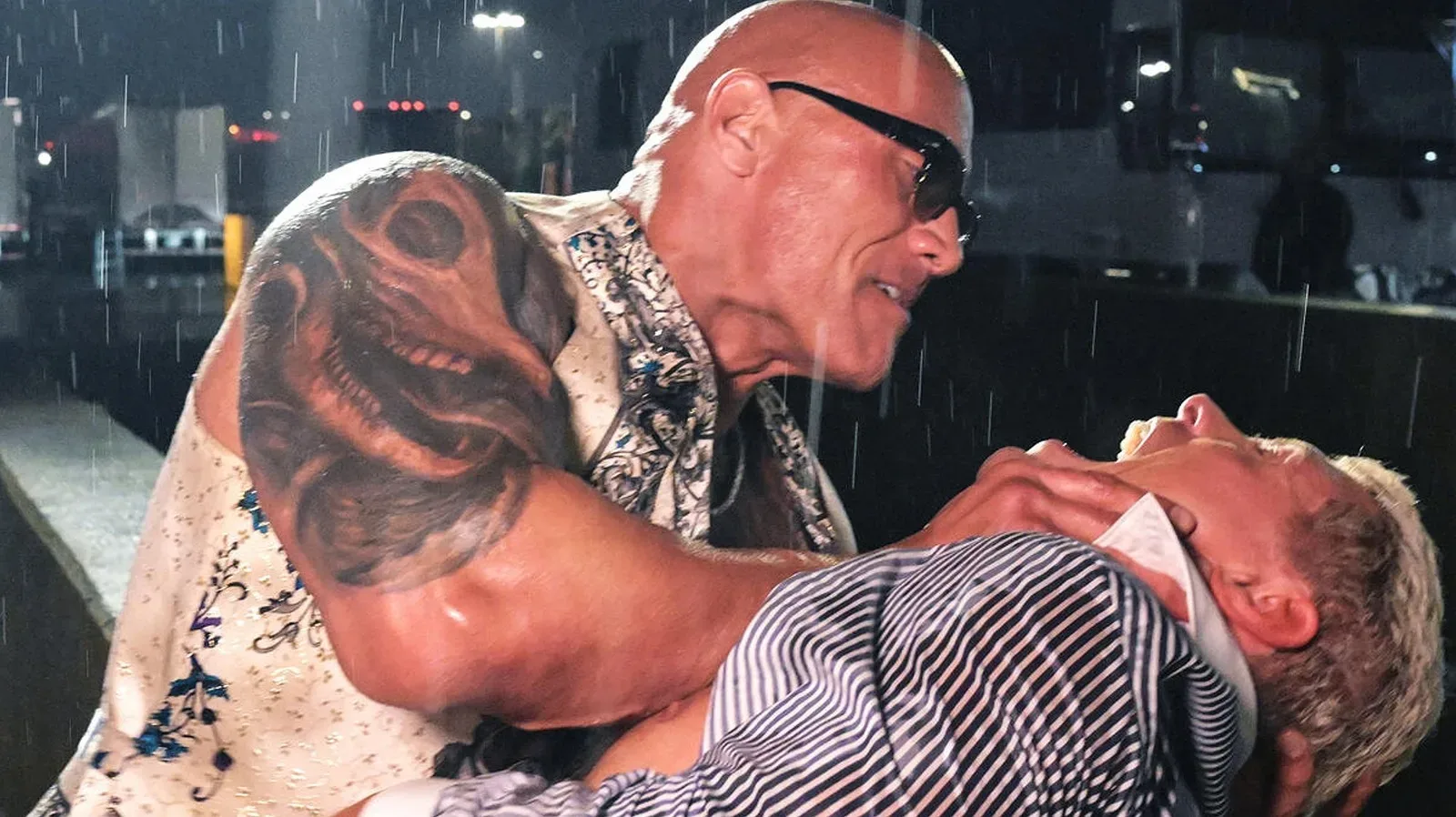
Cody Rhodes and Dwayne “The Rock” Johnson remain tied together by one of WWE’s most layered modern stories, and Rhodes says the relationship has become just as difficult to categorize away from the ring as it has been on television.
Speaking on Last Meals, Rhodes discussed being invited to the premiere of the live-action Moana film and admitted he is never entirely sure what kind of interaction he will have with Johnson. Their WWE history includes betrayal, violence, championship stakes, and an unresolved rivalry, yet their families share connections that long predate the current era of wrestling storytelling.
“I’m always wondering why he invites me to these things, because it’s like I’m the only one [from WWE] who gets invited, and are we going to fight? Are we hugging? We’re hugging! Okay, yeah,” Rhodes said on Last Meals. “That’s the most complicated male relationship I have in my life.”
It is a striking description of a connection that has existed on several levels at once. In WWE continuity, The Rock was the imposing Final Boss who appeared to take away Rhodes’ WrestleMania destiny before Rhodes reclaimed it. Beyond the cameras, however, the two men are connected through family relationships and the broader history of wrestling’s territorial past.
For more background on this topic, read Roman Reigns Says WWE Schedule Is About ‘Quality Over Quantity’.
That mix of real history and fictional conflict has helped make every interaction between Rhodes and Johnson feel significant. Even when they are simply seen together outside a WWE arena, fans have reason to wonder whether a friendly appearance is merely personal or whether it might carry implications for a story that has not fully reached its conclusion.
A WrestleMania XL Story Built On Real Emotion
The central chapter of Rhodes and The Rock’s WWE rivalry played out on the road to WrestleMania XL in 2024. Rhodes had already made finishing the story his defining mission, pursuing the WWE Championship after falling short against Roman Reigns at WrestleMania 39. The arrival of The Rock changed the landscape almost immediately.
Johnson’s return initially placed him in the position of challenging Reigns himself, creating the possibility that Rhodes would once again be moved away from the championship match he had spent years trying to reach. The response from fans transformed the direction of the build, and WWE ultimately pivoted toward a larger conflict involving Rhodes, Reigns, The Rock, Seth Rollins, and the Bloodline.
The Rock’s Final Boss persona became the engine behind that conflict. He was not presented as a nostalgic legend dropping in for a one-off match. Instead, he operated as a calculating power figure with a personal interest in Rhodes’ failure. The character’s attack on Rhodes on WWE Raw gave their issue a far more hostile foundation than a simple disagreement over a WrestleMania main event.
Rhodes and Rollins defeated The Rock and Reigns on the first night of WrestleMania XL, though the stipulation attached to that victory ensured that Rhodes would enter his title match against Reigns under Bloodline Rules. Rhodes nevertheless overcame Reigns the following night to win the WWE Championship, achieving the milestone that had been at the center of his return to WWE.
For Rhodes, the emotional architecture of that story was never just about match placement. It was about someone of The Rock’s stature appearing to take away an opportunity that Rhodes had made deeply personal. Rhodes described that aspect of the program as having a substantial amount of truth behind it.
“There’s just a huge amount of reality with what happened at WrestleMania 40, him coming in, him taking my thing away, and me taking it back,” Rhodes said.
That honesty is a major reason the program resonated. Rhodes’ entire WWE presentation has often rested on the idea that his ambitions are rooted in family legacy, particularly his desire to win a championship that his father, Dusty Rhodes, never held. The Rock’s involvement placed another famous wrestling family at the center of that narrative, making the collision feel larger than a standard feud.
Family Ties Beyond WWE Storylines
Rhodes explained that the personal relationship between the Rhodes and Johnson families stretches back much further than viewers may realize. He characterized it as a “territorial tie,” a phrase that speaks to the older wrestling landscape in which families, promoters, and performers formed relationships across regional promotions long before WWE became the industry’s dominant national force.
He noted that Johnson has known Rhodes’ mother, Michelle Rubio, for years. Rhodes also said that Rubio and The Rock’s mother, Ata Johnson, have maintained a longstanding relationship. Those details give added context to why the two stars can move from a storyline built on aggression and mistrust to warm interactions at major entertainment events.
In wrestling, it is common for real personal history to inform television narratives. What makes this case different is the scale of the participants. Rhodes is one of WWE’s defining current stars and a central championship figure. Johnson is one of the most recognizable entertainers in the world, a member of the Anoa’i family, and someone whose presence can reshape WWE programming immediately.
As a result, the line between reality and storyline naturally attracts attention. Rhodes’ uncertainty over whether he and Johnson will hug or fight is humorous, but it also captures the atmosphere surrounding their connection. They have genuine familiarity, while their on-screen history gives audiences no reason to assume that familiarity will remain uncomplicated.
The Final Boss Remains An Unfinished Possibility
Rhodes also praised The Rock’s Final Boss character, calling it one of the strongest concepts Johnson has ever presented in wrestling and suggesting that it remains largely unexplored.
“[The Final Boss] is one of the best characters, and it’s really untapped, that not only he ever did, but wrestling’s ever had,” Rhodes said.
That assessment will fuel continued discussion about whether WWE eventually returns to the issue between them. The Final Boss was not portrayed as a character whose goals ended when Rhodes won the WWE Championship at WrestleMania XL. The Rock’s presence carried the implication that he could re-enter the title picture, the Bloodline story, or Rhodes’ personal journey whenever the moment was right.
There is also the matter of the later storyline in which The Rock said he wanted Rhodes’ soul and helped facilitate John Cena’s heel turn against Rhodes. That development added another layer to a situation that already had several unresolved threads. It positioned Johnson as a force capable of influencing major events without necessarily stepping into the ring himself, while reinforcing the idea that his interest in Rhodes had not disappeared.
WWE has not provided a definitive payoff to that aspect of the story. That leaves room for numerous directions, from a direct match between Rhodes and The Rock to a broader angle involving Cena or other major WWE figures. At present, though, any specific outcome remains uncertain.
The possibility matters because The Rock’s Final Boss persona is designed around authority as much as physical confrontation. Unlike a traditional rival who needs to appear every week to maintain momentum, the character can loom over the product through brief appearances, implications, and connections to larger power structures. A return does not need to begin with a match announcement to have an impact.
Why Rhodes And Johnson Still Feel Connected
Rhodes’ remarks show why the Rhodes-Rock story retains interest even during periods when it is not the immediate focus of WWE television. Their dynamic contains multiple contrasts: professional respect and personal tension, family familiarity and storyline hostility, a completed WrestleMania chapter and questions that still have not been answered.
For Rhodes, the WrestleMania XL outcome represented a defining triumph. He did not merely overcome Reigns to win the WWE Championship; he navigated a chaotic situation in which The Rock’s return threatened to redirect the path he had fought to earn. That achievement is inseparable from the story’s larger emotional context.
For Johnson, the Final Boss persona opened a different kind of role. It allowed him to draw on his legacy without simply revisiting past versions of The Rock. The character was colder, more strategic, and more willing to use influence as a weapon. Rhodes’ belief that there is still more to explore reflects the fact that the concept was introduced with enormous impact but has not yet been fully exhausted.
Until WWE chooses to revisit those threads, Rhodes and Johnson’s public interactions will likely continue to invite speculation. A hug at a premiere may be exactly that: a friendly moment between people whose families have known each other for years. Given everything that has happened on WWE programming, however, fans can understand why Rhodes approaches the question with a little uncertainty.
That uncertainty is part of what makes the relationship compelling. Cody Rhodes and The Rock are linked by history, legacy, and one of WWE’s biggest recent stories. Whether their next meaningful encounter is warm, hostile, or something in between, the Final Boss remains a major unresolved presence in Rhodes’ WWE world.
In pictures

Darryl Polo
Darryl Polo is a passionate wrestling fan covering WWE, AEW, TNA and beyond. He loves great rivalries, breakout stars and the moments that keep fans talking long after the bell. How we work.