
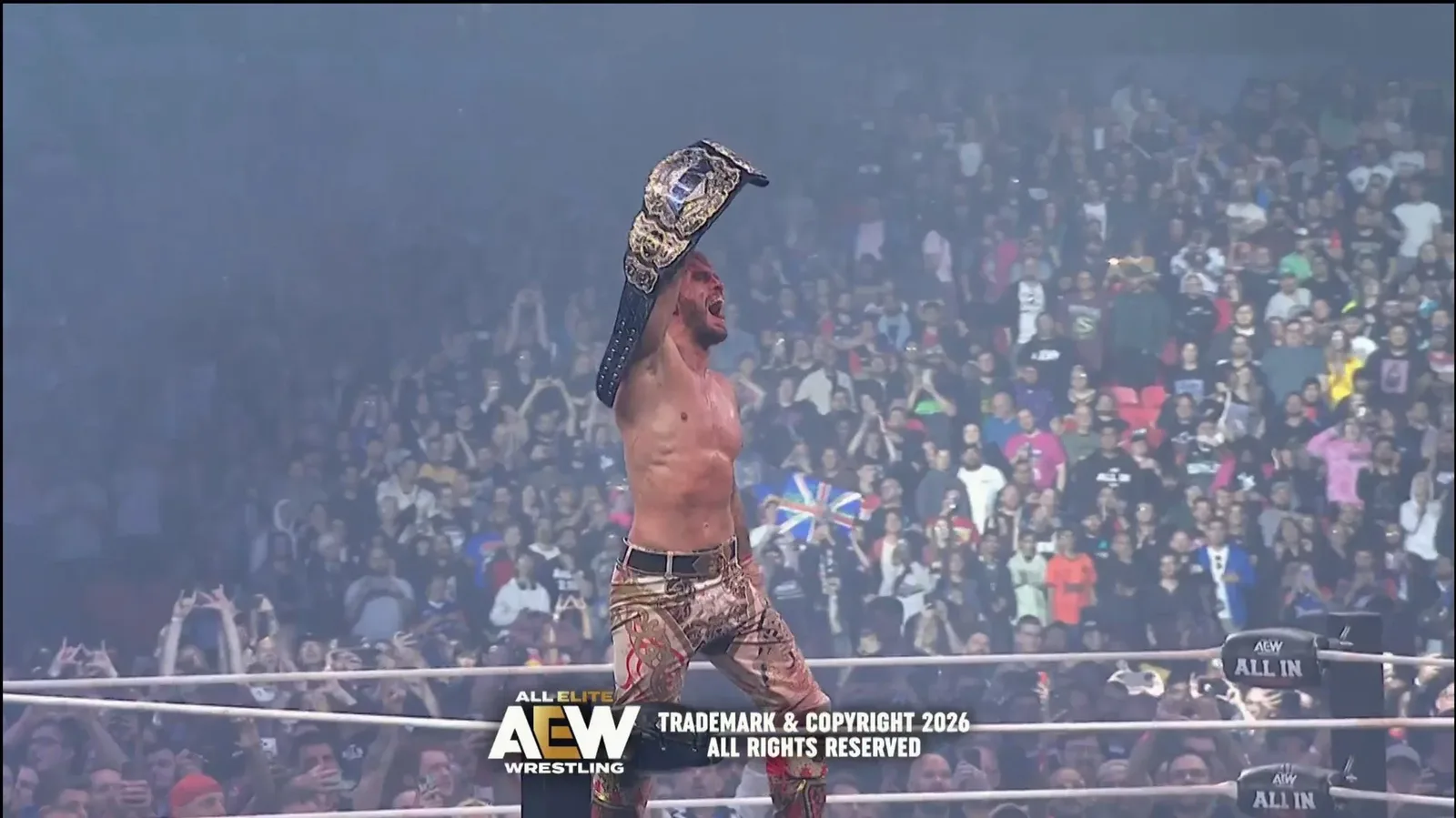
Will Ospreay believes professional wrestling no longer needs to protect kayfabe in the all-encompassing way it did in previous generations, though he still sees a clear line between acknowledging the craft and exposing parts of the production that do not improve a fan’s experience.
Speaking during a recent interview with Real Radio Monsters, Ospreay addressed the changing relationship between wrestling promotions, performers and audiences in an era when behind-the-scenes content is more readily available than ever. His central argument was not that kayfabe has disappeared or cannot still work. Instead, Ospreay said the medium itself has changed, and that fans are capable of investing emotionally in fictional rivalries even while understanding the performers are playing roles.
“I mean it can still be done to this day and age for sure,” Ospreay said of maintaining kayfabe. “It can be, but just like, I think, you don’t go into like a cinema. I like the Avengers and like Spider-Man and I love Batman. I don’t go into those things and instantly just go, well, ‘they’re not protecting the business.’”
Ospreay compared wrestling to entering the world of a superhero movie. The audience knows it is watching actors, special effects and a constructed story, but that knowledge does not prevent viewers from becoming immersed in the stakes presented on screen. He feels wrestling can operate under the same principle when it gives its audience compelling characters and stories.
For more background on this topic, read Liv Morgan Calls ‘Bad Lieutenant: Tokyo’ Filming a Different Challenge From WWE.
“I go into there knowing that I’m going to be sucked into a story and sucked into that universe,” Ospreay continued. “So like, it’s the same thing with wrestling. Whenever you walk into any arena that we do, we’re all characters and we’re all there to perform a show.”
Ospreay sees a place for character work beyond television
For Ospreay, modern kayfabe is not necessarily limited to pretending every match result and rivalry is completely real in everyday life. He noted that social media offers wrestlers another platform to extend their personas, deliver promos and build interest in a program. That approach can allow a story to reach fans outside a weekly television broadcast without requiring performers to maintain the stricter public separation that was once expected across the industry.
“Sometimes it gets dictated onto like social media where people act as their characters from there and they can cut promos there and it can promote over over to like different sources and different places,” Ospreay said.
That distinction is important to Ospreay’s view. He is not dismissing the value of illusion, character consistency or a wrestling promotion’s fictional universe. Rather, he believes the presentation can acknowledge the audience’s sophistication while still protecting the elements that make a live wrestling show feel immediate and dramatic.
Wrestling audiences have long been aware, to varying degrees, that matches are planned performances. The business has nevertheless relied on its ability to create emotion through athleticism, personality, conflict and consequence. Ospreay’s comments suggest that the goal in 2026 should be less about persuading every fan that the mechanics of the business are unknown and more about giving them a reason to care once the bell rings and the story begins.
That is particularly relevant for a performer such as Ospreay, whose work is often defined by the balance between high-level physical execution and major-match emotion. His position is that the audience can appreciate the difficulty and artistry involved in wrestling without having every component of the production spelled out for it.
Not every backstage detail needs to be part of the presentation
While Ospreay believes wrestling has evolved past full kayfabe protection, he was equally clear that he does not support putting every backstage process in front of the camera. He said there are still “aspects” that should remain protected and expressed frustration with material that reveals production logistics rather than enhancing a storyline.
“I feel like wrestling has kind of evolved from that standpoint, like once upon a time it needed to be protected and I still feel like aspects of it do need to be protected,” Ospreay said. “That’s why I’m not the biggest fan of the the backstage like stuff that’s being shown.”
His objection centers on the difference between showing fans meaningful context and showing them information that can pull them out of the fictional world. Ospreay specifically cited timing cues and commercial breaks as examples of details he does not believe viewers need to know.
“I just think there are some things that fans need to see and some things that fans don’t need to see, and I don’t think fans need to know what time cues are. I don’t think they need to know when the commercial break’s coming up.”
In Ospreay’s view, that kind of access risks shifting the focus from the wrestlers and their stories to the people and processes behind the presentation. He was blunt in criticizing what he sees as unnecessary self-congratulation around production content, adding, “Like, it just seems like one big ego fest. Look how amazing we are, the guys behind the camera. It’s like, shut up.”
The comments do not amount to a call for wrestling to return entirely to the customs of past decades. Ospreay explicitly said maintaining kayfabe can still be done today. But he presented a more selective standard: preserve what serves the drama, the character work and the fan’s suspension of disbelief, while avoiding disclosures that merely make the performance feel mechanical.
The modern kayfabe debate remains about presentation
Debates over kayfabe often become framed as a choice between total secrecy and complete transparency. Ospreay’s position falls between those extremes. He recognizes that wrestling exists in a culture where fans have unprecedented access to interviews, social media posts, documentaries and backstage programming. Attempting to recreate every condition of an earlier era may not be realistic, and it may not be necessary for wrestlers to connect with an audience.
At the same time, his comments underline that access has limits. A fan can know wrestlers are performers and still want the company to make the match, the rivalry and the moment feel important. The challenge is deciding which layers of the process add depth and which ones dilute the emotional stakes.
Ospreay’s superhero comparison captures that balance. Moviegoers understand that a superhero universe is fictional, but they are still invited to take the characters’ problems seriously within the boundaries of the story. Wrestling can ask for the same kind of engagement. It does not need to disguise its existence as a performance in every setting, but it does need to protect the world it creates when the audience is meant to be absorbed by it.
That outlook also leaves room for performers to use modern media intelligently. Social platforms can be an extension of a wrestling character, a place for a rivalry to develop or a way to direct attention toward a match. Used in that manner, social media can strengthen the overall presentation rather than undermine it. The issue, from Ospreay’s perspective, comes when behind-the-scenes exposure reveals operational details that have no storytelling value.
Ospreay has also recently discussed his preference not to talk about WWE during interviews, another indication that he is deliberate about where he directs his public comments. In this case, his focus was broader than any one promotion. He addressed a question facing the entire industry: how wrestling should present itself to an audience that understands more about the business than ever before.
His answer is that the craft does not depend on full kayfabe protection to succeed. Fans can enter an arena knowing they are about to watch performers play characters and still be fully invested in the drama. But for that investment to hold, Ospreay believes promotions should be careful not to expose the cues, schedules and production machinery that turn the show into a process rather than an experience.
For Ospreay, the evolution of wrestling is not about abandoning its illusions. It is about choosing the right ones to preserve.

Darryl Polo
Darryl Polo is a passionate wrestling fan covering WWE, AEW, TNA and beyond. He loves great rivalries, breakout stars and the moments that keep fans talking long after the bell. How we work.