
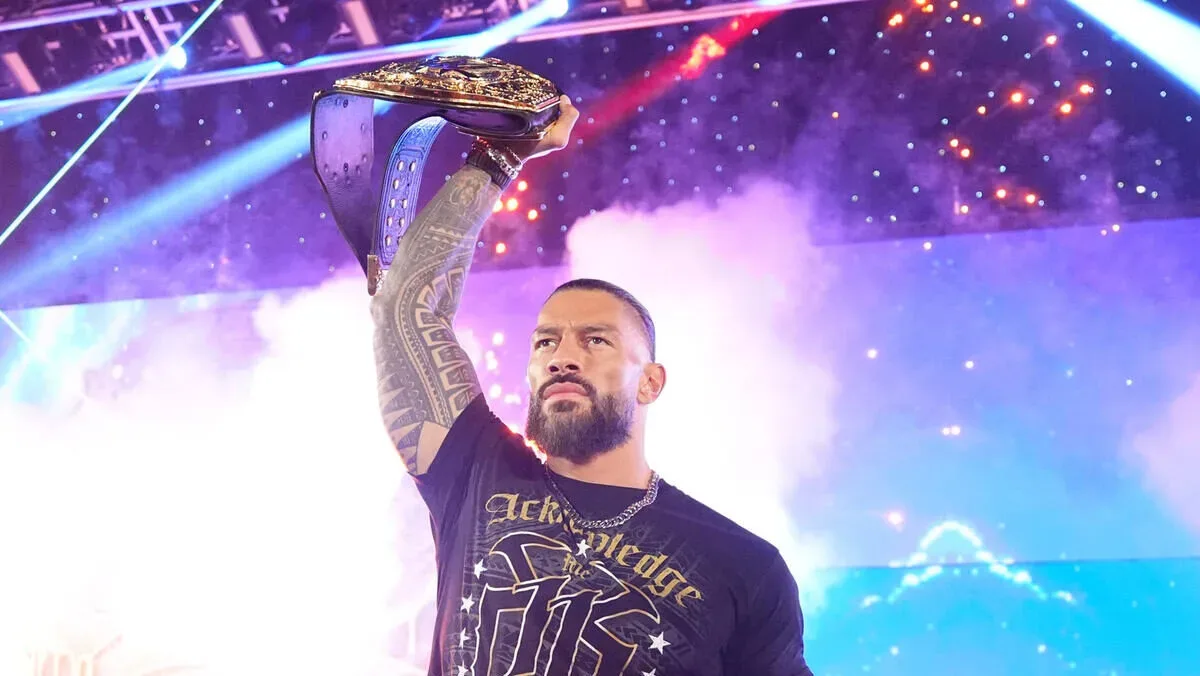
Roman Reigns has made it clear that he sees his WWE schedule through a different lens than the traditional full-time model. During a new interview with Sam Roberts, Reigns discussed the selective nature of his in-ring appearances and summed up his philosophy in simple terms: “quality over quantity every single day of the week.”
The former Undisputed WWE Champion has wrestled only 20 matches since the beginning of 2024, a figure that underscores just how carefully his physical appearances have been managed. Rather than treating every television date or live event as an automatic wrestling commitment, Reigns explained that there are specific conditions that need to be met before he is willing to take on the physical toll of a match.
Reigns acknowledged the unusual reality of choosing a profession built around taking hard falls and absorbing punishment, even if he does not personally enjoy that aspect of the job.
“I don’t like to fall down at all and I some reason chose to do that for a living but that’s a part of the deal,” Reigns said. “Yeah man, it’s got to be on a Saturday or a very important Sunday. It’s got to check off one of my dates, you know what I mean? There’s some requirements that come with that level of physicality for me.”
For more background on this topic, read Tony D’Angelo Addresses WWE Main Roster Wait Ahead Of NXT Halloween Havoc.
The comment offers a straightforward view of how Reigns approaches the ring at this stage of his career. WWE can present Reigns on television, in promotional settings, or in storyline segments without requiring him to compete every week. But when the moment calls for an actual match, Reigns wants the occasion to meet a higher threshold.
Reigns Pushes Back On A 10-Match Estimate
Roberts jokingly suggested that Reigns works roughly 10 or 11 matches annually. Reigns immediately objected to that estimate, making it clear that even that number was more than he had in mind.
“Don’t push it, 10? What the fuck? [laughs] 10? We’re at 8, alright? Sprinkle some TV appearances around that, you know. You know, quality over quantity every single day of the week.”
Reigns delivered the response with humor, but the underlying message was consistent with his broader approach. He is not measuring the value of his WWE role by volume. A smaller number of matches, paired with selected television appearances, is the formula he prefers.
That distinction matters because professional wrestling has long placed enormous value on availability. For much of WWE history, top stars were expected to work extensive live-event schedules, regular television matches, premium live event bouts, media obligations, and travel-heavy weeks. That workload created many of wrestling’s most durable legends, but it also came with a significant physical cost.
Reigns is openly stating that his own circumstances are different. His schedule is designed around major occasions and appearances that carry particular weight rather than routine repetition. In his view, limiting the number of times he wrestles helps preserve the importance of the moments when he does compete.
A Selective In-Ring Role Does Not Mean A Small WWE Presence
The number of matches Reigns works does not fully capture his visibility or influence. As he noted, television appearances remain part of the equation. A wrestler does not necessarily need to have a match in order to move a story forward, create anticipation, confront an opponent, or establish the stakes for a future showdown.
For Reigns, the distinction between appearing and wrestling is central. A TV segment can provide the audience with his presence while avoiding the level of physicality he described. That allows WWE to use him in ways that maintain focus on his character and storylines without treating every appearance as another in-ring outing.
It also reflects how top attractions can be used in a modern WWE environment. The company’s weekly programming has a large roster, and a major figure can remain important without being asked to wrestle on every episode. Reigns’ comments indicate that this is not accidental; he is intentionally prioritizing dates that fit his standard for significance.
The phrase “Saturday or a very important Sunday” is especially notable because it frames major weekend events as the natural setting for his most physical work. Reigns did not lay out a rigid public formula for which dates qualify, but he did make clear that the occasion needs to matter. The decision is not simply about showing up and working a match because it is available on the calendar.
The Value Of Making Matches Feel Important
Reigns’ “quality over quantity” approach speaks to the value of scarcity in wrestling presentation. When a performer wrestles constantly, audiences may become accustomed to seeing that athlete compete. When a performer’s matches are less frequent, the bouts can take on added significance because viewers know they are not guaranteed to happen again the following week.
That does not mean a reduced schedule automatically makes every match meaningful. The story, opponent, stakes, and performance still matter. But Reigns’ comments show that he believes selectivity is part of the process. If he is going to absorb the impact that comes with a WWE match, he wants the situation to justify it.
His wording also avoids pretending that the physical side of wrestling is minor. Reigns directly referenced falling down as part of the deal, a lighthearted description of an extremely demanding profession. Even the most controlled match carries repeated impacts, exertion, and risk. A schedule built around fewer matches can therefore be viewed as an attempt to reserve that wear and tear for situations with the greatest possible payoff.
Reigns did not specify a firm match limit for a calendar year. His joking correction from 10 to eight should not necessarily be read as a formal declaration that he will only wrestle eight times. Still, his reaction leaves little doubt about the broader point: he does not see 10 or 11 annual matches as a modest number for his current preferences.
Roman Reigns Embraces His Position
Elsewhere in the conversation, Reigns spoke confidently about his standing in professional wrestling, saying that he “owns that shit.” The remark fits the same self-assured perspective seen in his discussion of scheduling. Reigns is not presenting himself as someone trying to keep pace with a conventional definition of a full-time WWE performer. He is presenting himself as someone who understands the value attached to his name, his appearances, and his matches.
That confidence has been a defining element of Reigns’ on-screen identity for years, but his comments also show how closely his real-world approach aligns with that larger-than-life presentation. Whether he is talking about a specific event, an appearance, or his number of matches, Reigns’ focus is on maintaining a standard rather than maximizing output.
For WWE, a schedule like Reigns’ creates a clear balancing act. His appearances can generate heightened attention, while the limited number of matches places greater pressure on the occasions when he does wrestle. Reigns himself appears comfortable with that trade-off. He is not making an argument for being everywhere. He is making an argument for being present when it counts.
What Reigns’ Comments Mean Going Forward
The interview does not announce any particular upcoming match, event, opponent, or schedule change. It does, however, offer a direct explanation for why Reigns’ in-ring output has been limited since the start of 2024 and why fans should not expect him to chase a heavier workload merely for the sake of a higher match total.
Reigns’ preferred structure is clear: selected dates, important occasions, television appearances used strategically, and matches that meet his personal requirements for that level of physicality. His stance is not complicated, even if it runs counter to the expectations often placed on top stars.
In the end, Reigns is defining success by impact rather than frequency. He may not want to wrestle every week, and he may not even want to reach 10 matches in a year. But he believes the limited schedule strengthens what he does bring to WWE. As Reigns put it, it is about “quality over quantity every single day of the week.”

Darryl Polo
Darryl Polo is a passionate wrestling fan covering WWE, AEW, TNA and beyond. He loves great rivalries, breakout stars and the moments that keep fans talking long after the bell. How we work.