
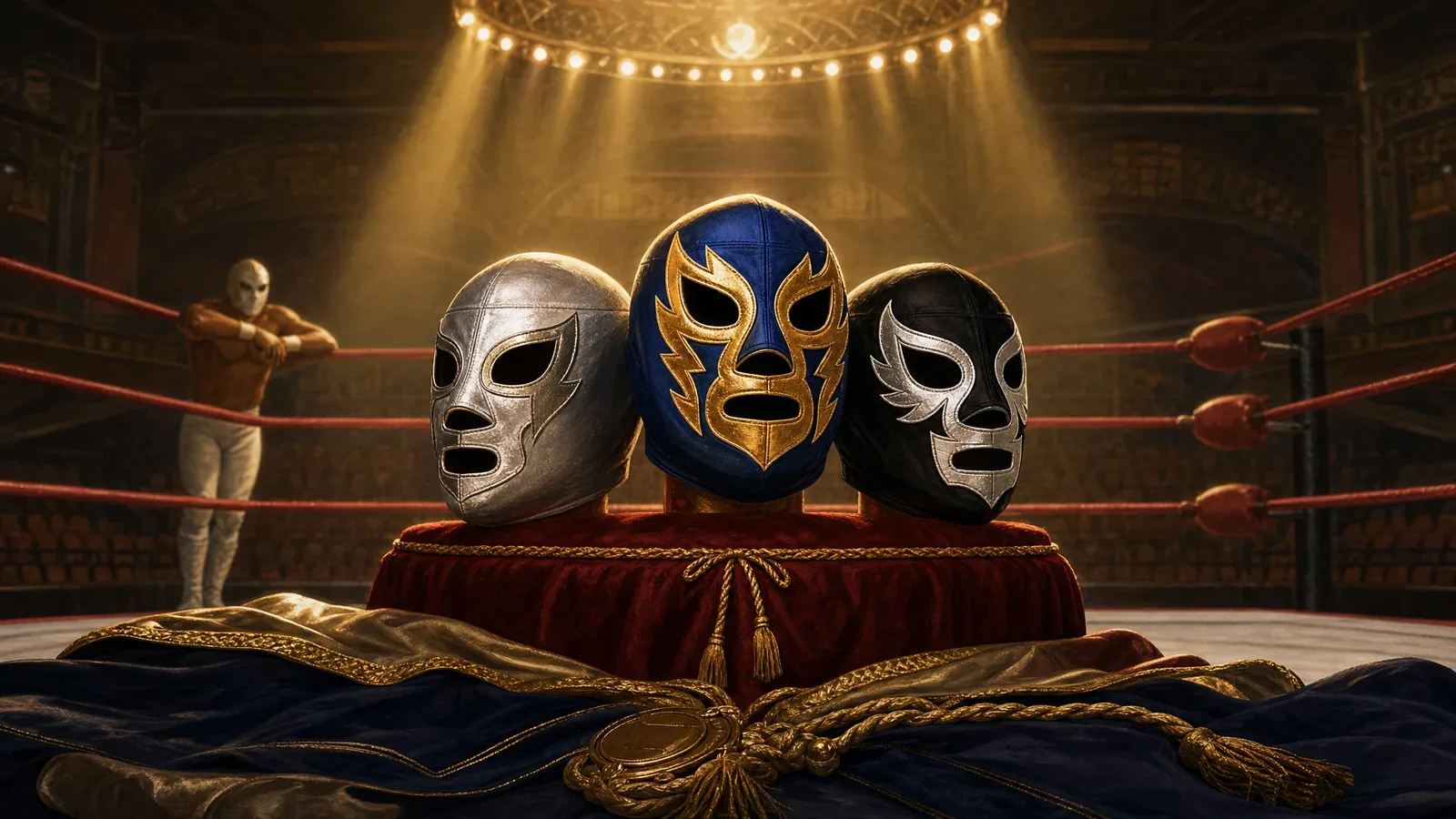
An anniversary of the promotion, not a later-created format
CMLL’s Aniversario is best understood first as a company commemoration. Empresa Mexicana de Lucha Libre, or EMLL, presented its first show at Arena Modelo on September 21, 1933; CMLL identifies Arena Modelo as a predecessor to Arena México. The first Aniversario followed in 1934, one year after that debut. That sequence matters for viewers approaching the event through modern cards: the anniversary did not originate as a tournament, a championship concept or a fixed apuestas attraction. Its basic subject was the promotion’s own founding and continued institutional history.
The name on the promotion has changed, but the anniversary archive belongs to a continuous institutional lineage. Salvador Lutteroth’s 1929 exposure to a wrestling show in El Paso preceded EMLL’s formation four years later, with Francisco Ahumada identified by CMLL as a founding collaborator. EMLL adopted the Consejo Mundial de Lucha Libre name in 1991. Consequently, an older card described as an EMLL anniversary card is not evidence of a separate annual tradition; it is part of the history that predates the CMLL name.
CMLL itself calls Aniversario its most important event of the year and frames September as the month in which it celebrates another year since its founding. That is a specific institutional claim rather than a demand that every edition resemble another. The archive instead provides a long record of different headline devices. A useful starting question for a fan is therefore not simply which match is biggest on a given card, but what form the anniversary celebration takes on that occasion: title match, apuestas, tournament, tag match or a larger elimination structure.
The earliest cards show no permanent main-event formula
The first documented Aniversario card took place at Arena Nacional on September 20, 1934, where Stephan Berne defeated Ray Rayan in a singles match. The 1935 and 1936 editions were also listed as singles matches. By 1939, however, the card was listed around the Mexican National Welterweight Championship. In other words, the earliest surviving outline already moves among ordinary singles presentation and championship focus. It is more accurate to see the anniversary identity as the constant than to project a single modern-style stakes formula backward across every edition.
The 1950s and 1960s make the variety even clearer. The archive includes a 1957 tag-team tournament for 10,000 pesos involving Black Shadow and Alex Romano, a 1958 mask match between El Espectro and Torbellino Blanco, and a 1959 hair match between Cavernario Galindo and Torbellino Blanco. Championships and apuestas were both present on anniversary programs in those decades. For viewers, that means a wager match is a major recurring strand of the tradition, but not the sole historical definition of what an anniversary program can contain.
Apuestas are useful to identify precisely. Máscara contra máscara places two masks at stake, while máscara contra cabellera places one wrestler’s mask against another wrestler’s hair; cabellera contra cabellera is hair versus hair. The anniversary archive records all of these broad kinds of consequences, but it also records championship matches and tournaments. Reading the stated stipulation is more informative than assuming that any card with an Aniversario number must culminate in the same kind of loss. The changing balance of stakes is part of the event’s documented history.
The anniversary story is also a venue story
The locations in the archive show that the annual commemoration was not always tied to one building. A 1937 listing notes that a fire at Arena Nacional forced shows back to the old Arena México. Subsequent anniversary records move among old Arena México, Arena Coliseo and the new Arena México across different periods. The venues are therefore not interchangeable background details. They place individual cards within a record that includes disruption, relocation and the development of the promotion’s major homes.
Arena Coliseo occupies a defined place in that path. It opened on April 2, 1943 and is described by CMLL as Mexico’s first arena built specifically for lucha libre. Several anniversary editions in the 1940s and 1950s took place there. Much later, the 46th Aniversario in 1979 was held at Arena Coliseo, headlined by Gran Cochisse versus Américo Rocca in a hair-versus-hair match. CMLL identifies it as the company’s last Aniversario at that historic venue, giving the location a clear endpoint within the anniversary chronology.
New Arena México opened on April 27, 1956 with capacity for more than 17,000 spectators, according to CMLL, and the promotion identifies it as the building that became known as La Catedral de la Lucha Libre. The 23rd Aniversario, held there on September 21, 1956, recorded El Santo defeating El Gladiador in máscara contra máscara. CMLL’s history also identifies El Gladiador as the first wrestler to lose his mask at the new Arena México. That pairing gives the building an early, directly documented connection to major mask stakes.
Direct apuestas created major precedents without becoming an exclusive rule
The 1956 El Santo–El Gladiador result is one early example, but later cards demonstrate the range of direct apuestas outcomes. In 1975, the anniversary celebrations included El Santo versus Perro Aguayo in máscara contra cabellera at Arena México. CMLL separately characterizes that bout as one of the generation’s most remembered matches. The point for a viewer is not to turn one remembered match into a universal template. Rather, the record establishes that a direct, personal wager could serve as a centerpiece within the broader anniversary commemoration.
The 1990s archive similarly places wagers alongside championship matches rather than replacing all other possibilities. The 1997 event included Hijo del Santo versus Negro Casas in máscara contra cabellera. The following year listed Último Guerrero versus Mr. Águila in máscara contra máscara. These entries are useful reference points because they specify the wager and the participants, while the wider description of the decade says anniversary cards often combined apuestas with title matches. A fan assessing a card should look at that full combination rather than judge its historical character from one bout alone.
There are also limits to treating the ledger as an uninterrupted chain of completed results. The 1985 program listed El Supremo versus El Dorado in a mask match, but the match was suspended because of the September 19 earthquake. The episode is a reminder that a scheduled stipulation and a settled historical outcome are different things. When using anniversary history, distinguish between a match announced or listed by the archive and a result that the record says occurred. That distinction keeps the weight of an apuestas stipulation clear without overstating an incomplete event.
Larger structures changed how a wager could be decided
The archive documents formats in which a final apuestas consequence emerged from a match larger than a conventional one-on-one challenge. The 66th Aniversario used parejas increíbles with a final suicida that produced a mask-versus-mask outcome. The 68th used a cage match with masks and hair at stake. These structures change the viewer’s route to the wager: the card may begin with partners who are not ordinarily aligned or with a group enclosed in a cage, then narrow toward the final loss. The stated stake remains central, while the structure surrounding it becomes part of the attraction.
Multi-person formats continued in later examples. The 71st Aniversario in 2004 used a four-way mask format, and the 72nd in 2005 used a three-way hair format. In 2010, the card listed a cage match involving 14 masks; in 2011, it listed a cage match involving 10 heads of hair. Those numbers illustrate a different scale of risk from a direct two-person wager. They do not erase the older singles tradition, but they show that the anniversary archive has accommodated both concentrated and broad-field versions of apuesta stakes.
The early 2010s also show movement between those approaches. The 2013 event combined parejas increíbles with a final suicida mask match involving La Sombra, Volador Jr., Atlantis and Último Guerrero. The 2014 and 2015 editions then returned to direct Atlantis máscara contra máscara victories, over Último Guerrero and La Sombra respectively. This sequence is especially helpful for avoiding a simple story of permanent change. The record supports coexistence and return: a larger format could be followed by a direct singles wager on later anniversary cards.
The archive records broader representation and varied centerpieces
Women’s stakes and championship matches are explicitly present in the anniversary record. The 2017 event listed Zeuxis versus Princesa Sugehit as máscara contra máscara de Amazonas. In 2021, CMLL identifies Lluvia and La Jarochita versus Dark Silueta and Reyna Isis for the Mexican National Women’s Tag Team Championship as the first women’s match to main-event an anniversary. These entries supply two separate markers: a women’s mask wager appears in the archive, and a women’s title match is identified by CMLL as an anniversary main event.
The recent archive also cautions against equating Aniversario solely with apuestas. The 2020 edition listed a CMLL World Tag Team Championship match. The 2021 records include both a hair-versus-hair match and the women’s tag-title main event. Taken together, those listings show a card can contain a wager and a title centerpiece in the same anniversary setting. For a fan, the practical question is which match is described as the main event and which stipulations appear elsewhere, rather than assuming a title match makes the annual identity less traditional or a wager makes every other match secondary.
A recent title-versus-mask example
Sports Illustrated reported a further variation for the 92nd anniversary event in 2025 at Arena México: Místico versus MJF, with the CMLL World Light Heavyweight Championship against Místico’s mask. The report said Místico won by submission with La Mística, making the title change the result of a match whose other stated stake was his mask. Sports Illustrated also reported that CMLL offered the match on Triller as a pay-per-view with English commentary because of international interest, and linked it to the then-active CMLL–AEW relationship. This is a documented recent example, not a rule for future editions.
How to read the anniversary ledger carefully
The anniversary number should not be treated automatically as proof of one card, one main event or one annual entry. CMLL’s current ledger labels 143 editions as documented rather than presenting a simple one-card-per-year series. It also records repeated anniversary numbers: two 69th Aniversario cards appear in September 2002, while the 50th, 55th and 63rd anniversaries each include multiple bouts in the table. That qualification helps readers avoid compressing a complicated archive into an overly neat numerical timeline.
A sound way to approach any historical Aniversario listing is to ask four grounded questions. Which company name appears in that period: EMLL or CMLL? Which venue hosted the program? Is the featured attraction a title match, an apuesta, a tournament or a multi-person structure? Finally, does the archive describe a completed result, a listed match or more than one dated program under the same number? Those questions follow the distinctions visible in CMLL’s own records and make room for continuity without forcing every anniversary card into one fixed model.
Explore more

Darryl Polo
Darryl Polo is a passionate wrestling fan covering WWE, AEW, TNA and beyond. He loves great rivalries, breakout stars and the moments that keep fans talking long after the bell. How we work.