
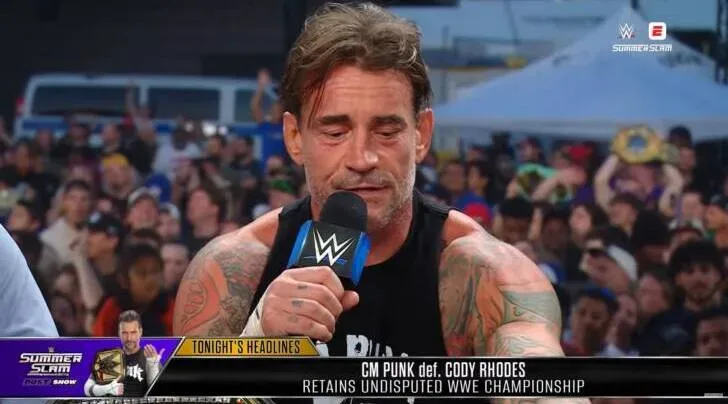
CM Punk has opened up about a serious injury from the earliest stage of his wrestling career that continues to affect him more than two decades later. During an appearance on Hot Ones: Extra Heat, Punk revealed that recurring vertigo stems from a skull fracture he suffered in 2002 during a Jersey Championship Wrestling match with Reckless Youth.
The injury kept Punk out of action for approximately two and a half months at the time. While he returned to the ring and ultimately became one of the most prominent wrestlers of his generation, he explained that the aftermath of the fracture has never entirely gone away. Punk said he developed severe vertigo after the incident, with the issue periodically returning and, on some occasions, affecting him while he is actively competing.
Punk described the condition as an issue tied to the inner ear and the body’s sense of balance. He said the subject is one he has not frequently discussed publicly, in part because of the reactions that can follow when an athlete explains an ongoing medical concern.
View the referenced post on X
“I fractured my skull once. This is the one that reoccurs every once in a while because after I fractured my skull, I developed vertigo really bad. Also, one I haven’t talked about too much because you talk about that and people kind of look at you. The doctors, they’ll be like, ‘Hmm.’ What happened was I fractured my skull and there was some bones in your inner ear that help with equilibrium. Those basically were like dice inside a cup and got rattled around and thrown around.”
For more background on this topic, read Lil Yachty Explains How WWE’s Gingerbread Man Became a Running Joke With Sami Zayn.
An injury from Punk’s independent-wrestling years
The 2002 match against Reckless Youth came well before Punk’s rise on the national stage. At that point, he was building his reputation on the independent circuit, long before his notable runs in Ring of Honor, WWE and AEW. The revelation provides additional context to the physical toll carried by a performer whose career has spanned decades and included countless high-pressure matches in a demanding profession.
Punk did not present the vertigo as a newly discovered concern. Instead, he framed it as a lingering consequence of the skull fracture, one that can return when the affected structures in his inner ear are disturbed. His explanation focused on the sensation of losing equilibrium, particularly after looking upward while lying down.
“Sometimes, those still get knocked loose. If I lay down and look straight up, the world spins. So, there’s been a lot of matches that you see that a lot of people are impressed with where I’m full on going through a bout of vertigo and I don’t know what’s going on.”
That comment is especially striking because it suggests that viewers may have watched acclaimed Punk performances without realizing he was battling a disorienting physical condition in real time. Wrestling requires performers to maintain timing, spatial awareness and coordination while executing complex sequences with another athlete. A sudden spinning sensation can make each of those tasks significantly more difficult, yet Punk said he has continued through episodes without the audience knowing what was occurring.
His comments do not identify particular past matches that were affected, nor did he specify how often bouts of vertigo occur. He also did not indicate that the condition has forced a recent absence or changed his current WWE status. What he did make clear is that the issue remains an occasional reality connected to an injury sustained in 2002.
Punk jokes about the SummerSlam moonsault
Even while discussing a serious health matter, Punk found room for his familiar self-deprecating humor. He referenced his recent SummerSlam match against Cody Rhodes, using his vertigo as a joking explanation for a moonsault that did not come off as cleanly as intended.
“I will also now blame the crookedness of my moonsault of my vertigo.”
The line reflects the way Punk has often addressed imperfections in the ring: directly, humorously and without attempting to ignore what viewers saw. A moonsault is among the more visually demanding maneuvers in wrestling, requiring a performer to rotate backward through the air and land with precision. Punk’s remark was clearly delivered as a joke, but it also tied a recognizable recent WWE moment to the balance issue he had just described.
His match with Rhodes at SummerSlam remains part of the larger story surrounding Punk’s current WWE run. The former WWE Champion returned to the company in 2023 and has since remained one of its most closely watched stars. His matches, promos and ongoing rivalries naturally receive considerable scrutiny, making the disclosure about competing through vertigo an added layer to how fans may view some of his performances.
Still, Punk’s account should not be treated as a diagnosis of any specific in-ring sequence or as an explanation for every mistake he has ever made. He spoke only about the recurring nature of vertigo following his skull fracture and offered the crooked moonsault as a humorous example. The important detail is his statement that he has wrestled during active bouts without fans being aware of the problem.
The challenge of performing through disorientation
Vertigo is commonly associated with a false sensation of movement or spinning, often accompanied by balance problems and disorientation. In the context Punk described, the concern is not merely discomfort. Pro wrestling is built around controlled movement, trust between opponents and the ability to orient oneself in a ring within seconds. Wrestlers constantly change levels, take falls, run the ropes, leap from elevated positions and absorb contact.
For a wrestler experiencing a spinning sensation, the challenge can extend beyond one move or one moment. Maintaining position during a sequence, recognizing cues and safely reacting to an opponent all depend upon awareness of where one is in the ring. Punk’s comments underline how much performers can manage behind the scenes of a match without an arena crowd or television audience recognizing it.
At the same time, Punk did not detail any treatment plan, medical restrictions or specific measures used when vertigo appears. He did not say that he has been cleared to compete through episodes, and he did not characterize the condition as an excuse for in-ring performance. His explanation was personal rather than clinical: an account of an old injury, an ongoing sensation and the reality that he has sometimes worked through it.
That distinction matters. Punk’s story offers insight into his own experience, but it does not establish a broader standard for how other wrestlers should handle dizziness, head injuries or balance-related symptoms. Those situations are inherently individual and require medical attention and professional judgment.
A candid look at an often-hidden part of wrestling
Professional wrestling has always placed a premium on toughness, particularly for performers who came up through the independent circuit. Punk’s remarks show the complicated side of that culture. He has acknowledged a condition that can be alarming and difficult to explain, while also noting that he previously kept quiet about it because people may react differently when such concerns are raised.
His choice to discuss the skull fracture and vertigo publicly does not change the fact that the injury happened a long time ago. It does, however, demonstrate that the physical consequences of an early-career incident can remain present long after the initial recovery period has ended. Punk was sidelined for around two and a half months in 2002, but his comments make clear that recovery from the immediate fracture did not necessarily mean an end to every related effect.
For fans, the takeaway is not simply that Punk has wrestled through another obstacle. It is also a reminder that polished television matches can conceal a great deal. The audience sees the finished performance: the entrances, the sequences, the reactions and the result. It may not see an athlete attempting to regain balance, work through sudden dizziness or adapt in the middle of a live match.
Hot Ones: Extra Heat, featuring Punk alongside Liv Morgan and Charlotte Flair, is currently streaming on Netflix. Punk’s appearance has now added an unusually candid chapter to the long story of his career: a 2002 skull fracture suffered against Reckless Youth, a prolonged battle with vertigo, and the reality that the issue has occasionally followed him all the way into the ring.
Darryl Polo
Darryl Polo is a passionate wrestling fan covering WWE, AEW, TNA and beyond. He loves great rivalries, breakout stars and the moments that keep fans talking long after the bell. How we work.