
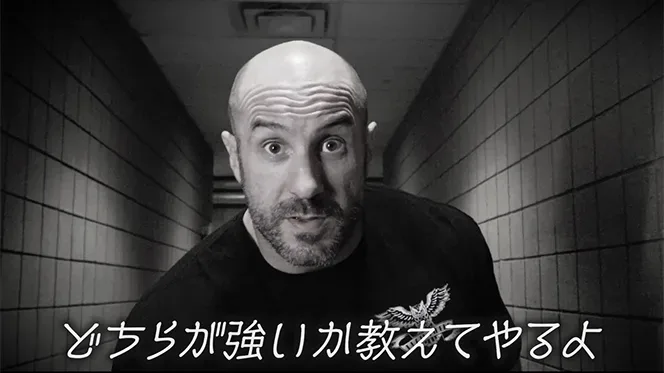
Claudio Castagnoli has built a professional wrestling career around astonishing displays of power, balance and control. Yet even a performer capable of lifting and rotating opponents of almost any size says those abilities do not carry over to one particular skill: elite-level mouse control in esports.
Castagnoli addressed the comparison while appearing on The Load-In with Paul Delos Santos during the League of Legends World Championships. Asked whether precise mouse work at the highest level of gaming is more impressive than lifting a 400-pound man, Castagnoli gave an answer rooted in the demands of his own profession.
“Well, for me, for my job, I would say it’s lifting 400-pound men,” Castagnoli said.
At the same time, Castagnoli was quick to reject the idea that the physical coordination needed for wrestling naturally makes him a standout gamer. In his view, the kinds of timing and control required in each setting are very different.
For more background on this topic, read Will Ospreay and Kyle Fletcher Set Face-To-Face Segment for AEW Dynamite/Collision Before Full Gear.
“The one doesn’t correlate to the other because of mass control and my timing in that and my timing in the ring,” Castagnoli said. “You would think it would match, but it absolutely doesn’t. I’m the worst. I just misclick and I click the wrong buttons.”
A Different Kind of Control
Castagnoli’s response draws a clear line between two forms of precision that can look similar from a distance. In a wrestling ring, he is controlling his own body, responding to an opponent’s movement, maintaining positioning and safely executing athletic offense in front of a live audience. In competitive gaming, a player must make rapid and exact inputs through a mouse and keyboard, often while processing a large amount of visual information in an instant.
Both disciplines require timing. Both reward repetition and composure. Both can punish even a small error. But Castagnoli’s self-assessment was that the skills are not interchangeable, despite his reputation as one of wrestling’s most physically coordinated powerhouses.
His reference to “mass control” is particularly fitting for a wrestler whose offense has frequently revolved around moving opponents in ways that seem to challenge conventional expectations. Castagnoli’s strength has never merely been about lifting weight. His most memorable feats often involve handling a resisting opponent, finding balance, and sustaining a demanding movement without losing control of either the action or the person he is performing with.
That is a major reason the Giant Swing has remained so closely associated with him over the years. The move demands that Castagnoli establish a secure grip, lift his opponent, create momentum and maintain rotation while keeping the sequence controlled. It is an imposing visual under any circumstances, but it becomes even more remarkable when the opponent is substantially larger than the man delivering it.
The Giant Swing Remains a Defining Feat of Strength
Castagnoli has used the Giant Swing on wrestlers considerably bigger than himself, including The Great Khali and Big Show. Those examples have helped cement the move as one of the strongest illustrations of his unusual combination of power, conditioning and technical confidence.
In professional wrestling, a feat of strength is never simply an individual achievement. It also depends upon trust, cooperation and precise execution between performers. A move such as the Giant Swing requires all of that, in addition to the physical ability needed to get an opponent off the mat and keep the rotation going. Castagnoli’s history with the move is therefore a reflection of his power, but it is also part of a larger body of work that has made him respected as an all-around in-ring wrestler.
His answer during the esports interview also carried a dose of humor. Castagnoli did not diminish the physical challenge of his work, but he openly acknowledged a weakness away from the ring. Calling himself “the worst” at mouse use and admitting that he misclicks or hits the wrong buttons is a refreshingly simple answer from an athlete who has spent decades being viewed as exceptionally capable.
That contrast is part of what made the question compelling. A wrestler who can swing giants around a ring might appear to possess the reaction speed and hand-eye coordination needed for a computer game. Castagnoli himself understands why people would make that assumption. Still, he insists that ring timing and gaming inputs are separate things.
From Wrestling Timing to Competitive Gaming Precision
Wrestling timing is built through live experience. It involves knowing when to move, when to pause, how to react to an opponent, and how to guide an audience through the rhythm of a match. A mistimed step can affect not only the flow of a sequence but also the safety of everyone involved. That timing is physical, instinctive and developed through years of repetition in a constantly changing environment.
Elite mouse control in a game such as League of Legends presents a different challenge. Players need efficient movement, accurate targeting and command execution under intense pressure. The physical motion may be smaller than lifting a heavyweight wrestler, but the required precision is unforgiving. One wrong click can alter a fight, a strategy or an entire match.
Castagnoli did not attempt to rank esports below wrestling or suggest that gaming is easy. If anything, his admission that he struggles with the controls recognizes the specialized ability involved. His own expertise is in a ring, where he has become known for applying strength with extraordinary poise. The mouse and keyboard, he said, are another matter.
The comments arrived while Castagnoli was attending the League of Legends World Championships, placing one of pro wrestling’s best-known power athletes in the middle of a major esports environment. The setting made the question especially appropriate: it invited a comparison between physical performance and digital competition while allowing Castagnoli to explain why excellence in one field does not automatically produce excellence in another.
Castagnoli’s Candid Perspective
Castagnoli’s willingness to speak plainly about his limitations has long complemented the intensity he brings to the ring. His career has included performances that make his strength look almost effortless, but the reality behind that presentation is extensive training, ring awareness and years of experience working with opponents of varied sizes and styles.
The Giant Swing is a particularly enduring example because it communicates his capabilities immediately. Fans do not need an explanation when they see a wrestler lift another wrestler, spin him repeatedly and remain in command of the motion. When the opponent is someone the size of Big Show or The Great Khali, the spectacle becomes even more striking.
Even so, Castagnoli’s esports answer makes a useful point about athleticism. Being physically powerful does not mean every form of coordination comes naturally. A wrestler can possess remarkable grip strength, core stability, balance and movement awareness while still struggling to make clean inputs on a computer. Likewise, an elite esports competitor’s precision is a skill earned through its own practice and discipline.
For Castagnoli, the answer to the original comparison was straightforward. Lifting a 400-pound man is the more relevant benchmark because it belongs directly to his job and to the skills he has refined throughout his career. But when it comes to navigating a game with a mouse, he sees no hidden advantage from his in-ring accomplishments.
That honesty does not change the legacy of the Giant Swing or the many feats of strength that have defined Castagnoli’s wrestling career. It simply adds another dimension to the performer behind them: one of wrestling’s most impressive physical forces, and by his own account, someone who may still click the wrong button when the competition moves to a screen.

Darryl Polo
Darryl Polo is a passionate wrestling fan covering WWE, AEW, TNA and beyond. He loves great rivalries, breakout stars and the moments that keep fans talking long after the bell. How we work.