
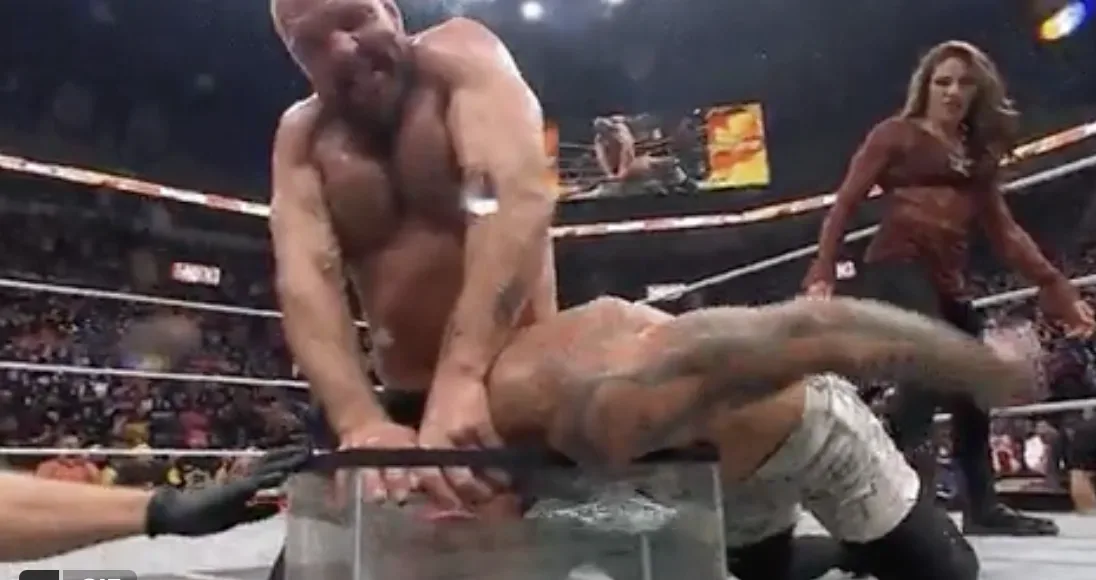
Swerve Strickland has participated in some of the most punishing and unforgettable hardcore matches in All Elite Wrestling, but even he can identify a line that made him pause.
During a recent interview, the former AEW World Champion was asked to name an instance in which AEW went “a little too far” with a wrestling spot. Strickland did not point to one of his own violent battles with Hangman Page, despite the fact that their rivalry featured an array of extreme imagery and brutal weapon use. Instead, he immediately brought up the moment Jon Moxley attempted to drown Darby Allin during one of their matches.
“Darby getting drowned. I was like ‘oh we’re here.’ Okay.”
The answer is notable coming from Strickland. AEW has built much of its identity around allowing performers to bring intensity, physicality, and creativity to major grudge matches, particularly when standard rules are no longer enough to contain the conflict. Strickland has been a key figure in that aspect of the company’s presentation. His feud with Page was among the most personal and violent rivalries in recent AEW history, producing both a Texas Deathmatch and a Lights Out Steel Cage match.
For more background on this topic, read Swerve Strickland Names PAC, Andrade, Kevin Knight and More as Potential AEW World Champions.
Those encounters were not presented as routine wrestling contests. They were designed to show the depth of animosity between two rivals who had exhausted ordinary ways of settling their issues. Cinder blocks, syringes, and other harsh visuals became part of the story of two competitors willing to inflict and endure extraordinary punishment. That background gives added weight to Strickland’s reaction to the Moxley-Allin spot.
A Different Kind of Extreme Moment
Professional wrestling has always had a complicated relationship with violence. The best hardcore matches use physical danger and discomfort to underline a rivalry, establish desperation, or provide a defining image for a character. At the same time, every promotion and every performer must decide where spectacle ends and excess begins.
Strickland’s response suggests that the attempted drowning segment landed differently from a traditional weapon shot, cage fall, or no-disqualification brawl. The visual of one wrestler holding another underwater is inherently more unsettling because it presents a threat that is immediate, claustrophobic, and difficult to separate from real-world danger. In Strickland’s telling, it was a moment that announced a new level of extremity.
His brief response also conveyed the surprise of seeing AEW reach that point. “Oh we’re here” is not a lengthy critique, nor is it an extended condemnation of the match or the wrestlers involved. It is the reaction of someone who understands the language of violent wrestling and still recognized that a particular visual had gone beyond what he expected to see.
That distinction matters. Strickland did not frame hardcore wrestling itself as a problem. His own AEW body of work makes clear that he appreciates the value of a well-timed extreme stipulation and has been willing to take part in major physical risks when the story demands it. Rather, he identified one specific moment as an example of AEW testing its boundaries.
Why Darby Allin Was Central to the Conversation
Strickland was also asked who he considers the craziest person in AEW, and his answer was even more decisive: Darby Allin.
“Darby. Darby. Darby. He runs the board completely. Because I’ve been to Darby’s house, you know. And it’s literally the same thing.”
Allin has long cultivated an image built on fearlessness, pain tolerance, and a willingness to attempt things other wrestlers might never consider. His AEW persona is inseparable from that edge. Whether he is fighting from underneath against a more powerful opponent or taking a major risk to create a pivotal moment, Allin’s presentation has consistently relied on the sense that he will sacrifice nearly anything to win or to prove a point.
Strickland’s comments add a personal dimension to that reputation. By saying he has been to Allin’s home and that it is “literally the same thing,” Strickland indicated that the intensity is not simply a switch Allin flips for the cameras. It is, at least from Strickland’s perspective, tied closely to Allin’s actual personality and outlook.
That does not make the Moxley spot less jarring. If anything, it helps explain why it stood out. Allin’s established willingness to embrace danger means audiences expect a great deal from him, and fellow wrestlers know he is capable of absorbing or participating in unusually extreme material. Yet the attempted drowning was memorable enough for Strickland to choose it when asked about AEW going too far.
There is also a significant contrast in the personalities involved. Moxley’s reputation has been built on a hard-nosed, violent style and an ability to make high-stakes fights feel ugly and urgent. Allin, meanwhile, embodies recklessness and defiance. Putting those two approaches together naturally creates an environment in which neither man seems inclined to retreat. The result was a spot that left an impression even on a peer as experienced with hardcore wrestling as Strickland.
Strickland’s Perspective Carries Unique Credibility
Few current AEW names are better positioned to discuss the balancing act of violence and storytelling than Strickland. His program with Page did not become significant merely because it featured weapons or bloodshed. The escalation was rooted in a bitter feud, with both men using increasingly severe measures to hurt the other and gain a psychological advantage.
The Texas Deathmatch and Lights Out Steel Cage match represented major peaks in that story. These were not matches where the stipulations existed without context; they were meant to reflect how far the rivalry had deteriorated. The use of cinder blocks, syringes, and other brutal elements was intended to make the conflict feel dangerous and deeply personal.
That experience gives Strickland a useful perspective on the difference between an extreme spot that serves a feud and a moment that makes viewers stop in their tracks. His comments do not erase the importance of pushing creative boundaries in wrestling. They do, however, underline that wrestlers themselves can recognize when a moment becomes especially difficult to watch.
AEW’s willingness to air intense and sometimes graphic physical confrontations has helped separate its product from more restrained wrestling presentations. For some viewers, that unpredictability is part of the attraction. They tune in knowing that a blood feud could develop into a match where wrestlers use the environment, weaponry, and stipulations to convey the severity of the issue.
For others, there is a natural question about how far that approach can go before the shock becomes greater than the story. Strickland’s answer places the Moxley-Allin drowning angle directly in that discussion. It was not merely another severe spot in a promotion with a history of severe spots. To him, it was the point where AEW had reached an especially startling level.
Violence, Character, and Escalation in AEW
Extreme wrestling is most effective when it reveals something about the characters involved. Moxley’s violence is usually framed as relentless and purposeful. He is a competitor who often thrives in chaos, finding comfort where others find panic. Allin’s willingness to put himself in harm’s way is likewise central to his character, portraying him as someone impossible to intimidate or break through conventional means.
When those identities collide, escalation is inevitable. The attempted drowning spot represented the kind of escalation that can immediately define a match or rivalry in viewers’ minds. It created a visual that cannot be easily dismissed as a standard exchange of wrestling offense.
Strickland’s reaction reflects the challenge for any company presenting this type of material. A promotion wants its major grudges to feel important. It wants decisive moments that fans remember, debate, and revisit. But it also has to recognize that escalating violence changes the emotional tone of a match. What may be thrilling to one part of the audience can be uncomfortable for another.
There is no indication in Strickland’s comments that he is calling for AEW to abandon hardcore wrestling or soften its approach across the board. His remarks were instead a candid answer to a direct question: if he had to name a point where the company went a little too far, the Moxley and Allin sequence was the one that came to mind.
That kind of honest assessment is especially striking because it comes from a wrestler whose own biggest AEW programs have been defined by their willingness to go to dark and violent places. Strickland knows what it takes to make a hardcore match matter. He also knows when a visual is so stark that it changes the room’s reaction.
Allin Remains AEW’s Benchmark for Fearlessness
While the drowning spot was Strickland’s answer for AEW going too far, his separate comments about Allin were clearly rooted in admiration as well as disbelief. Calling Allin the “craziest” wrestler in AEW was not presented as a close debate. Strickland repeated the name three times before explaining that Allin’s off-screen environment mirrors the intensity fans associate with him on television.
That reputation has made Allin one of AEW’s most distinctive talents. His approach creates immediate stakes because audiences know he is willing to gamble with his body and take punishment to achieve a memorable outcome. It is an approach that has made him a natural fit for some of the company’s harshest rivalries and most dramatic physical scenarios.
For Strickland, though, the line between fearless and shocking was crossed in that Moxley encounter. His comments offer a rare peer-level perspective on a moment that clearly stood out in a company where extreme matches and hard-hitting images are far from unusual.
AEW will continue to feature rivalries that demand escalation, and wrestlers such as Strickland, Moxley, and Allin will remain central figures whenever the promotion explores its more violent side. But Strickland’s answer is a reminder that even within that world, some moments register differently. For him, Jon Moxley attempting to drown Darby Allin was the unmistakable signal that AEW had gone “a little too far.”

Darryl Polo
Darryl Polo is a passionate wrestling fan covering WWE, AEW, TNA and beyond. He loves great rivalries, breakout stars and the moments that keep fans talking long after the bell. How we work.