
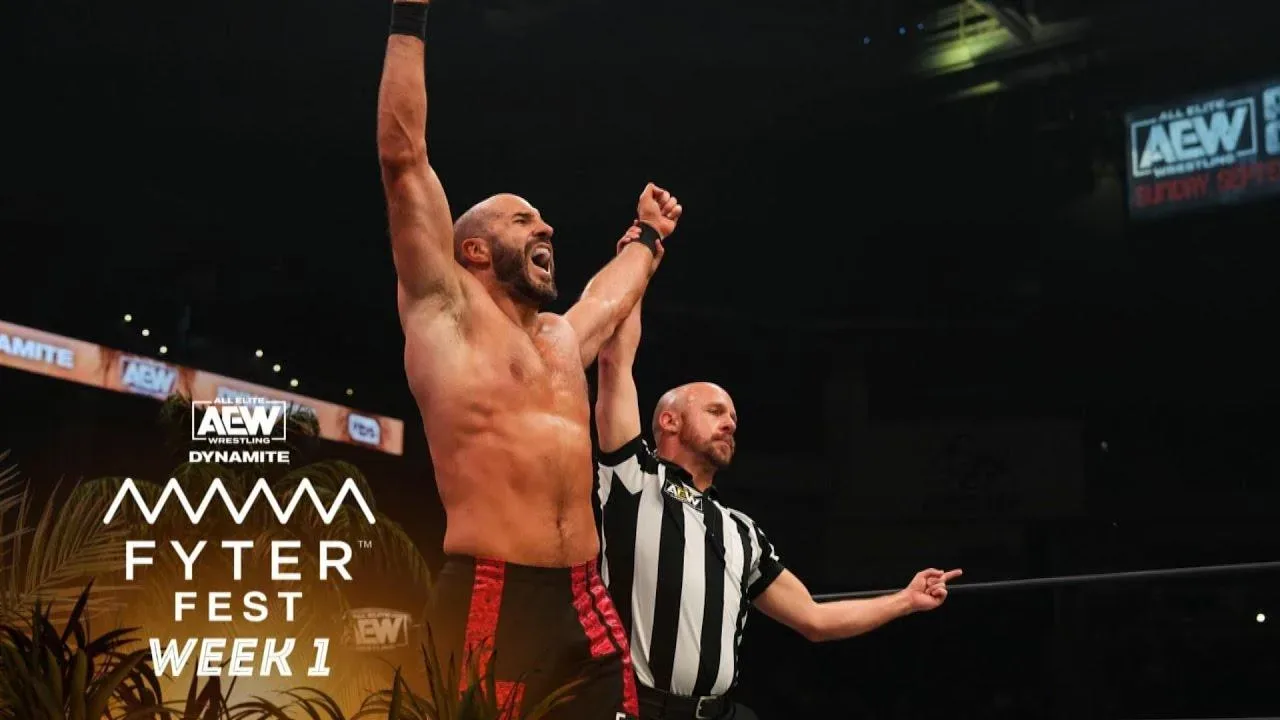
Claudio Castagnoli’s reputation in professional wrestling has long been built around remarkable strength, technical precision and an ability to adapt in virtually any setting. But before he became a familiar figure on television and a widely respected international performer, Castagnoli was also handling a far more personal part of the presentation himself: his ring gear.
Castagnoli revealed that he made his own wrestling attire during the early stages of his career, including after he relocated to the United States. The AEW star said the process was not limited to minor alterations or repairs. He cut the material, sewed it and assembled the gear himself.
“When I started wrestling, when I moved to the United States and even up to the point where I was on TV, I used to make my own ring gear,” Castagnoli said. “I sewed it, I cut it, I made it all myself.”
It is a revealing detail from a performer whose career has spanned multiple countries, promotions and eras of the industry. Wrestlers’ gear can be a crucial part of establishing an identity, whether it is through color choices, logos, fabrics, entrance jackets or designs intended to reflect a character. For Castagnoli, however, the earliest versions of that process came through practical necessity as much as creative expression.
For more background on this topic, read Stu Hart Memorial Bridge Opens West Of Calgary In Tribute To Wrestling Patriarch.
Sewing Skills Became a Useful Wrestling Tool
Castagnoli explained that he had learned sewing while in school. That foundation gave him the ability to make gear at a time when he was still finding his footing after moving to the United States. Rather than immediately locating a specialist to make his trunks and other attire, he took on the work himself.
His explanation was straightforward: he did not initially know people who could create wrestling gear for him, and purchasing fabric to make his own clothing was less expensive than commissioning custom work. For an emerging wrestler, those realities mattered.
“We learned it in school, like sewing and all that kind of stuff,” Castagnoli said. “I couldn’t find anybody that does it or did it, and it was also, you know, when you just moved over here, I didn’t really know anybody. It was also way cheaper to just get my own fabric and do it.”
That combination of learned skill and financial practicality is familiar to many performers beginning their journeys in wrestling. The industry often demands substantial personal investment long before a wrestler reaches a larger stage. Training, travel, boots, gear and other necessities can quickly become major expenses, particularly for someone working to establish connections in a new region.
Castagnoli’s comments provide a glimpse into that earlier period without overstating it. His ability to sew did not define his wrestling career, but it was a useful resource that allowed him to present himself in the ring while continuing to build experience. It also illustrates how much work can happen outside the ring before a performer ever reaches television.
From Self-Made Attire to Professional Gear Designers
Castagnoli did not continue making all of his own gear indefinitely. As his career developed and his travel increased, he connected with people who could take over that responsibility. He readily acknowledged that specialists were able to do the job at a higher level than he could.
“Then once I started traveling more and obviously all over the place, I got people that do it,” Castagnoli said. “They do it way better than I do.”
That progression reflects the changing needs of a wrestler whose schedule and profile grew over time. Gear-making requires much more than simply putting together a garment. Ring attire must be designed for movement, durability and comfort, while also holding up under the physical demands of matches and frequent travel. A wrestler’s wardrobe may also need to evolve for television, special events, photographs and major career moments.
As performers become more visible, gear can become an important element of their larger presentation. That can mean more detailed designs, a greater variety of looks and the need for reliable turnaround from experienced creators. Castagnoli’s transition to working with gear makers was therefore a natural result of a career that continued to expand.
Still, his story stands out because he remained responsible for his own attire even after reaching television. The fact that he continued sewing his gear through that stage emphasizes both his confidence in the skill and the self-sufficient approach he carried from his earlier days.
Ring Gear Has Become More Visible to Fans
For years, many fans may have seen ring gear simply as part of a wrestler’s finished on-screen appearance, without much insight into how it was conceived or made. In the current wrestling landscape, that process has become more visible. Performers and gear creators have increasingly shared the craftsmanship that goes into creating an in-ring look.
Bianca Belair is among the wrestlers who has helped bring that work to wider attention by showing her own gear-creation process. Those behind-the-scenes looks have highlighted the time, planning and technical skill involved in producing attire that is both functional and visually distinctive.
Castagnoli’s experience comes from a different set of circumstances. He was not describing a modern effort to showcase a creative hobby or offer fans a window into a gear-making process. Instead, he was recalling the resourcefulness required when he was getting started, navigating a move to the United States and working with what was available to him.
There is nevertheless a shared appreciation in both examples: ring gear is not incidental. It is work. Whether it is constructed by the wrestler wearing it or by an established designer, the finished product represents careful labor that has to meet the unique demands of professional wrestling.
A Small Detail That Adds to Castagnoli’s Career Story
Castagnoli framed the revelation as a personal fun fact, but it also adds meaningful context to the path he has taken in wrestling. His career has included competition across the world and a body of work that has made him one of the most recognizable technical power wrestlers of his generation. The image of Castagnoli personally cutting fabric and sewing his own attire belongs to a much earlier chapter, but it is connected to the same persistence needed to advance in the profession.
It also reinforces that wrestlers frequently develop skills beyond what audiences see between the ropes. Some take an active role in their designs, some create aspects of their entrance presentation, and some rely closely on specialists who translate their ideas into finished gear. In Castagnoli’s case, necessity led him to become directly involved in the entire process.
He eventually found professionals who could provide a stronger final product, but that does not diminish what he did at the beginning. If anything, his willingness to handle the task himself speaks to the kind of adaptability required of a wrestler building a career away from home.
Castagnoli Also Addressed His Current Medical Status
Elsewhere in a separate recent interview, Castagnoli stated that he is not currently medically cleared. No additional details about the nature of that status are included in his comments referenced here, and there is no basis to speculate beyond what he has said.
For now, Castagnoli’s gear story offers a lighter look at the early resourcefulness behind an accomplished career. Before the larger stages, broader travel and professional attire makers, he had fabric, the sewing knowledge he learned in school and the determination to make what he needed himself.
“I just kind of kept at it,” Castagnoli said. It is a simple description of his approach to sewing, but it also fits the steady, disciplined mindset that has characterized his years in professional wrestling.

Darryl Polo
Darryl Polo is a passionate wrestling fan covering WWE, AEW, TNA and beyond. He loves great rivalries, breakout stars and the moments that keep fans talking long after the bell. How we work.