
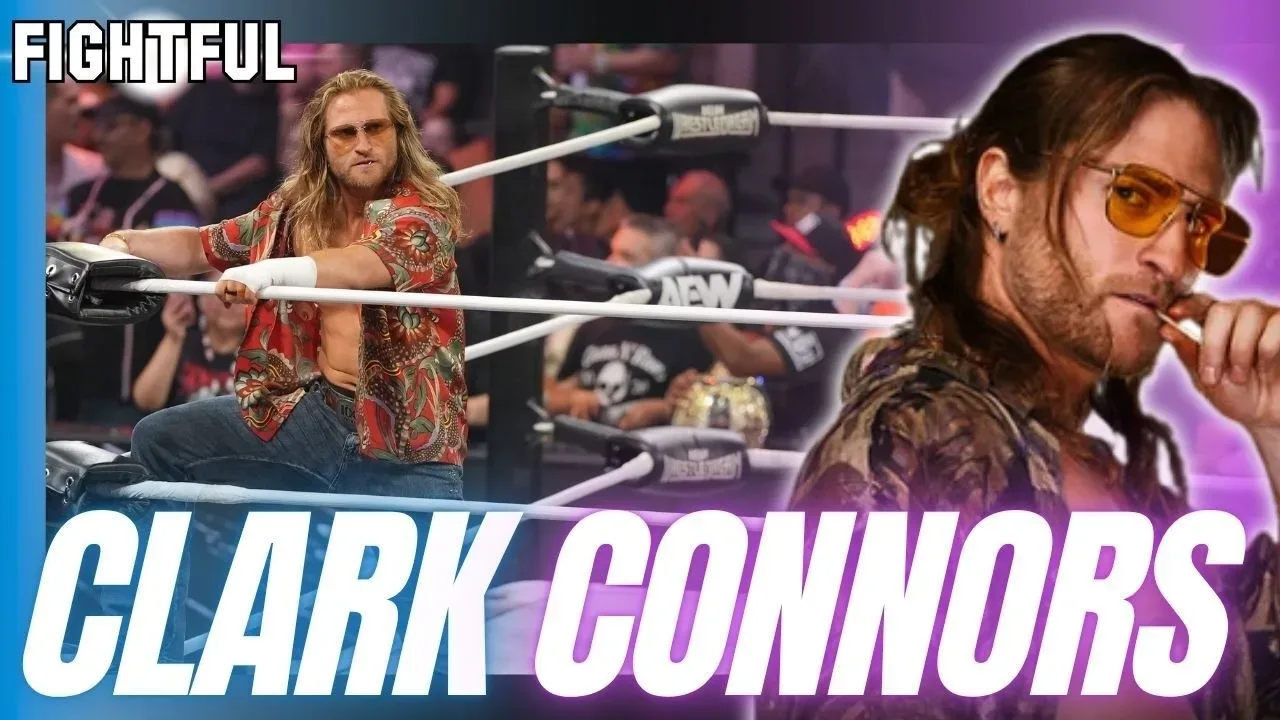
Clark Connors sees the end of NJPW of America as a difficult but understandable moment for a branch of New Japan Pro-Wrestling that helped shape a generation of talent in the United States.
New Japan recently announced that it is shutting down the NJPW of America operation and entering liquidation. The changes include the closure of its California-based training school and adjustments involving Tokon Shop Global. For Connors, who was among the original members of the L.A. Dojo and became closely identified with the NJPW STRONG period, the news carries obvious personal significance. Still, he believes the decision makes sense from a business perspective.
Connors said that he and fellow L.A. Dojo-era wrestlers Gabe Kidd, Karl Fredericks, Alex Coughlin, and Kevin Knight were deeply tied to the identity of STRONG. “You could say that I kind of was the STRONG brand for a while,” Connors said, pointing to the group of young wrestlers who helped give the U.S. expansion effort its early foundation.
That history gives Connors a firsthand view of what NJPW of America represented. The L.A. Dojo was not simply an outpost for visiting Japanese stars or a logistical base for American events. It was a developmental system that produced performers who could work within New Japan’s style and culture while also giving the company fresh faces for its U.S.-based programming. Connors emerged from that system as a hard-hitting junior heavyweight before eventually becoming part of Bullet Club War Dogs.
For more background on this topic, read NJPW x CMLL Fantasticamania 2027 Participants Revealed for Sendai and Korakuen Hall Tour.
A Defining Role in the STRONG Project
NJPW STRONG was central to New Japan’s American strategy during a turbulent period for the industry. The brand provided a platform for New Japan talent, independent wrestling regulars, and L.A. Dojo prospects, particularly as the pandemic reshaped travel and live-event operations. It also gave Connors and his peers meaningful exposure in a setting that was distinct from the main New Japan cards in Japan.
For wrestlers such as Connors, Kidd, Fredericks, Coughlin, and Knight, STRONG was more than a television label. It became a proving ground. The performers were asked to carry shows, develop rivalries, and demonstrate that the dojo system could create homegrown talent capable of moving through the wider New Japan structure.
Connors said the company had moved faster in the United States than originally planned. In his view, the California dojo opened earlier than anticipated, with the strong impression he made at his tryout contributing to that accelerated timeline. The early arrival of the dojo allowed New Japan to put resources into a group of prospects and begin building a U.S. presence with a longer-term developmental component.
That ambition, however, was met by the unprecedented disruption of the pandemic. New Japan’s ability to move talent between Japan and the United States was affected at the same time that the company was trying to establish its American infrastructure. Connors believes that interruption had a lasting impact on what NJPW of America could have become.
“If it wasn’t for the pandemic,” he said, “in my opinion, they would be so much stronger over here.”
The comment reflects the challenge faced by the company’s U.S. plans. New Japan had established major events in America, developed STRONG as a recognizable brand, and invested in the L.A. Dojo. But the pandemic created conditions that no promotion could fully control. Travel restrictions, altered event schedules, and the wider uncertainty around live entertainment all complicated the process of growing an international operation.
Connors Understands the Business Reality
Although Connors was candid about the lost potential of the American expansion, he did not portray the closure as a failure of the wrestlers or the concept behind STRONG. Instead, he framed it as a practical move by a promotion that must prioritize its core business.
“I think it’s a smart business decision on their part,” Connors said. He added that New Japan understands “where their bread is buttered,” an acknowledgment that the promotion’s primary foundation remains in Japan.
That distinction is important. New Japan’s U.S. expansion generated notable moments and created opportunities for talent, but the company’s identity, touring base, and most established operations have always been centered in Japan. The decision to close NJPW of America therefore signals a shift in how the promotion will manage its overseas ambitions rather than an indication that New Japan has ceased to be an international company.
The company has maintained a global audience for decades, and its wrestlers continue to have worldwide name value. Yet operating a separate U.S. business infrastructure, including a physical training school and related commercial functions, requires a different level of investment and long-term certainty. Connors’ remarks suggest he understands why New Japan would choose to focus its resources where it believes they can be used most effectively.
His response also avoids treating the previous era as something to dismiss. Connors said the NJPW of America run “had a great run,” a concise assessment of a period that included the rise of STRONG, the development of the L.A. Dojo class, and major U.S. events under the New Japan banner.
The L.A. Dojo’s Lasting Influence
The closure of the California training school is one of the most consequential elements of the announcement because of what the L.A. Dojo represented. The dojo was designed to cultivate wrestlers who could be prepared for New Japan’s demanding environment. It became a recognizable path for young talent hoping to build careers within the company.
Connors is among the clearest examples of that system’s impact. His time in the dojo helped establish him as a New Japan prospect, and the STRONG environment gave him a stage on which to develop a more complete professional identity. The connection is also visible in the careers of others from that class. Kidd has become a prominent name in New Japan, while Knight has continued to build his profile within the promotion. Fredericks and Coughlin were likewise significant figures during the L.A. Dojo and STRONG years.
Even with the physical school closing, the legacy of the project remains in the talent it produced and the visibility it gave to American-based performers. The L.A. Dojo did not merely bring in wrestlers for short-term appearances; it created a system whose graduates became part of the company’s broader story.
Connors’ own career provides a reminder that the end of one business structure does not erase the accomplishments made within it. He remains connected to New Japan’s world, and his progression from dojo prospect to an established figure in the War Dogs illustrates the kind of development the program was designed to facilitate.
“Never Say Never” on a Future U.S. Presence
While the liquidation announcement marks the end of NJPW of America in its existing form, Connors does not believe it necessarily closes the book on future American expansion. He stressed that professional wrestling moves in cycles and suggested the company could again build up its U.S. footprint once conditions change.
“When New Japan gets its feet under itself again back in Japan,” Connors said, “I can easily see them opening back up over here so, never say never.”
That perspective leaves room for the possibility that New Japan could revisit a more substantial United States operation at a later date. Connors did not claim that such a move is planned, nor did he offer a timetable. His point was instead that the current closure should be viewed within the changing realities of the wrestling business. Companies expand, scale back, reorganize, and pursue new strategies as their priorities and financial conditions evolve.
For now, the final NJPW of America event remains Resurgence, which took place in May 2025. Its place as the last show under that operation gives the event added historical weight, even if Connors’ comments make clear that he does not see the end of NJPW of America as the end of New Japan’s relationship with U.S. fans.
The immediate impact will be felt most strongly by those connected to the California dojo, the former STRONG ecosystem, and the business operations being wound down. But Connors’ assessment offers a measured conclusion from someone who lived through the effort from its earliest days. There is disappointment in what the pandemic may have prevented, but also appreciation for what the project accomplished.
For Connors, the NJPW of America chapter was meaningful, productive, and capable of being revisited in another form someday. The current decision may be a retreat from a particular model, but in his view, it is also a business choice that could allow New Japan to regain its footing and potentially return to the U.S. market with renewed purpose in the future.

Darryl Polo
Darryl Polo is a passionate wrestling fan covering WWE, AEW, TNA and beyond. He loves great rivalries, breakout stars and the moments that keep fans talking long after the bell. How we work.