
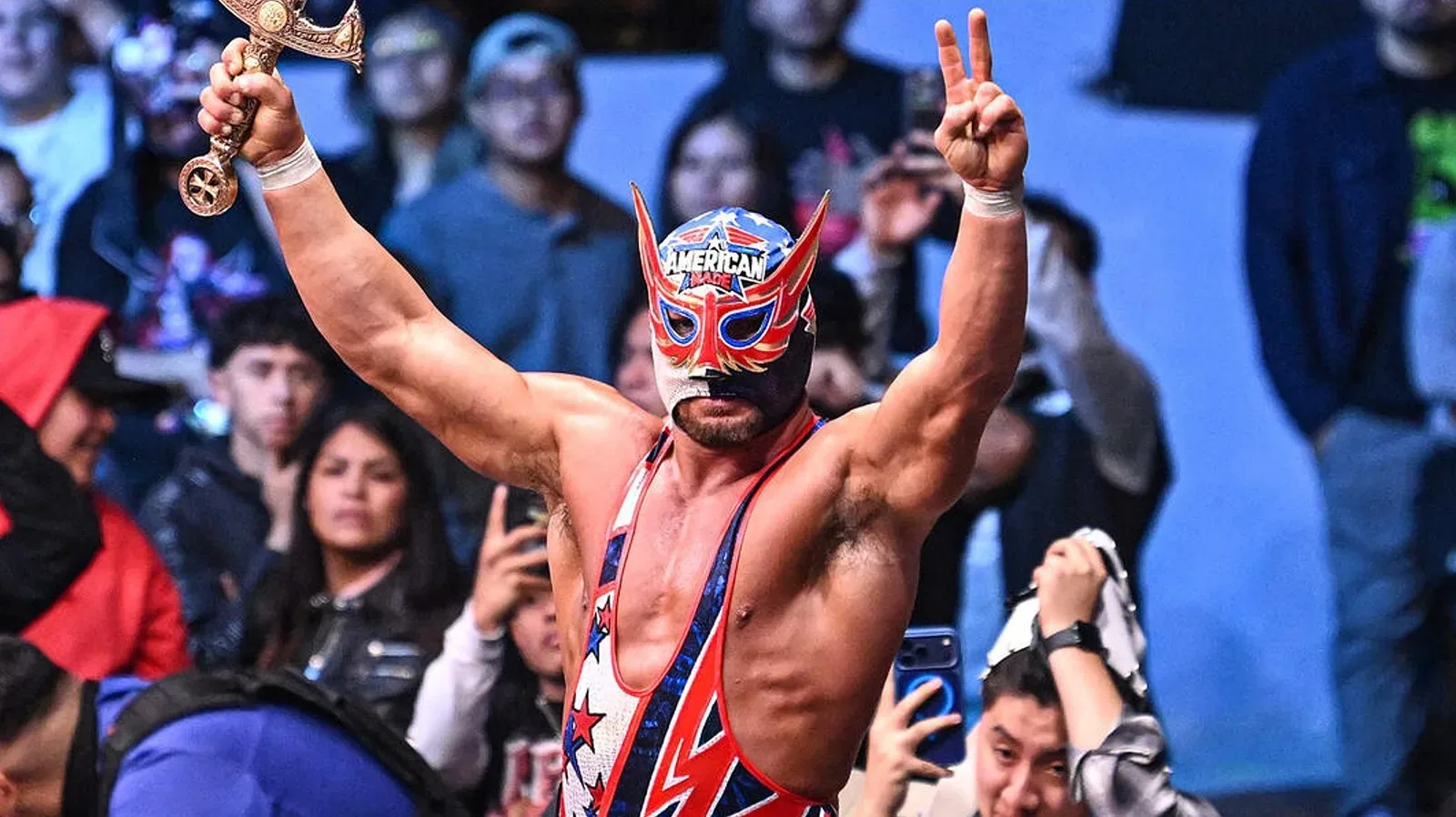
Chad Gable has opened up about the origins of El Grande Americano, explaining that the masked persona grew out of his work opposite WWE’s luchadores in 2024 and an ambition to give those rivalries a more distinctive, more personal edge.
El Grande Americano became one of the more unusual extensions of Gable’s WWE presentation: an American wrestler under a lucha-inspired mask, built as a deliberately aggravating foil for performers connected to Mexican wrestling traditions. The character carried broad visual elements and an intentionally provocative premise, but Gable has stressed that its purpose was not simply to generate laughs. In his view, the act was designed to create heat, deepen the conflict with the luchadores around him, and ultimately give those babyface opponents something meaningful to fight against.
Speaking on INSIGHT with Chris Van Vliet, Gable recalled that the idea began while he was wrestling and interacting with luchadores as himself during the fall of 2024. He felt there was further potential in the direction beyond what had already been established on television.
“I was doing some stuff with some of the luchadores in, I think, like September/October [2024] ... as Chad Gable, and I thought: ‘Man, we can get a lot out of this, I think; a lot more than we already right now. We can turn this into something special,’” Gable said on INSIGHT with Chris Van Vliet.
For more background on this topic, read Roman Reigns Reflects on WWE Frustration Before His Tribal Chief Transformation.
Gable confirmed that the initial pitch came from him. Rather than merely continuing the same rivalry dynamics under his own name, he envisioned a masked identity that could make the antagonism feel more pointed. El Grande Americano was conceived as a character who would put on the imagery associated with lucha libre while using it in a way meant to antagonize the wrestlers and culture he was targeting.
“I thought of this idea of, like, donning the mask, and kind of using it to insult their culture and get more personal with this,” Gable explained on INSIGHT with Chris Van Vliet.
A Heel Device Built Around Lucha Libre
The concept was always likely to invite a strong reaction because masks hold major cultural and professional significance in lucha libre. A mask is not simply ring gear within that tradition. It can represent identity, family lineage, regional pride, career accomplishment, and the mystique that separates luchadores from many other styles of wrestling. Building a heel persona around someone appropriating those symbols gave Gable’s character a clear source of conflict without requiring a complicated explanation.
That tension was central to the El Grande Americano idea. Gable said the intention behind the character was to use the offense as part of a wrestling story, not to diminish lucha libre itself. The broader aim was to elevate the culture by placing it at the center of a visible rivalry and by creating an antagonist who could help make the babyface luchadores more sympathetic and more important to the audience.
It is a distinction that matters when discussing a character such as El Grande Americano. The persona was meant to be disrespectful within the storyline, because that disrespect gave the opposing wrestlers a reason to pursue him. In traditional wrestling terms, the heel’s job is often to generate enough resentment that the eventual response from the babyface feels satisfying. Gable’s description frames El Grande Americano as a tool for that kind of emotional investment.
The creative process did not remain a one-person concept. Gable said WWE creative officials became involved as the character developed, and he believes their collaboration improved the original idea. That is often the point where an early performer-driven pitch has to become a fully functional television character: the visual presentation, motivations, opponents, match structure, and longer-term direction all need to work together. Gable’s comments indicate that El Grande Americano gained more definition after that collaborative process began.
Not Intended as a Pure Comedy Character
Because El Grande Americano included exaggerated elements, some viewers may have read the presentation as comedy. Gable, however, rejected the idea that the act was ever intended to be a simple “ha-ha” character. He acknowledged that it could be entertaining, but said the driving purpose was heat.
“I don’t think we ever presented it as that and that was never supposed to be the intention,” Gable said on INSIGHT with Chris Van Vliet. “Entertaining? Sure, but no it was never a ‘ha-ha funny’ type thing; I think it was kind of mean-spirited to jab at these [luchadores].”
That explanation provides useful context for the balancing act at the heart of the gimmick. Wrestling audiences can respond to an over-the-top villain while still understanding that the character’s excess is part of the reason they want to see him lose. For Gable, the ridiculous aspects were not the destination. They were part of the presentation of an antagonist whose behavior was supposed to feel insulting enough to provoke a reaction.
That approach also fits Gable’s broader strengths as a performer. He has long been recognized for technical wrestling ability, but his WWE work has also shown a willingness to embrace highly specific character choices. El Grande Americano gave him another way to combine physical credibility with a larger-than-life persona. The mask altered the visual instantly, while the premise gave each confrontation with a lucha-focused opponent a built-in issue.
Just as importantly, Gable’s remarks make clear that he saw the program as having value beyond his own character. The intent was to help raise the profile of the luchadores involved. In wrestling storytelling, an effective villain can make an opponent’s victory feel bigger by making the audience care more deeply about the conflict. Gable’s stated goal was to create precisely that type of platform for the babyfaces positioned against El Grande Americano.
The Character Continued Beyond Gable’s Injury
El Grande Americano’s story took an additional turn after Gable suffered an injury. Another version of the character emerged, portrayed by the former Ludwig Kaiser. The development allowed the identity to continue even while Gable was unavailable, preserving the mask and the concept as an active piece of the story.
The existence of a second El Grande Americano also reinforced an idea that has existed throughout wrestling history: a masked identity can become larger than the individual who first wore it. In this case, the character was initially tied directly to Gable’s vision and performance, but the later transition showed that the presentation could be used in another direction when circumstances changed.
That evolution eventually connected El Grande Americano to a major stipulation at Lucha Libre AAA Worldwide’s Noche de los Grandes, where the character was part of a Mask vs. Mask match. A mask stipulation carries especially high stakes in lucha libre, where the loss of a mask can be treated as one of the most significant defeats of a wrestler’s career. The match represented a high-profile continuation of a concept that Gable says began with a simple desire to get more from his WWE interactions with luchadores.
Gable’s account also shows how a wrestling idea can shift substantially after its first spark. What began as his own thought during a series of fall 2024 programs developed through WWE creative collaboration, became a notable masked heel identity, and later continued through a second performer after injury altered the original path.
Why the Original Motivation Matters
The most revealing part of Gable’s explanation is that he viewed El Grande Americano as a vehicle for spotlighting lucha libre, even though the character’s on-screen behavior was framed as an insult. That apparent contradiction is common to villain-driven wrestling storytelling. The heel acts in a way that is intentionally objectionable, but the narrative is structured so that the audience is encouraged to invest in the people and traditions the heel is attacking.
Gable did not present the persona as a detached parody. He described it as a means of making the rivalries more personal, more emotionally charged, and more capable of producing a payoff for the wrestlers opposite him. Whether audiences embraced every element of the character in the same way is a separate question, but his stated creative objective was clear: El Grande Americano was supposed to be an antagonist, not a punchline.
From Gable’s perspective, the mask was the mechanism that allowed the feud to move beyond standard in-ring competition. It made the issue visual before a bell even rang, immediately signaling the character’s role and giving the luchadores a target that represented more than a typical opponent. That is why the gimmick’s origins remain significant even after its evolution. The defining idea was not merely that Chad Gable would wear a mask. It was that the mask would help create a stronger wrestling story around lucha libre and the performers carrying that tradition into WWE.
In pictures

Darryl Polo
Darryl Polo is a passionate wrestling fan covering WWE, AEW, TNA and beyond. He loves great rivalries, breakout stars and the moments that keep fans talking long after the bell. How we work.