
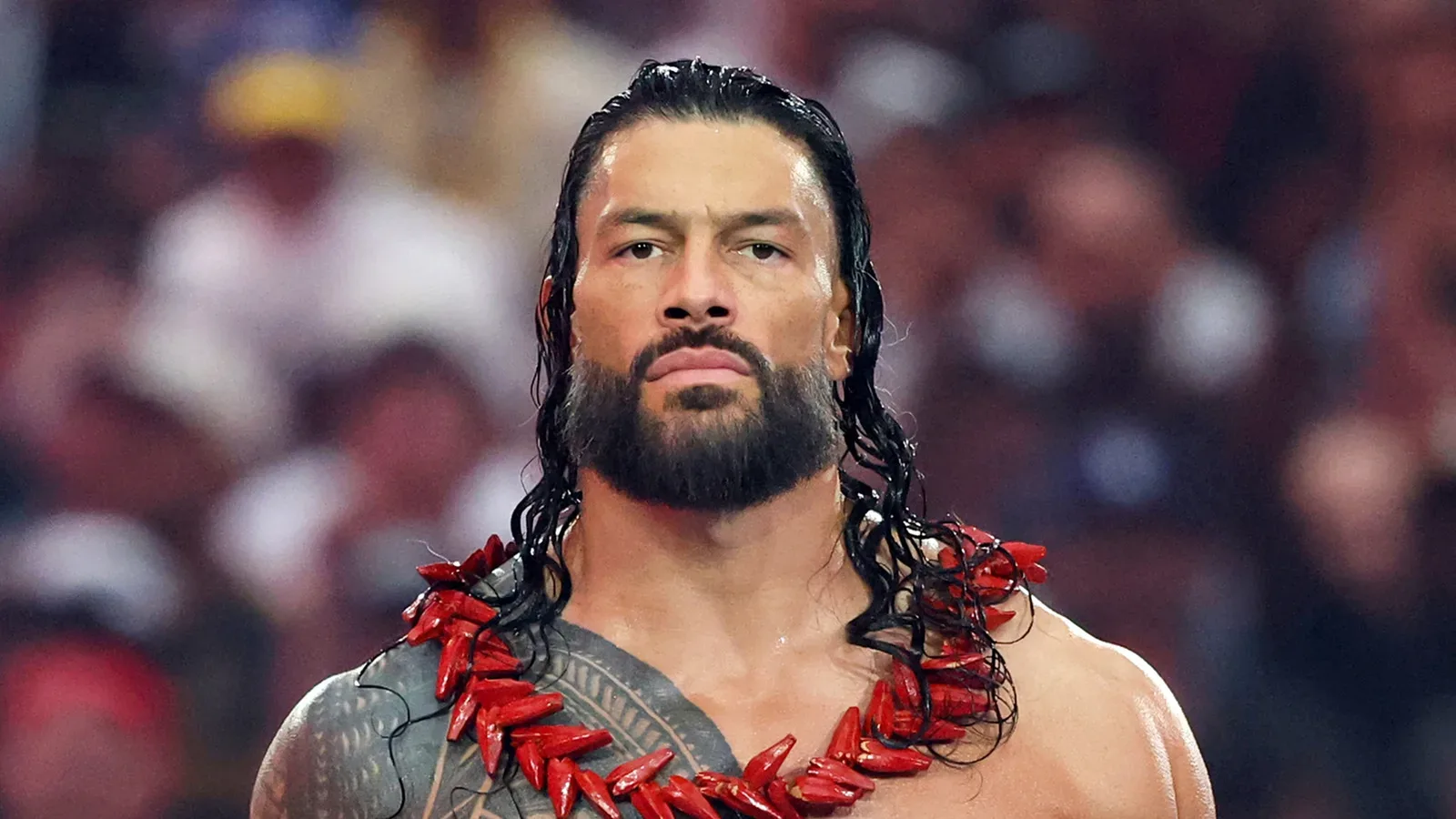
Roman Reigns has looked back on the difficult stretch of his WWE career that preceded the rise of “The Tribal Chief,” explaining that he had reached a point where he no longer felt connected to the creative direction surrounding his character.
During an appearance on notsam while promoting Street Fighter, Reigns was asked when he felt that he truly came together as a performer. His answer pointed not to one of his world-title victories, nor to his early breakout years alongside Seth Rollins and Jon Moxley in The Shield, but to the period just before the COVID-19 pandemic changed WWE’s landscape.
“It didn't click until...it was honestly before COVID hit and I left, and I had dog food all over me,” Reigns said on notsam. “It was just one of those situations where I just wasn't creatively...I just wasn't in line. I didn't like what I was doing, I didn't like the way I was portrayed. And it was just time to take complete ownership. And the proof is in the pudding.”
The comments provide a direct assessment of an era that remains one of the most debated parts of Reigns’ WWE tenure. He was unquestionably positioned as one of the company’s central stars throughout much of the 2010s, winning multiple world championships and appearing in the biggest matches on the calendar. At the same time, the presentation of Reigns as a singles babyface regularly produced divided reactions from WWE audiences.
For more background on this topic, read Stephanie Vaquer Reportedly Avoids Lengthy Absence After Ankle Injury at WWE Money in the Bank.
For Reigns, the issue was not framed as a rejection of his accomplishments. Instead, he described a creative disconnect: he did not like what he was doing and did not like how he was being portrayed. That distinction is significant given how dramatically his on-screen identity changed after his eventual return.
The long road from The Shield to a polarizing singles run
Reigns first became a major WWE figure as part of The Shield, the dominant trio he formed with Rollins and Jon Moxley. The group’s arrival immediately gave all three performers a strong platform, with Reigns often presented as the powerhouse and explosive finishing force of the unit. Their chemistry, intensity, and shared identity helped make The Shield one of the defining acts of its generation.
Once the group separated, WWE’s efforts to establish Reigns as a singular franchise-level star became increasingly clear. He was placed in major championship programs, headlined high-profile events, and collected multiple world-title reigns between 2015 and 2019. Those accomplishments made him one of the most decorated and visible names of the period.
Yet success on paper did not erase the vocal resistance he faced in arenas. Many fans objected to the forcefulness of the push and to the creative approach around his character. Reigns was often presented with the language and hero framing traditionally assigned to WWE’s top fan favorite, but a meaningful section of the audience refused to embrace that version of him.
The split reaction became a recurring part of his entrances and major matches. Supporters remained present, but boos and hostile crowd responses were also common. Reigns’ ability in the ring and his standing as a top-tier attraction were frequently evident, while the character itself often felt caught between WWE’s intended presentation and the reactions it was receiving.
That environment put Reigns in a uniquely complicated position. He was not being overlooked or denied opportunity; he was being given some of the biggest opportunities available. But his new comments make clear that opportunity alone did not make the work creatively satisfying. Reigns felt he was not aligned with the material, and the eventual changes to his career suggest he believed the answer was to assert more personal ownership over the direction of the act.
The dog food storyline became a symbol of the disconnect
Reigns specifically referenced having “dog food all over” him, an unmistakable callback to the storyline involving Baron Corbin and Dolph Ziggler near the end of 2019 and into early 2020. The feud drew substantial ridicule, particularly after an angle in which Corbin and Ziggler covered Reigns in dog food.
For many viewers, the segment became shorthand for the frustrations associated with Reigns’ presentation during that stage of his career. The issue was not simply that Reigns lost a confrontation or endured humiliation—such moments can be effective tools in wrestling storytelling when they build toward a satisfying response. The broader criticism was that the angle did not seem to match the aura of a performer WWE had spent years presenting as a top-level star.
Reigns’ recollection demonstrates that the storyline also held personal meaning for him beyond the audience reaction. In describing that period as part of the moment when things had not clicked, he connected the angle to a larger dissatisfaction with his creative position. The dog food segment was not presented as an isolated complaint; it represented a time when he felt the character on television was not the character he wanted to be.
That honesty adds context to why his later reinvention carried such force. The Tribal Chief persona did not merely offer a new nickname, new entrance music, or a new set of allies. It presented Reigns in a way that leaned into control, status, authority, and menace—qualities that gave his natural presence a far more fitting framework.
Leaving before the pandemic changed WWE
Reigns identified the period before COVID-19 hit as the point at which his outlook shifted. His departure from WWE programming created a break between the version of Reigns that had been struggling to find creative alignment and the version that would later return with a fundamentally different identity.
When Reigns came back, the change was immediate in tone. He was no longer operating as the familiar heroic figure WWE had persistently attempted to establish over the previous years. Instead, he embraced the role of a dominant antagonist, building his authority around the concept of being the head of his family and the central power in WWE.
The Bloodline storyline became the vehicle for that transformation. Reigns’ work alongside his family gave the character emotional stakes and a structure that extended beyond standard championship rivalries. The story was able to explore loyalty, manipulation, legacy, pride, and control, while Reigns’ performance brought a new degree of restraint and confidence to his promos and in-ring presence.
His statement that it was “time to take complete ownership” is especially notable in light of that evolution. Reigns did not provide a detailed behind-the-scenes account of the decisions involved, and there is no need to overstate what his remarks establish. Still, he plainly connected the success of his later work with having greater creative alignment and a stronger sense of ownership over how he was portrayed.
That is the central contrast between the two eras: the earlier run saw Reigns presented as a top star amid persistent audience resistance and creative criticism, while the later run saw him become one of the industry’s most acclaimed and commanding characters. His own view is that the turning point came when he stopped accepting a presentation that did not feel right to him.
“The proof is in the pudding”
Reigns’ final phrase was concise but telling. “The proof is in the pudding” speaks to the scale of what followed. The Tribal Chief era elevated Reigns from a polarizing focal point into a performer whose character work, major-event aura, and long-form storytelling became central to WWE programming.
The transformation also changed the conversation around him. Rather than being defined primarily by the debate over whether audiences were being asked to support him, Reigns became a figure whose authority and villainy were integral to the drama. The hostility that had once undermined the intended babyface presentation could now be channeled into reactions that supported the character’s role.
His history with The Shield, his championship résumé, and the obstacles of his singles run all remain important parts of the full Roman Reigns story. But his remarks show that he does not view every successful milestone as evidence that he had found his voice. In his telling, that clarity arrived later, after frustration had built and after he recognized that he needed to be more fully invested in the version of himself WWE presented to the world.
For a star who spent years at the center of WWE’s biggest debates, the Tribal Chief transformation remains a powerful example of how much can change when performer, character, and audience response begin moving in the same direction. Reigns’ own reflection makes the contrast even sharper: before the shift, he did not like the work or the portrayal. After taking ownership, he believes the results spoke for themselves.
In pictures

Darryl Polo
Darryl Polo is a passionate wrestling fan covering WWE, AEW, TNA and beyond. He loves great rivalries, breakout stars and the moments that keep fans talking long after the bell. How we work.