
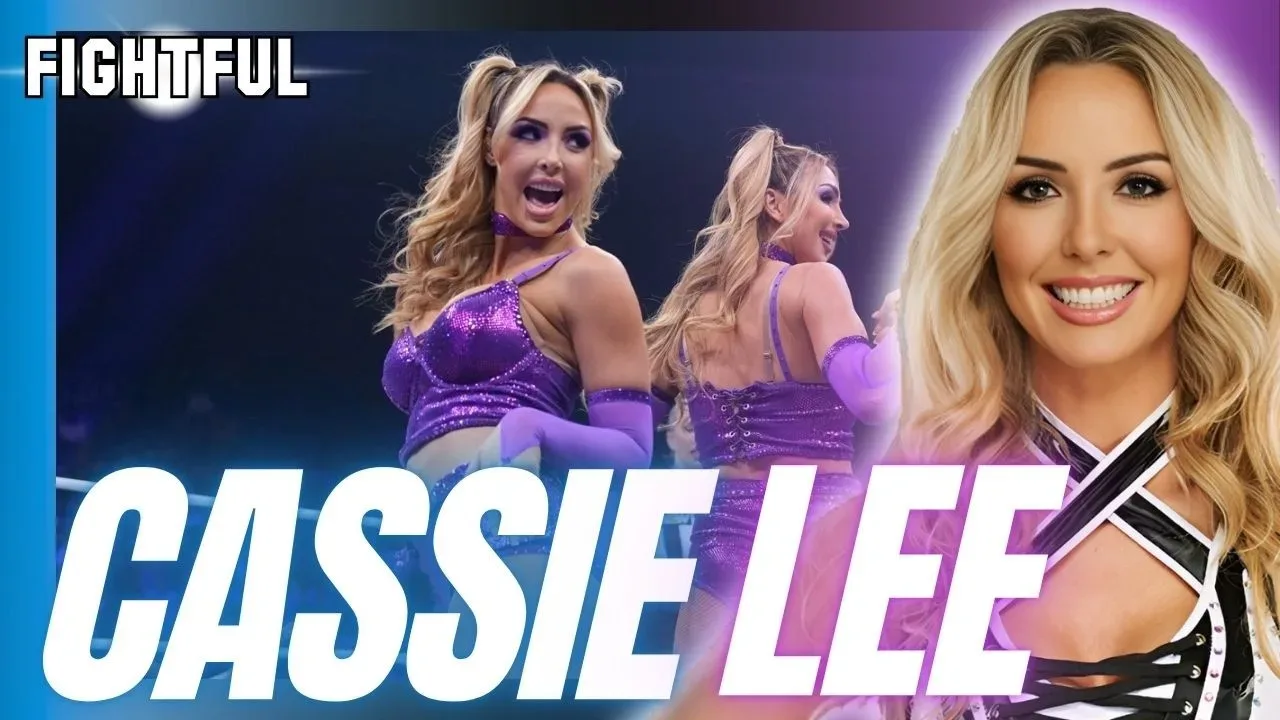
Cassie Lee has made her feelings about tag team wrestling and her partnership with Jessie McKay unmistakably clear: she does not see anyone else filling that role.
During a recent interview, Lee was asked to consider a difficult hypothetical — who she would choose as a tag team partner if McKay were unavailable. Rather than naming another wrestler, Lee rejected the premise entirely and stressed that McKay is the only person she would want beside her in a tag match.
“Oh, shit. There wouldn’t be anyone else. That’s an interesting question because I love tag team wrestling, but I wouldn’t want my tag partner to be anyone else but her.”
The answer was brief, but it spoke to the bond Lee and McKay have established through years of working together. Since Lee debuted in 2015, the pair have competed in hundreds of tag team matches across several major promotions, including WWE, TNA, AEW, and Ring Of Honor. In an industry where alliances, rosters, and creative directions can change quickly, their connection has remained the defining element of Lee’s tag team identity.
For more background on this topic, read Booker T Details How Michael Cole, Shawn Michaels and NXT Shaped His Commentary Career.
A partnership built around familiarity
Tag team wrestling requires a level of trust that is different from the relationship between two wrestlers who simply happen to share the ring on the same night. Partners need to understand timing, positioning, momentum shifts, and the small decisions that can determine whether a sequence succeeds. They also have to present a united identity to an audience, both inside the match and outside it.
Lee’s response indicates that her connection with McKay goes beyond finding a compatible in-ring partner. She described herself as someone who loves tag team wrestling, but her enthusiasm for the format is directly tied to the person with whom she has spent so much of her career competing. The answer was not that another partner would be impossible to find in a literal sense. Instead, Lee made clear that she would not want to replace the relationship she has built with McKay.
That distinction matters. Wrestlers regularly move between singles competition, temporary teams, factions, and rivalries. Tag partnerships can also be affected by promotion changes and shifting opportunities. Lee’s comments show that, for her, the appeal of tag team wrestling is inseparable from the history she shares with McKay.
Years of experience across multiple promotions
Lee and McKay’s shared history stretches across a significant period of modern wrestling. Having worked together in WWE, TNA, AEW, and Ring Of Honor, they have had the chance to bring their partnership to different locker rooms and in front of different audiences. Every promotion has its own presentation, style, roster makeup, and expectations, but the continuity of their pairing has given them a foundation wherever they have appeared.
That type of experience can be particularly valuable for a tag team. Repetition is not merely about accumulating matches; it can create an instinctive feel for one another’s movement and rhythm. The more frequently partners work together, the more naturally they can react when a match changes direction. That familiarity can translate into cleaner exchanges, more confident double-team sequences, and a stronger ability to tell a story through the structure of a match.
Lee did not attempt to list alternatives or turn the question into a comparison among potential partners. Her immediate reaction underscored how fully she identifies McKay as her teammate. For fans who have watched the two perform together across promotions, that answer reflects the consistency of a partnership that has endured through different stages of their careers.
Why the answer stands out
Hypothetical questions are common in wrestling interviews because they invite performers to discuss dream opponents, possible teams, or matches that have not happened. Lee’s answer stood out because she did not frame the question as an opportunity to choose from a long list of talented wrestlers. She instead used it to affirm the partnership already in place.
There is also a notable emotional honesty in the way Lee responded. Her initial reaction was spontaneous, before she explained her position more directly. She acknowledged her love of tag team wrestling, then immediately connected that love to McKay. The statement was not a broad claim about being unwilling to work with anyone else under any circumstances; it was a personal expression that McKay is the partner she wants.
For a team that has wrestled together hundreds of times, the sentiment carries more weight than a routine endorsement. Their extensive match history gives Lee’s words a clear context. She is speaking about a partnership shaped by real experience in the ring, not simply a pairing built around a short-term storyline or a one-off alliance.
Tag team wrestling remains central to Lee’s perspective
Lee’s comments also reinforce how strongly she values tag team wrestling as a discipline. The format can give wrestlers opportunities to display chemistry and character dynamics that are not always available in singles competition. A team can create suspense around tags, isolate an opponent, use tandem offense, and build its identity around the contrast or connection between two performers.
For Lee, the format has clearly been a major part of her career since her 2015 debut. Her remarks suggest that she does not view being in a tag team as a secondary role or a fallback from singles wrestling. Instead, she spoke of tag team competition with genuine affection, while emphasizing that the right partnership is what makes it meaningful for her.
McKay is therefore not presented as merely one possible half of a duo. She is the person Lee associates with that entire aspect of her wrestling career. Their shared work across WWE, TNA, AEW, and Ring Of Honor has allowed that association to become especially durable.
Lee also discusses her Fisherman’s Suplex
Elsewhere in the interview, Lee addressed the origin of her signature Fisherman’s Suplex. While her comments about McKay centered on their partnership, the discussion of the move offered another look at an element of Lee’s individual in-ring presentation.
Signature offense is an important part of how wrestlers establish a recognizable identity. A move can become a visual calling card, particularly when it is consistently used at key moments in a match. Lee’s Fisherman’s Suplex is one of the techniques associated with her work, and her discussion of its origin adds another layer to the way she approaches her performance.
The combination of topics — her defining tag partnership and a signature move — captures two connected sides of Lee’s career. She has developed a clear identity as an individual wrestler, while also building an enduring legacy alongside McKay. Those qualities do not conflict with one another. Instead, they help explain why Lee can speak so passionately about both her own in-ring style and the teammate with whom she has shared so much history.
No hesitation from Lee
Ultimately, Lee’s response left little room for ambiguity. Asked to name another possible partner, she said there would not be one. Her reasoning was equally direct: she loves tag team wrestling, but she does not want that role to belong to anyone other than Jessie McKay.
In a business often defined by change, that level of certainty is notable. Lee and McKay have worked together in multiple promotions and accumulated hundreds of tag matches since Lee’s 2015 debut. Lee’s latest comments make clear that she sees their partnership as more than a chapter of her career. It remains the standard by which she measures the idea of having a tag team partner at all.

Darryl Polo
Darryl Polo is a passionate wrestling fan covering WWE, AEW, TNA and beyond. He loves great rivalries, breakout stars and the moments that keep fans talking long after the bell. How we work.