
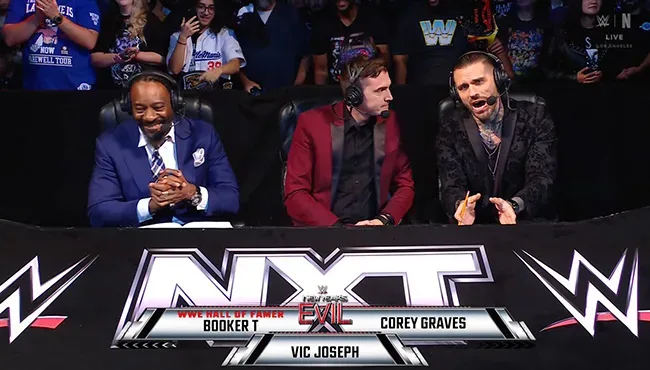
Booker T has become one of the most recognizable voices in WWE NXT, bringing the same energy, unpredictability and larger-than-life personality that defined his Hall of Fame in-ring career to the broadcast desk. But the path from former world champion to color commentator was not a carefully plotted post-wrestling plan. As Booker explained in a recent interview, it began as a way to entertain fellow wrestlers while traveling with WCW and later WWE.
Long before he was calling Trick Williams entrances or providing the soundtrack for Stephanie Vaquer's Devil's Kiss, Booker was informally doing play-by-play behind the scenes. He recalled sitting in front of monitors during overseas tours and narrating matches for the wrestlers around him, often inventing names for moves and taking his delivery to intentionally outrageous places.
“This thing goes back to WCW,” Booker said. “Every time we were on the road overseas, I was the commentator in the back for the boys, in front of the monitor. I just would be having fun, and I would give guys different names; I would name their moves totally different names. I would just be way over the top with it.”
That habit continued when Booker arrived in WWE. At the time, it was simply a way to pass long hours on the road and make his peers laugh. However, it caught the attention of someone whose faith would prove pivotal to Booker's second career: Michael Cole.
For more background on this topic, read WWE Reportedly Has No Urgent Timeline to Reveal WrestleMania 43 Date in Saudi Arabia.
Michael Cole's confidence opened the door
As Booker approached the latter stages of his in-ring run, Cole approached him about joining WWE's commentary team. Booker admitted that his first reaction was skepticism. The idea of being a full-time announcer was far removed from the spontaneous commentary he had supplied for colleagues backstage, and he did not initially believe he was equipped for the assignment.
“How would you like to start doing commentary and get on the commentary team?” Booker recalled Cole asking. His immediate response was, “What are you talking about? I can’t do that.”
Cole felt differently, and Booker credited him as the key figure in putting him on television as an announcer. Booker said Cole continued to trust him even through early mistakes that made the transition feel daunting. One memorable error occurred when Booker accidentally used profanity during a live broadcast while saying he wanted to see a fight. He said he did not even realize what he had said until Cole questioned him in his headset.
For Booker, those moments underscored how steep the learning curve could be. He knew he would make mistakes and expected that WWE would eventually decide he was not ready for the position. When he was removed from the Raw and SmackDown commentary teams and retained for kickoff-show duties, he said the decision actually brought relief rather than disappointment.
“I was so happy that day,” Booker said, noting that Corey Graves was surprised by his reaction. “I just knew I wasn’t ready for that.”
Booker later returned to commentary, was taken away from the desk again, and ultimately found the role that has suited him best with NXT. The journey reflects an unusual professional evolution: a performer with elite wrestling instincts learning an entirely different craft in public, with Cole's belief giving him the room to grow.
NXT gave Booker T room to sound like Booker T
The difference between Booker's earlier main-roster work and his current NXT role, in his view, is creative freedom. He recalled an experience from the Vince McMahon era in which he was instructed through his headset to say the phrase “much to his chagrin.” Booker said he did not know what the word meant at the time and worried that using a phrase so unlike his natural vocabulary would undermine the persona and authenticity that had connected him with audiences.
That concern has not followed him to NXT. Booker said Shawn Michaels' direction was straightforward: be himself. The instruction allowed Booker to lean into his own cadence, reactions and unique turns of phrase rather than attempting to fit a more rigid template.
After Booker's first night calling NXT, he recalled Michaels telling him, “Man, I don’t know what you were saying, but I liked it.” For Booker, that response was a sign that he had landed in the right environment.
The freedom is not just about delivering entertaining reactions. Booker views NXT as a place where his experience can directly benefit developing wrestlers. A former student of wrestling who now teaches and mentors through his Reality of Wrestling operation, Booker said he enjoys helping younger talent understand the strategic side of their profession.
“I’m a teacher at heart,” Booker said. “I love teaching and explaining and trying to get you to understand.”
That perspective also influences his analysis. Booker said it can be difficult to sharply critique established main-roster wrestlers, who are expected to perform at a polished professional level. NXT, on the other hand, is a developmental setting where mistakes are part of the process. He believes he can identify errors, explain what went wrong and help younger wrestlers improve from a place of firsthand understanding.
Booker compared wrestling development to chess, emphasizing that success is not about blindly moving forward. A wrestler needs awareness, timing and strategy to become truly effective. That philosophy comes through in his calls, even when his delivery is at its most animated.
Vic Joseph and the art of knowing when to let a moment breathe
Booker's NXT partnership with Vic Joseph has become central to the sound of the brand. Booker called Joseph “the maestro,” praising his broadcast partner for directing the flow of the show and recognizing when commentary needs to step back. Their chemistry is especially evident during entrances and signature moments, when an organic reaction can sometimes do more than a perfectly timed statistic or line of analysis.
Booker cited the emergence of Trick Williams as a major example. Recalling one particular entrance, Booker said he was unusually energized after coffee and two espressos, while the building itself was already hot. When Williams appeared, Booker began reacting with a stream of “What?” and “Yeah!” calls, continuing to talk him all the way to the ring.
Once the music ended, Joseph told him to repeat the approach every week. The result became part of Williams' presentation and helped turn his entrance into one of NXT's most participatory crowd experiences.
Booker stressed that Joseph deserves significant credit for making those moments work. While Joseph may receive praise from Booker for allowing him room to operate, Booker believes his partner has developed into one of the strongest commentators in WWE when given the opportunity.
He compared Joseph's career timing to that of Joey Styles, another announcer Booker admires. Styles excelled as the singular voice of ECW but found himself in a different situation after joining WWE. Booker believes Joseph's earlier WWE run simply came at the wrong moment, before he had fully had the chance to season himself and refine his craft.
Booker said his goal alongside Joseph is not to compete for attention. Instead, he wants to give Joseph space and responsibility, while avoiding some of the more formal announcing duties himself. “I don’t try to share the spotlight,” Booker said. “I want to give them all the spotlight, as well as all the responsibility, because I don’t want to do no reads.”
Why Booker T's calls are built around the talent
Booker's voice is often as memorable as the moves he reacts to. His call for Stephanie Vaquer's Devil's Kiss, punctuated by “Ah, ah, ah,” has generated discussion among viewers, but Booker sees it as an extension of a lesson he learned during his wrestling career: a great moment needs a soundtrack.
He pointed to the Spinneroonie as the clearest example. Booker said the move did not fully become his signature until Mark Madden gave it an enthusiastic name and reaction. Once audiences had a label and an audible cue to associate with it, they began to embrace it more deeply.
“Spinneroonie wouldn’t have been the Spinneroonie” without that reaction, Booker said. “I didn’t know the Spinneroonie was my signature” until it was presented that way.
He applied the same thinking to Vaquer. Booker believed her move needed an easily recognizable sound that fans could follow and eventually repeat. He acknowledged that some people initially questioned the call, but he argued that the intention was always to add emphasis to Vaquer's presentation and give audiences another way to invest in what they were seeing.
For Booker, the ultimate test is whether the crowd embraces it. If an arena begins joining in, and the reaction becomes part of a wrestler's identity, then the call has done its job. His philosophy remains rooted in helping performers get over rather than making the broadcast about himself.
“Everything I do,” Booker said, “everything is all for the talent. It’s all for the young talent to get over.”
That mission has made Booker T a natural fit for NXT. He brings veteran perspective, an unfiltered voice and a willingness to make every entrance, maneuver and breakthrough moment feel bigger. After initially fearing he was not ready for commentary, Booker has built a role that draws on the same instincts that made him one of wrestling's most charismatic performers. Every “What?” and every excitable reaction is part of an effort to make the next generation feel like stars.

Darryl Polo
Darryl Polo is a passionate wrestling fan covering WWE, AEW, TNA and beyond. He loves great rivalries, breakout stars and the moments that keep fans talking long after the bell. How we work.