
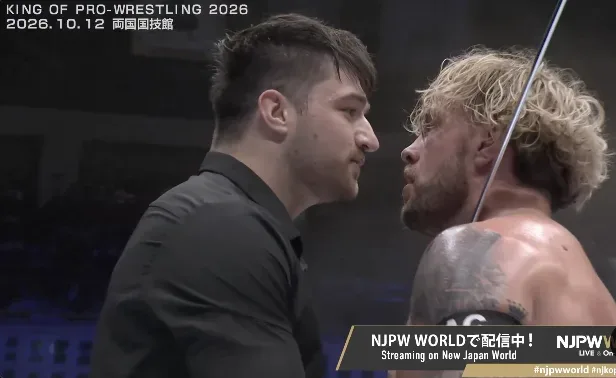
Callum Newman has voiced his frustration over the growing AEW presence around New Japan Pro-Wrestling programming as Wrestle Kingdom 21 approaches, stressing that he believes established stars should not view NJPW as an easy route to major matches in Japan.
Kenny Omega, Jon Moxley, MJF and Will Ospreay have all appeared on recent NJPW shows to build toward future New Japan matches. The prospect of several high-profile AEW names being involved around Wrestle Kingdom 21 has created considerable attention, but Newman made clear that the situation does not sit comfortably with him.
Newman framed his criticism around the work required of wrestlers who come through New Japan’s system and spend time on the road with the promotion. While he said he is not personally resentful toward the AEW wrestlers involved, he argued that their existing visibility in another major promotion should not automatically translate into top-level positioning in NJPW.
Newman Says NJPW Is Not an “Easy In”
Speaking to NJPW, Newman said his issue is rooted in what he sees as an imbalance between wrestlers who endure the daily demands of the New Japan environment and outside names who can arrive for a major bout with little time spent working the company’s schedule.
For more background on this topic, read Callum Newman Says Will Ospreay Formed U.S. United Empire Group Without Telling Him.
“I’m not salty about them, I just feel angry because when their wrestlers want to make a name for themselves in Japan, they feel NJPW is an easy in for them just because they have AEW on their resume.”
For Newman, the reputation attached to an AEW résumé is not a substitute for proving oneself in New Japan. His comments point specifically to the distinction between being a recognizable international name and taking part in the routine that defines the promotion for many of its regular wrestlers.
“New Japan is not that easy.”
That statement sits at the center of Newman’s argument. NJPW has long placed significant value on its dojo structure, its touring calendar and the ability of wrestlers to establish themselves before reaching the biggest stages. For a performer who has built his identity within that setting, the chance for a visiting wrestler to step directly into a featured position can naturally be a point of tension.
Newman highlighted the wrestlers training in the dojo and working toward their place on the roster. He argued that it is difficult to watch talent who have put in that effort compete for opportunities while a wrestler from AEW can enter the picture for a major event almost immediately.
“For all the people who do all the squats in that Dojo every day to get here, an AEW wrestler who can hop, skip and jump their way into a main event rubs me the wrong way.”
The comments are not presented as a dismissal of the ability of the AEW names expected to be involved. Rather, Newman’s concern is about the process and about who carries the workload across the calendar. His position is that earning a prominent NJPW spot should involve more than arriving with a major-company profile.
The Demands of a Full Tour
Newman also focused on the difference between making a special appearance and participating in a full New Japan tour. A marquee match can draw attention and create a major attraction for a card, but his point is that it does not expose a wrestler to the same physical and logistical demands facing the talent who remain on the road throughout a tour.
He said many of the wrestlers coming in from AEW only work a single event rather than committing to an extended run of dates.
“Because most of those guys as well, they only come in to do one show. They never do a full tour, never know how hard touring actually is.”
Newman described a schedule in which an outside wrestler can travel in shortly before a show, wrestle, and then leave again. In his view, that arrangement means they do not experience the full grind that New Japan regulars are expected to handle.
“They fly in day before, do a match and fly back home. That’s it. I don’t think they get the schedule.”
The distinction Newman is making is important in the context of NJPW’s identity. Major events such as Wrestle Kingdom are often the destination for stories and rivalries built over time, but the promotion’s broader rhythm is shaped by tours and the wrestlers who appear repeatedly as those programs develop. Newman’s argument is that the work away from the biggest cards matters just as much as the match that takes place under the brightest lights.
His remarks also underline why an outside star’s rapid ascent on an NJPW card can be viewed differently by those who have spent months or years building their standing in the company. A one-night appearance can be an attraction for fans, yet it can also raise questions about how opportunities are distributed among wrestlers who are present for the entire schedule.
A Criticism That Includes Former NJPW Standouts
The potential Wrestle Kingdom 21 involvement of Omega, Moxley and Ospreay carries an added layer because all three have substantial history in New Japan. They are not simply wrestlers with no previous connection to the promotion.
Omega, Moxley and Ospreay are all former IWGP Heavyweight Champions, and all three have competed in the G1 Climax. Omega and Ospreay were also the leading gaijin stars in NJPW before later moving to AEW. That history gives their possible returns a different context from a completely new crossover appearance.
At the same time, Newman’s comments indicate that past accomplishments do not erase his concern over the present-day structure of those appearances. His objection is not based solely on whether a wrestler has ever paid their dues in New Japan. Instead, he is emphasizing the realities of the current roster and the responsibility of working tours now.
That makes his viewpoint more nuanced than a simple criticism of outside involvement. Omega, Moxley and Ospreay each have credentials in NJPW, including experience in one of the promotion’s most demanding tournaments. But Newman is arguing that a return for a major attraction is fundamentally different from being part of the week-to-week touring environment.
MJF’s appearances also add to the wider AEW presence being established on NJPW programming. With multiple AEW figures showing up to set up future matches, Wrestle Kingdom 21 is positioned to have a notable crossover element. That can create high-profile matchups and conversation, but Newman has made clear that he sees a potential cost if regular NJPW talent are moved aside in the process.
What Newman’s Comments Mean Heading Toward Wrestle Kingdom 21
Newman’s comments reflect a familiar competitive tension in professional wrestling: the value of a major outside attraction versus the expectations of wrestlers who are present for every tour, every road show and every step of a company’s internal climb. NJPW’s ability to bring in recognizable AEW talent may increase the scale of Wrestle Kingdom 21, but it also puts focus on the wrestlers looking to secure their own defining opportunities.
For Newman, that tension is personal because he identifies strongly with the standards and effort associated with New Japan. His message is that NJPW should not be viewed as a place where a wrestler can automatically access a main-event role simply because they are already prominent elsewhere.
There is no indication in Newman’s remarks that he is questioning the individual talent of Omega, Moxley, MJF or Ospreay. His frustration is directed at the perceived ease with which an AEW wrestler can enter a major NJPW program and the limited amount of touring that may accompany those appearances.
As Wrestle Kingdom 21 continues to take shape, those concerns will remain part of the conversation surrounding AEW’s involvement. The announced and teased appearances bring star power, history and the possibility of major matches. Newman, however, is speaking for the perspective of those who believe the road to New Japan’s biggest stage should be defined by more than a brief return or a single high-profile booking.
His stance is straightforward: NJPW is demanding, its touring schedule matters, and the wrestlers who commit to that system deserve to have their work recognized when the promotion’s largest events are assembled.

Darryl Polo
Darryl Polo is a passionate wrestling fan covering WWE, AEW, TNA and beyond. He loves great rivalries, breakout stars and the moments that keep fans talking long after the bell. How we work.