
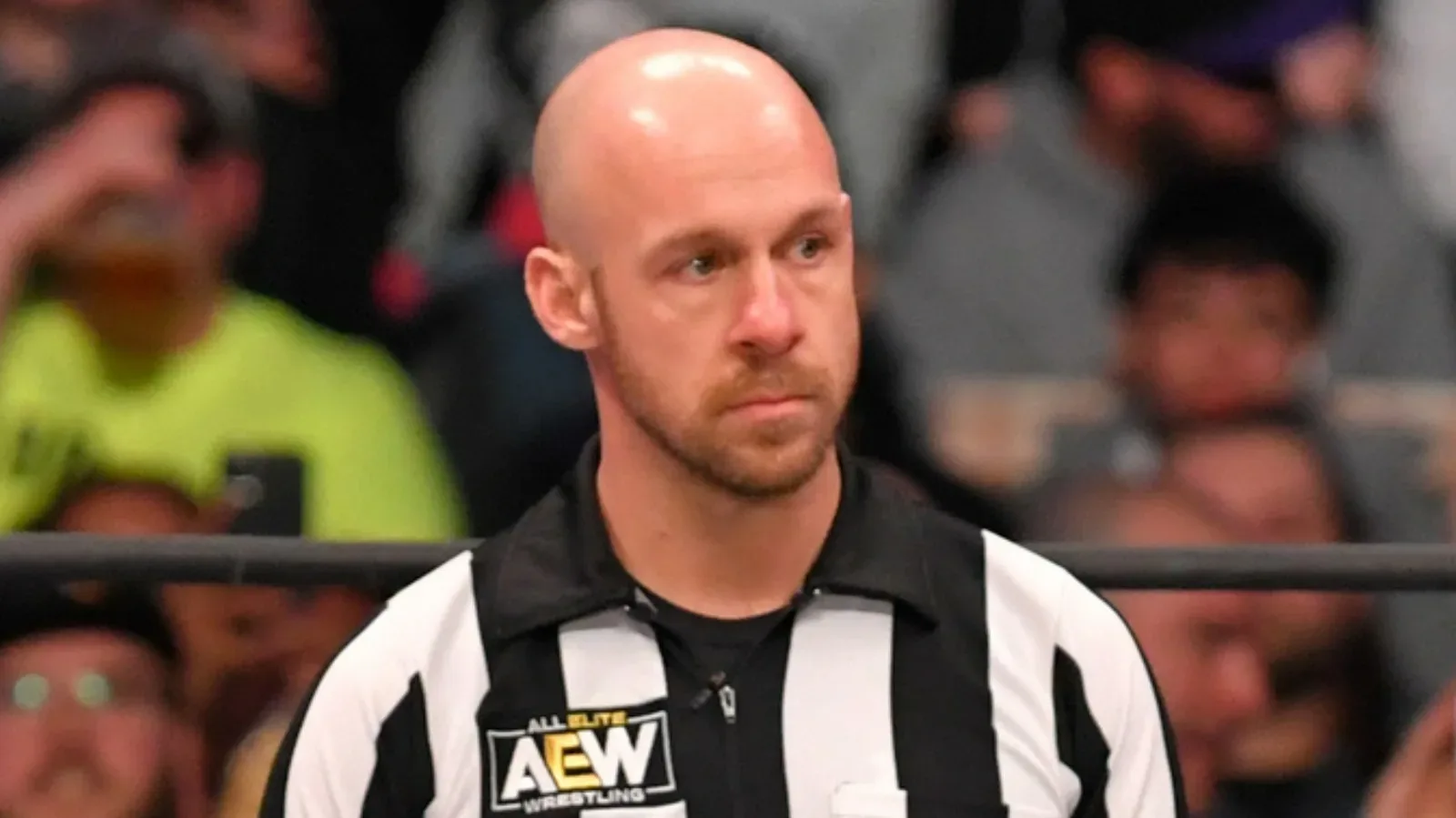
Bryce Remsburg had already built one of the most recognizable reputations among independent wrestling referees by the time All Elite Wrestling launched in 2019. Yet even after 17 years working events across the independent scene, Remsburg says stepping into AEW’s televised environment demanded a major adjustment.
Remsburg has been part of AEW since the first Double or Nothing in May 2019, becoming a consistent member of the promotion’s officiating crew while also working as a travel manager. His visibility in the company has made him one of the referees most familiar to AEW viewers, whether he is enforcing the rules, guiding the action through a complicated closing sequence, or helping keep a live television match on schedule.
During an appearance on The Certified Mark Show, Remsburg explained that his experience before AEW was valuable but did not make the transition effortless. He compared his lengthy independent career to completing an undergraduate education, with AEW representing a more advanced stage of professional development.
“Refereeing on the independents and refereeing on television for AEW are two different beasts,” Remsburg said. “I did seventeen years on the indies from 2002 to 2019. And I feel like I had kind of gotten my bachelor’s degree. But when AEW started, just really, I began my master’s program.”
For more background on this topic, read Billy Gunn Reflects on Austin and Colten’s AEW Paths, From Family Feuds to Pride.
That distinction is important when considering the referee’s role in a nationally televised wrestling promotion. At an independent event, an official must still make judgments, maintain the pace of the bout, communicate with wrestlers, and preserve the structure of the match. Those responsibilities do not disappear on television. Instead, they are joined by another layer of duties tied to production timing, camera needs, commercial breaks, and coordination among multiple people behind the scenes.
For Remsburg, the most significant change was the constant communication available through an earpiece. While officiating an AEW match, he can receive direction from company president Tony Khan, agents, and television producers. That gives an official access to information that is generally not part of the traditional independent-wrestling environment, but it also means processing instructions while remaining focused on the action directly in front of him.
Communication Changes the Job
Professional wrestling referees are often expected to be almost invisible when a match is unfolding smoothly. They need to be close enough to react to pinfalls, submissions, rope breaks, and out-of-ring action, but they also need to avoid blocking performers or drawing attention away from the story being told. On a televised broadcast, that balancing act becomes even more precise.
A referee may be responsible for positioning around the cameras, responding to a planned moment at the correct time, relaying information to talent, and making sure a finish is executed cleanly. In a promotion such as AEW, where bouts can feature quick pacing, multiple participants, dives to the floor, weapons, ringside personnel, or extended sequences of near-falls, maintaining control of the match while listening to production communication is a demanding task.
Remsburg said the earpiece initially made it difficult to stay fully grounded in the match itself. Being instructed and speaking during a bout was a new part of the job, and he did not immediately feel completely comfortable with the process.
“It took me a while to feel like I was being present in the moment because I was hearing things and talking,” Remsburg said.
That candid assessment underlines a reality of television wrestling that is rarely obvious to viewers. The action inside the ring is only one part of a larger live production. A referee’s performance must fit within that production without appearing mechanical or distracted. The official still has to sell urgency when a wrestler is fighting to beat a count, deliver an emphatic three-count when the finish arrives, and respond credibly when order breaks down. At the same time, the person in stripes may be receiving information that affects what needs to happen next.
Independent wrestling gave Remsburg a substantial base to build from. Seventeen years in that environment meant learning how to work with a broad range of wrestlers, styles, venues, and crowd sizes. It also meant developing instincts, composure, and an understanding of how an official contributes to the presentation of a match. But AEW required him to apply those skills in a setting where the show was being assembled in real time for a television audience.
AEW’s Early Television Period Became a Turning Point
Remsburg identified the period after the COVID-19 pandemic halted normal live-event operations as a particularly meaningful part of his evolution in AEW. Before the pandemic, the company had presented 23 weeks of Dynamite. When AEW moved to shows without crowds, including taped episodes in Jacksonville, the altered circumstances gave him more space to become comfortable with the specific demands of television refereeing.
He was careful not to frame the pandemic itself positively. Instead, Remsburg pointed to the unusual work environment that followed as an opportunity to improve his confidence in the role.
“It definitely...I am not saying that a global pandemic was a good thing in any shape, way, or form. But I will say we did 23 weeks of ‘Dynamite’ before COVID happened and we went to no crowds,” Remsburg said. “And then doing those ‘Dynamite’s’ in front of no crowds, sometimes they were taped in Jacksonville, really gave me an opportunity to start feeling confident for refereeing for television.”
Empty-arena and limited-attendance wrestling changed the experience for everyone involved. Without a crowd supplying noise and momentum, performers and officials had to adapt to a different atmosphere. The production side of the presentation also carried increased importance, as television became the primary connection between promotions and their audiences during that period.
For a referee who was still acclimating to headset communication and a nationally televised rhythm, the environment apparently provided useful repetition. Working television on a regular basis, even under extraordinary circumstances, allowed Remsburg to strengthen the habits needed to manage a match while remaining connected to the people producing the program.
An Often Overlooked Part of the Broadcast
Remsburg’s comments offer a useful look at an element of wrestling that is frequently taken for granted. Fans can see the referee count a fall or signal for a bell, but much of an official’s work happens in the small decisions between those obvious moments. Positioning, timing, communication, awareness of the clock, and maintaining the intended flow of the contest all influence how a match is received.
On the independent circuit, referees often operate with fewer production resources and a different set of logistical concerns. The stakes can still be high, particularly in a close-knit locker room or before a passionate local audience, but the workflow differs from a live weekly television broadcast. In AEW, the referee is part of a broader operation involving wrestlers, agents, producers, camera crews, commentary, and company leadership.
Remsburg’s “master’s program” comparison does not diminish independent wrestling. Rather, it speaks to the difference in the skills required at each level. His years from 2002 through 2019 prepared him to take the opportunity with AEW, while the promotion’s television structure forced him to add new tools to his approach.
That process is also a reminder that longevity in wrestling does not eliminate the need to adapt. Even established officials can find themselves learning an entirely new way of performing their role when the setting changes. For Remsburg, the shift from independent events to AEW did not simply mean working on a bigger platform. It meant learning how to function within the relentless communication and precision of live television.
Now a familiar part of AEW’s referee crew, Remsburg can look back on that early transition with a clearer understanding of what made it difficult. His experience shows why a referee’s job extends far beyond what appears on screen: the best officials make a complicated production assignment look natural, all while helping the wrestlers remain the focus of the match.
Quotes from Bryce Remsburg’s appearance on The Certified Mark Show.
In pictures

Darryl Polo
Darryl Polo is a passionate wrestling fan covering WWE, AEW, TNA and beyond. He loves great rivalries, breakout stars and the moments that keep fans talking long after the bell. How we work.