
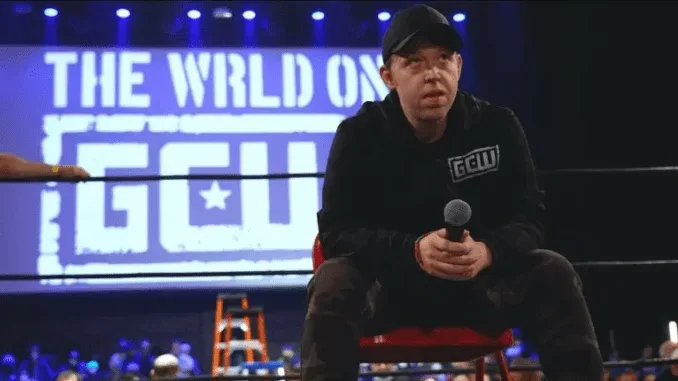
Game Changer Wrestling promoter Brett Lauderdale has offered a sharp public criticism of Major League Wrestling’s approach to talent contracts, arguing that performers—particularly younger wrestlers—have little reason to sign with the company under the terms he described.
Lauderdale’s comments came after discussion of an apparent roster evaluation within MLW. The promotion is reportedly considering which contracts to renew while examining viewership information from Tubi, with the objective of creating payroll flexibility for one or two more significant free-agent additions rather than retaining multiple mid-level talents.
In response, Lauderdale took issue not only with the number of MLW tapings he believes the company runs, but also with what he described as the practical limits an MLW agreement can place on a wrestler’s options elsewhere. His central point was that a contract must provide meaningful financial security if it asks talent to give up booking freedom or potentially slow their momentum.
View the referenced post on X
“There is literally zero reason to sign a contract with MLW,” Lauderdale wrote. “They only do a handful of tapings per year and you dont make any money.”
For more background on this topic, read Josh Barnett Questions Jake Hager’s Power Slap Run After Eye Injury.
Lauderdale further argued that a wrestler’s career can lose momentum while under contract, and said talent cannot move to AEW or WWE unless MLW agrees to release them. He also asserted that MLW contracts include a provision preventing wrestlers from appearing for GCW.
The GCW promoter’s remarks are his view of the situation and of the value proposition presented to wrestlers. No specific MLW agreement was provided alongside his post, and the precise wording, scope, duration, and applicability of any reported restriction were not detailed in the public discussion. As with any talent contract, terms can be material to the individual deal, the performer involved, and the promotions covered.
Lauderdale’s Focus Is on Career Mobility
The most notable part of Lauderdale’s argument was not simply that he dislikes MLW’s business model. Rather, he framed the issue around career mobility for wrestlers who are still building a name, growing an audience, and trying to turn independent bookings into more durable opportunities.
His position is that a wrestler should carefully weigh the trade-off between contractual exclusivity and the compensation being offered. A deal that limits availability can be worthwhile when it comes with a substantial guaranteed income, a regular schedule, or a clear platform for advancement. Lauderdale argued that, without that type of guarantee, committing years of a career to an agreement can be harmful.
“For young wrestlers, signing away years of your career without a substantial money GUARANTEE is detrimental,” Lauderdale wrote.
That framing reflects a long-running reality across professional wrestling, especially in the independent landscape. A performer’s value is often built through visibility across different promotions, consistent in-ring activity, social-media attention, merchandise opportunities, and the ability to accept bookings as interest grows. Contractual restrictions can alter that path, whether they are broad exclusivity provisions or narrower limitations involving particular companies.
Lauderdale suggested that MLW can still use performers it wants without necessarily requiring them to be under contract. “If they want you on their show bad enough, they will book you with or without a contract,” he wrote. The comment underscores his belief that talent should not rush into a long-term commitment merely because a promotion expresses interest.
It also places emphasis on leverage. For an established wrestler with options, a contract may be evaluated very differently than it would be by an emerging performer seeking steady work. Lauderdale’s message was directed most clearly toward those younger talents, whom he believes need to protect their ability to develop rather than exchange it for a deal he considers insufficiently rewarding.
The GCW Clause Claim
Lauderdale specifically stated that MLW has a clause barring contracted wrestlers from working for GCW. Given his role as the promoter of GCW, that allegation naturally adds a direct competitive dimension to his comments.
GCW has become a prominent destination on the independent wrestling circuit, presenting events with an eclectic mix of established names, rising independent wrestlers, international talent, and performers from other nationally visible promotions. Access to a platform of that kind can matter considerably to wrestlers looking to expand their profile. Lauderdale’s criticism suggests he sees any restriction involving GCW as especially consequential for talent deciding whether to enter an MLW agreement.
At the same time, Lauderdale did not publicly lay out the exact terms of the clause he referenced. It is therefore not clear from his statement whether the reported provision applies to every MLW contract, which events or dates it covers, how long it lasts, or whether exceptions may exist. His post presented the restriction as a reason he believes talent should avoid signing, but it did not include contractual language for independent review.
The disagreement nevertheless illustrates how aggressively promotions can compete for talent availability even when they operate on different schedules and in different segments of the wrestling market. Wrestlers frequently balance television or streaming commitments against independent dates, and a restriction affecting a major independent promoter may become a major consideration in contract talks.
Roster Evaluation Adds Context to the Debate
Lauderdale’s reaction followed reports that MLW is planning a roster refresh. The reported plan involves evaluating contracts while using Tubi viewership data, with an eye toward not renewing some deals. The intended financial outcome is said to be room on the payroll for one or two larger free-agent pursuits instead of maintaining several mid-level names.
Roster changes are a familiar part of the wrestling business, but the reported approach gives added context to Lauderdale’s criticism. If MLW is indeed shifting resources toward a smaller number of more prominent signings, questions about what the company offers contracted wrestlers will naturally become more visible. For talent, the calculation is not solely about signing a deal; it is also about the stability of that position, the number of appearances available, and the opportunities a contract may close off.
Nothing in the reported roster plans establishes that any individual wrestler will be released, renewed, or signed. Nor does it identify the free agents MLW may pursue. The discussion remains centered on a potential business strategy: using available payroll in a more concentrated manner after reviewing audience data.
Lauderdale’s remarks amount to a forceful counterargument from a promoter whose company could be affected by the restrictions he described. His position is clear: he believes talent, particularly wrestlers early in their careers, should prioritize freedom to work and demand substantial guarantees before agreeing to limitations on that freedom.
MLW Comes Off Saturday Night SuperFight
The conversation arrives shortly after MLW presented Saturday Night SuperFight on November 7. The event marked the promotion’s latest major show as it continues to operate its schedule and assess its roster direction.
For MLW, the reported evaluation of Tubi data and contract spending suggests a focus on determining where it can best allocate resources. For Lauderdale and GCW, the issue is framed through access to talent and the effect contractual restrictions may have on the broader independent scene.
There is no indication in Lauderdale’s comments that this is a newly created dispute, and he did not identify any specific wrestler whose decision prompted his post. Instead, he used the roster-refresh discussion to issue a wider warning about contracts, earning potential, and opportunity cost.
The larger takeaway is straightforward: contract discussions remain one of the most consequential decisions for wrestlers at every level of the industry. Lauderdale believes MLW’s agreements do not offer enough in return for the restrictions he says they impose. Whether individual performers share that assessment will depend on the terms available to them, their existing opportunities, their financial needs, and their own goals in wrestling.

Darryl Polo
Darryl Polo is a passionate wrestling fan covering WWE, AEW, TNA and beyond. He loves great rivalries, breakout stars and the moments that keep fans talking long after the bell. How we work.