
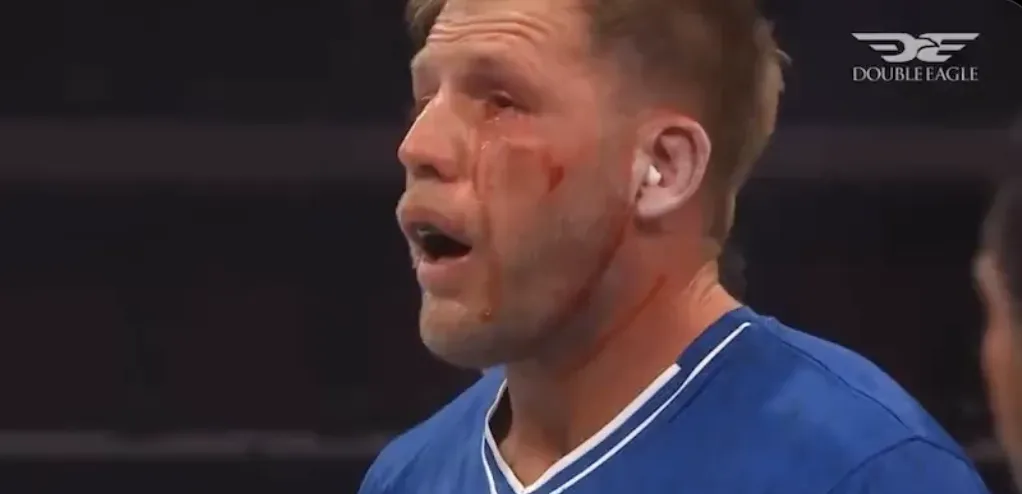
Josh Barnett has delivered a forceful criticism of Jake Hager’s involvement in Power Slap, questioning why a performer with Hager’s lengthy background in amateur wrestling, professional wrestling and mixed martial arts would choose to compete in the striking-based competition.
Hager signed with Power Slap earlier in 2026 and made his debut on April 17. By September, he had reached his third appearance for the promotion, facing Johnny Magna. That contest ended with Hager losing by referee stoppage after he suffered an eye injury.
The injury has now become a central point in Barnett’s assessment. Speaking with Ariel Helwani, the veteran heavyweight did not hide his concern over the potential downside of slap fighting for someone who has already built a wide-ranging combat-sports resume.
“We’ve had our differences in the past, but watching Jake Hager go out there, it’s just, what are you doing? What are you thinking?” Barnett said.
For more background on this topic, read Mercedes Martinez Shares Injury Update as WWE Raw Welcomes Back Penta and Je’Von Evans.
Barnett’s comments were not presented as a critique of Hager’s athletic credentials. On the contrary, he pointed directly to the former World Heavyweight Champion’s considerable experience as the reason he believes the Power Slap path makes little sense. Hager competed as a Division I collegiate wrestler at Oklahoma, was an All-American, spent years as a prominent name in WWE and AEW, and also fought professionally in Bellator.
For Barnett, that collection of experience should leave Hager with a broad set of options beyond a format in which participants absorb unprotected open-hand strikes. The former MMA champion argued that Hager’s established name and skill set could still be valuable in several areas of combat sports and professional wrestling.
Barnett says Hager has more to offer
The heart of Barnett’s argument was that Hager does not need to pursue slap fighting to remain active, visible or competitive. He specifically referenced Hager’s Oklahoma wrestling background and expressed disappointment at seeing a decorated collegiate wrestler enter the Power Slap environment.
“There’s so much more you can do with your life and career,” Barnett said. “You’d be better off doing MMA than you would be ever doing slap fighting. It’s just not worth it.”
That distinction is notable because Barnett is not speaking as someone dismissive of contact competition in general. His career has included high-level professional wrestling and MMA, two fields where physical risk is an unavoidable reality. Instead, his criticism is focused on what he sees as the risk-reward balance of Power Slap, particularly for an athlete who has already had success in more established combat disciplines.
Hager’s move to Power Slap came after an unusually diverse career. Wrestling fans first knew him on a national level through WWE, where he worked as Jack Swagger and became World Heavyweight Champion. He later joined AEW under his real name, becoming an important part of the Inner Circle alongside Chris Jericho and regularly appearing in major programs for the company.
Outside of the ring, Hager also took on MMA competition under the Bellator banner. His amateur wrestling base was a defining component of his presentation in both wrestling and MMA, and it remains central to how Barnett views his potential. Barnett’s position is that those credentials should provide a foundation for opportunities that do not require Hager to take the kind of punishment that resulted in his September stoppage.
The September bout remains the key concern
Hager’s loss to Johnny Magna was only his third Power Slap match, making the eye injury especially relevant to the discussion around his future. A referee stoppage is a stark outcome in any combat setting, but Barnett made clear that he sees little justification for accepting that risk in slap fighting.
“For what?” Barnett said when discussing Hager’s injury. “No, I’m sorry, there’s nothing. I can’t say anything good about slap fighting, that’s it.”
The statement leaves little room for ambiguity. Barnett is not merely suggesting that Hager should be more selective about matches or alter his preparation. He is arguing against slap fighting itself and believes Hager, specifically, should walk away from it.
That opinion arrives at a moment when the physical consequences of combat sports continue to be examined closely by wrestlers, fighters and fans. Every athletic pursuit carries a different kind of risk, and performers make their own decisions about where they compete. Barnett’s point is not that Hager lacks toughness or willingness to compete. Rather, he believes Hager’s willingness is being directed toward a format that does not provide enough upside to justify the possible damage.
Hager has not publicly responded to Barnett’s comments within the information currently available. As a result, there is no indication that the September injury has changed his plans with Power Slap or that he intends to step away from the promotion. Barnett’s remarks represent his personal and strongly held view of Hager’s situation, not a confirmed update on Hager’s future.
A blunt message from a fellow combat-sports veteran
Although Barnett acknowledged that he and Hager have had differences in the past, his comments were framed as frustration and concern rather than a discussion of their prior issues. He repeatedly returned to Hager’s accomplishments: the Division I background, All-American recognition, WWE and AEW experience, and Bellator fights.
That context is important. Barnett is not questioning whether Hager has the credentials to work in a physically demanding environment. He is arguing the opposite—that Hager has already demonstrated enough ability across multiple disciplines that he should have alternatives available to him.
In professional wrestling, a recognizable former champion with a legitimate amateur and MMA résumé can bring value to a variety of roles. In MMA, a heavyweight with Hager’s visibility and wrestling foundation carries a different type of credibility. Barnett’s observation is that Hager’s résumé is substantial enough that returning to MMA, pursuing wrestling work, or taking another career direction would make more sense than continuing with Power Slap.
Whether Hager agrees is ultimately his decision. Athletes often pursue opportunities for reasons that are not always visible from the outside, including competitive ambition, personal interest and the desire to test themselves in a new environment. Barnett nevertheless made his stance unmistakable: he believes the potential physical cost is too high, particularly after Hager’s eye injury against Magna.
Hager’s next move remains unclear
There has been no confirmed announcement in the available information regarding Hager’s next Power Slap appearance. His record in the promotion now includes the September defeat to Magna by referee stoppage, with the injury placing an unwanted punctuation mark on a run that had only just begun months earlier.
For wrestling audiences, the story also underscores how Hager’s career has remained connected to combat sports even after his most prominent WWE and AEW runs. His identity has long been shaped by his amateur pedigree and legitimate fighting background. Power Slap was another extension of that combat-athlete image, but Barnett plainly believes it is an extension Hager should reconsider.
Barnett has never been known for softening his opinions, and his message here was direct. In his view, Hager has already accomplished too much and has too many viable avenues remaining to accept the dangers attached to slap fighting. The eye injury against Johnny Magna only reinforced that feeling.
For now, the debate is less about whether Hager is capable of competing and more about whether Power Slap is a worthwhile use of his experience. Barnett’s answer could not be clearer: he does not believe it is worth it.

Darryl Polo
Darryl Polo is a passionate wrestling fan covering WWE, AEW, TNA and beyond. He loves great rivalries, breakout stars and the moments that keep fans talking long after the bell. How we work.