
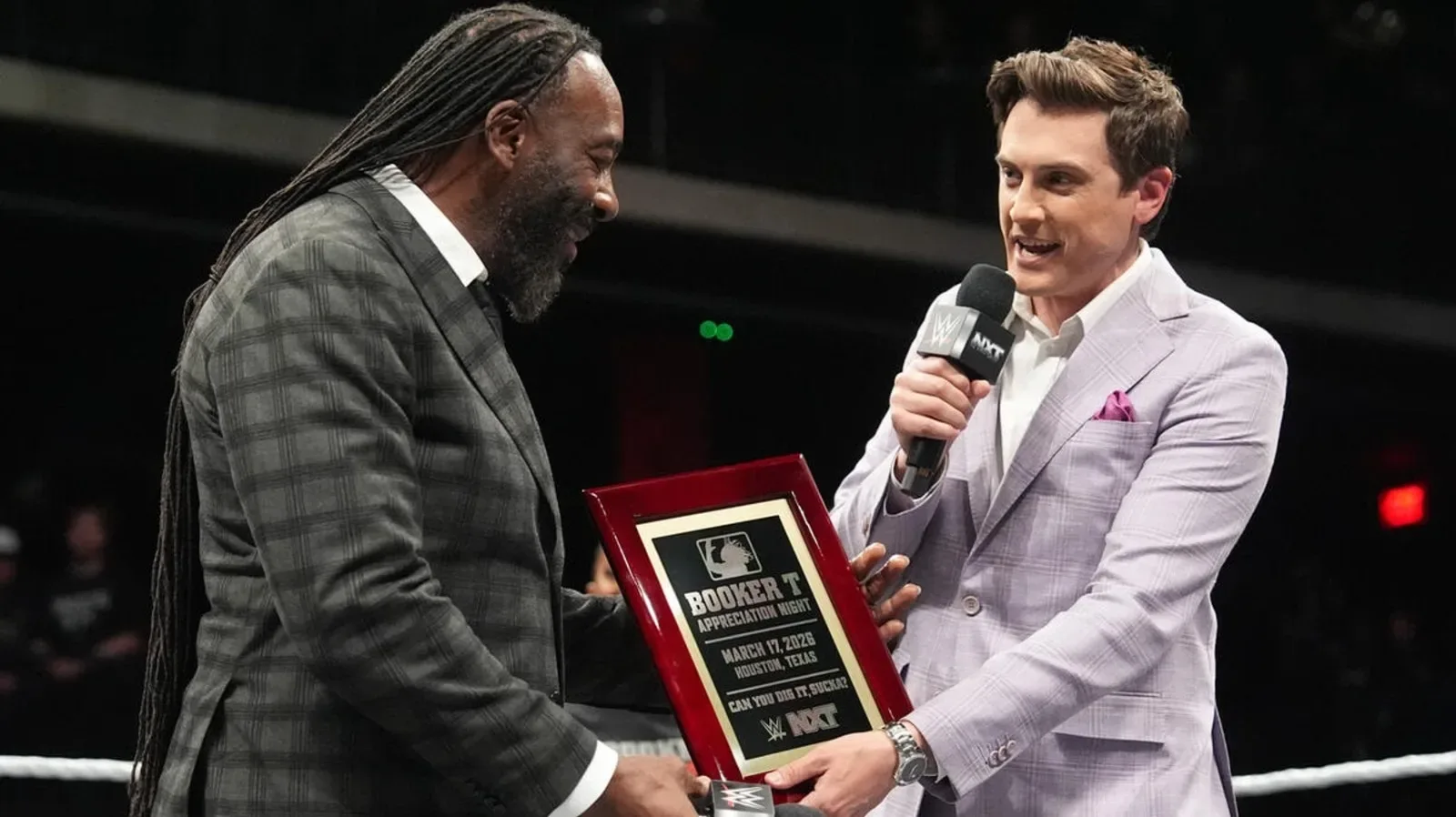
Booker T’s second career in WWE has become one of the most recognizable parts of NXT programming. The Hall of Famer brings the same energy, spontaneity, and larger-than-life personality that defined his time in the ring to the commentary desk, where he has worked alongside play-by-play announcer Vic Joseph. For Booker, though, that role was never a destination he expected to reach after retiring from active competition.
Speaking on Notsam Wrestling, Booker reflected on the path that took him from a celebrated in-ring career to becoming one of WWE’s most distinctive analysts. He credited Michael Cole for first seeing potential in him as a broadcaster, even when Booker himself was uncertain that he belonged in the position.
“I didn’t [think I would become a commentator]. You know, I really didn’t,” Booker said. “You know, I thank Michael Cole, you know, for bringing me on the team some years back. And I just didn’t think I was the guy. I didn’t think I fit in.”
That uncertainty was not simply a matter of Booker adjusting to a new job after wrestling. He described the main-roster environment as especially difficult, explaining that finding a comfortable rhythm on WWE’s biggest weekly shows was a major challenge. His remarks offer a candid look at the learning curve faced by performers who transition from the ring into a live television role where timing, chemistry, storytelling, and production demands all matter at once.
For more background on this topic, read Eric Bischoff Reflects On Chris Jericho’s Early Creative Ambition In WCW.
Booker said he was even removed from commentary more than once during that period. Rather than presenting those experiences with bitterness, he recalled one moment with his characteristic humor.
“And on the main roster, it was so freaking hard. I got fired a couple of times. One time, they told me to take me off commentary. I go, ‘Guys, I was going to come talk to you guys about it,’” Booker joked. “They just stuck with me and stuck with me.”
The important part of that story is that WWE continued to give Booker opportunities. A wrestler’s instincts do not always translate immediately to a broadcast booth, particularly on a tightly produced national television program. Booker’s early uncertainty, the changes in his assignments, and the support he received along the way eventually led him to the role in which he believes he truly discovered his identity as a commentator.
NXT Became the Turning Point
For Booker, the move to NXT changed everything. It was there that he found a partnership with Joseph that allowed his strengths to become clearer. Joseph handles the play-by-play responsibilities, guiding viewers through matches, explaining the stakes, keeping track of developments, and providing the structure that holds a live broadcast together. Booker, meanwhile, has increasingly leaned into the personality-driven analysis and emotional reactions that make him such an individual presence on the show.
He said the experience of working with Joseph helped him understand that he did not need to imitate a traditional analyst or force himself into a role that did not suit his instincts. Instead, he came to embrace being a hype man: someone who enhances the urgency of the action, reacts loudly to what is happening, draws attention to a performer’s attitude or momentum, and gives the broadcast a different texture.
“And then really, you know, getting the chance to go down to NXT and work with Vic kind of made me realize who I really was as an analyst, as a commentator, but more as a hype man than anything,” Booker said. “Because Vic, he does so much work, and I just try to back him up, and it’s been such a great tag team between him and me.”
That description of the pair as a tag team is fitting. Commentary partnerships work best when each announcer has a defined function but remains responsive to the other person. The play-by-play announcer must maintain the broadcast’s direction, while the analyst can provide perspective, personality, and insight shaped by experience. In Booker and Joseph’s case, their contrast has become part of the appeal. Joseph supplies the framework, and Booker adds a volatile, often humorous, always unmistakable voice.
Booker’s assessment of Joseph also underscores how much preparation is involved in a broadcast role. While viewers hear the exchanges in real time, play-by-play announcers carry a substantial share of the responsibility for presenting wrestlers, ongoing rivalries, match narratives, and key moments clearly. Booker’s praise makes clear that he values the work Joseph does in making the two-man booth function smoothly.
Finding the Right Role After the Ring
For a wrestler with Booker T’s résumé, a post-ring transition could have taken many directions. He is a multi-time WWE Hall of Famer whose career included championship success and memorable runs in WCW, WWE, and TNA Wrestling. His personality has also made him a natural fit for interviews, panel appearances, and other media work. Yet commentary requires a different discipline from delivering a promo or competing before a live crowd.
It also asks former wrestlers to explain the product without becoming the focus of it. The best color commentators can use their experience to make a match feel more significant while allowing the competitors in the ring to remain central. Booker’s eventual realization that he could contribute most effectively as a high-energy complement to the primary announcer was a meaningful step in that process.
His on-air style has never been restrained. That is precisely why it works within the NXT setting. The brand has long been built around hungry talent looking to establish themselves, and Booker reacts to the matches with the enthusiasm of someone who understands what it means to fight for a place in the industry. Whether he is praising an athlete’s toughness, questioning a wrestler’s choices, or getting caught up in the intensity of a major sequence, he projects the feeling that every development matters.
That approach is rooted in a broadcasting history that predates his WWE commentary work. Booker has previously recalled getting started informally during his WCW days, when he would call action behind the scenes to entertain people in the locker room. He later brought that inclination into his on-screen persona during his time in TNA Wrestling. Those experiences were very different from calling WWE television, but they helped reveal an interest in the craft that continued after his in-ring career ended.
Michael Cole’s Early Confidence Still Matters
Booker’s comments also shine a light on the value of mentorship and patience in wrestling broadcasting. Michael Cole has been one of WWE’s most prominent announcers for decades and has worked with numerous former wrestlers as they have learned the demands of television commentary. Booker’s acknowledgment of Cole suggests that the initial opportunity carried real importance, even if Booker did not immediately feel comfortable in the role.
There is a broader lesson in his story. A performer may have a clear voice, deep wrestling knowledge, and extensive charisma, yet still need time to identify the best way to use those qualities in a booth. Booker did not present his early struggles as evidence that commentary was not for him. Instead, he framed them as part of a process that eventually led to a much better fit in NXT.
His candidness is notable because broadcasters are often judged quickly by audiences. Every call, reaction, and line is heard instantly, and a commentator’s chemistry with colleagues can shape how viewers experience a match. Booker’s journey demonstrates that a role can evolve. His strengths became more apparent once he was paired with the right broadcast partner and given room to settle into a style that felt authentic.
A Booth Partnership Built on Contrast
Joseph and Booker’s continued partnership has given NXT a reliable booth identity. Joseph’s composed play-by-play delivery and Booker’s animated analysis are not competing approaches; they are complementary ones. Booker openly recognizes that Joseph handles a great deal of the broadcast’s workload, allowing him to focus on amplifying the action and adding the perspective of a wrestler who has experienced pressure at the highest level.
That balance has helped turn a career Booker once doubted into a lasting part of his WWE legacy. He entered commentary without believing he was necessarily the right person for it. He encountered difficulties on the main roster and considered walking away from the assignment. But through WWE’s persistence, Cole’s confidence, and especially the opportunity to work with Joseph in NXT, Booker found a role that matches his natural strengths.
For Booker T, the commentary desk is no longer simply the place he landed after wrestling. It has become another stage for his unmistakable voice, with Vic Joseph serving as the partner who helped him understand exactly how that voice could best serve the show.
In pictures

Darryl Polo
Darryl Polo is a passionate wrestling fan covering WWE, AEW, TNA and beyond. He loves great rivalries, breakout stars and the moments that keep fans talking long after the bell. How we work.