
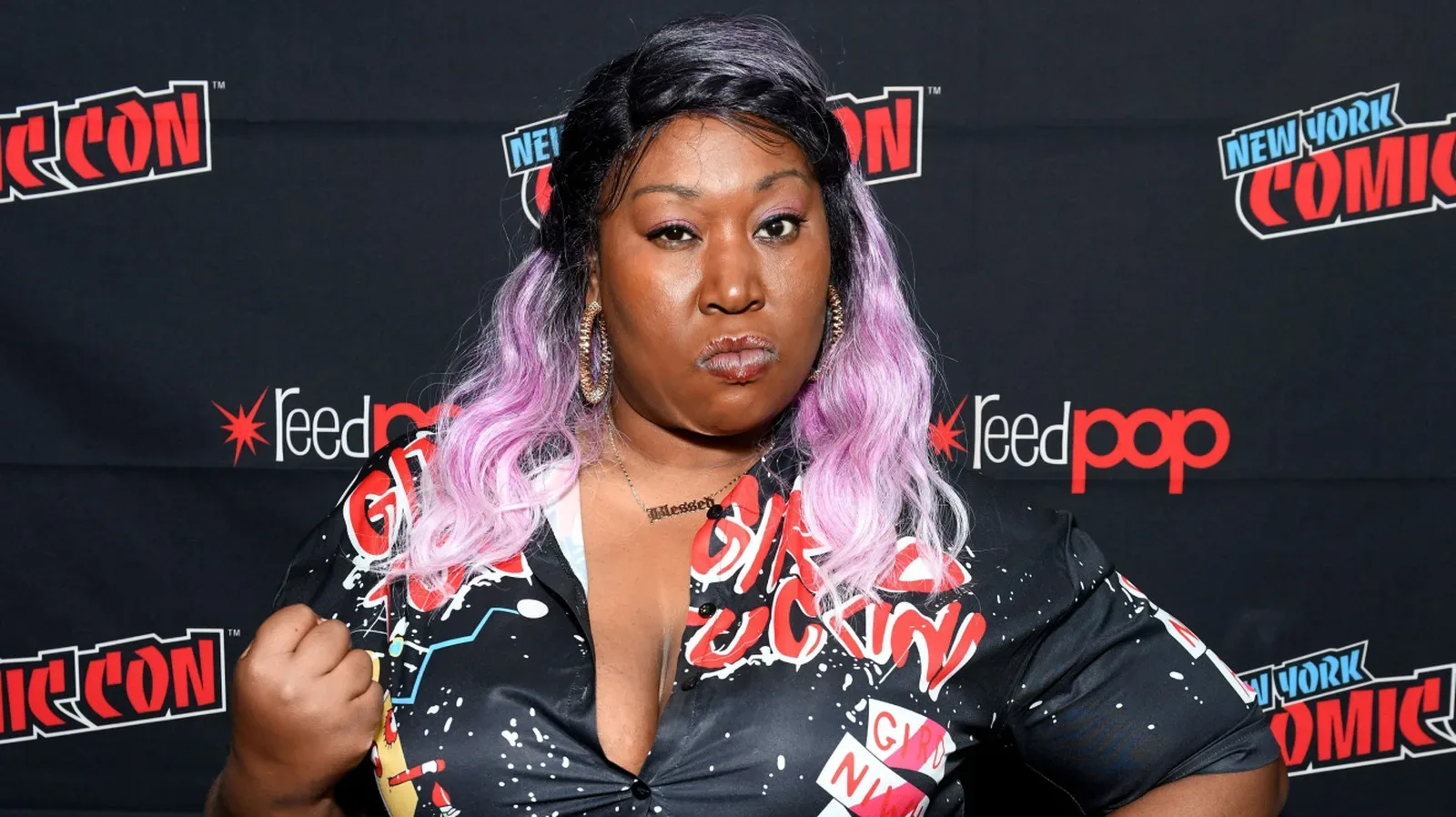
Awesome Kong’s path into professional wrestling was never built around an easy entry point. Before becoming one of the most influential powerhouse wrestlers of her generation, the performer known in WWE as Kharma faced skepticism, rejection and a decision that required her to put her entire livelihood behind a dream.
During an appearance on The Rich Eisen Show, Kong looked back at the formative period that took her from a longtime viewer to a wrestler who would make a major impact in Japan, Shimmer, TNA, WWE and later AEW. Her story is one of persistence, but it is also a reminder of how rapidly her career changed once she made a commitment to training and accepted the risks involved.
Kong explained that wrestling had been part of her life well before she considered stepping inside a ring. While working in a foster home, she watched wrestling with the children. The shared viewing became frequent enough that someone close to her suggested her enthusiasm and personality could translate into becoming a wrestler herself.
At first, Kong did not see that as a serious possibility. The turning point arrived as she watched Trish Stratus during the early stage of Stratus’ WWE career. Kong said seeing someone learn the mechanics of the sport on television helped her recognize that wrestling was not an unreachable world. She believed that if she could identify mistakes and understand the process of improvement, she could pursue that process herself.
For more background on this topic, read Amazing Red Reflects On His Lasting Influence And The Moves That Changed Wrestling.
A Tryout That Became Fuel
An unexpected opportunity soon followed. Kong’s brother-in-law was interested in trying out for Tough Enough and asked her to print an application. She printed two copies, and the chain of events led to WWE inviting her to Las Vegas for a tryout.
The experience did not unfold as she hoped. Kong recalled delivering a dramatic promo before being dismissed quickly. She pushed back, feeling that she had made the trip and deserved more than a brief evaluation. Bob Holly, she said, encouraged further questions, but the session remained memorable for an especially discouraging assessment from Jim Ross.
Kong said Ross told her that he did not believe a woman of her size could ever be successful in wrestling. Rather than allowing the comment to end her ambition, she turned it into motivation. That response would become central to the career that followed, as Kong ultimately established herself as an attraction whose physicality and presence were defining strengths.
Her eventual accomplishments gave the moment a particularly striking context. Kong became a dominant force in women’s wrestling at a time when opportunities for women, especially performers outside the industry’s traditional image standards, could be limited. Her work repeatedly demonstrated that star power did not depend on fitting one prescribed mold.
After the tryout, Kong returned to the hotel where she was staying with her mother. The rejection did not lead to a retreat. Instead, it sparked a discussion about how to reach Japan, a destination that would prove essential to her development as a wrestler.
Taking the Leap Into Wrestling
Kong’s earliest steps toward the ring came through an unconventional connection. She appeared on a weight-loss program on Discovery Health, which led to an introduction to School of Hard Knocks. From there, she was introduced to the New Japan dojo in Santa Monica, opening the door to a move that would accelerate her wrestling education.
The sequence developed quickly. Kong said the relevant events happened within months of one another, and her growing wrestling ambitions soon collided with the demands of her job. When her employer would not allow her to leave for another opportunity, she faced a major personal and professional choice.
She chose wrestling.
Kong sold her business and committed her resources to pursuing the profession. Her plan was to give herself five years to make an all-out effort in wrestling. It was not merely a decision to attend training sessions or work occasional events; it was a full investment in a new career with no guarantee of success.
That willingness to bet on herself took her to Japan, where she developed in an environment renowned for demanding standards and hard-hitting competition. Japanese women’s wrestling has long been a proving ground for performers who want to combine technical discipline, physical intensity and larger-than-life presentation. Kong emerged from that setting as a wrestler capable of commanding attention wherever she appeared.
Championship Success in Japan
Only two years into her professional wrestling career, Kong captured the WWWA World Single Championship in All Japan Pro-Wrestling in 2004. The achievement marked an enormous early milestone and validated the decision to leave behind the security of her previous career.
Her work in Japan helped form the foundation of the Awesome Kong persona that audiences would come to know. Kong was presented as an overwhelming physical force, but her appeal was never limited to power alone. Her timing, intensity and ability to make opponents’ attempts to overcome her feel dramatic made her a formidable presence in any division.
By the time she returned to the United States in 2006, Kong had already gained valuable experience that separated her from many contemporaries. She began working with Shimmer, the promotion that played a crucial role in showcasing women’s wrestling talent during that era, while also appearing for other independent groups.
Those appearances helped introduce a wider American audience to Kong’s style. She was a distinctive figure in a wrestling landscape that often gave women limited time and narrowly defined roles. Kong’s presentation made a clear statement: she was not there to conform to anyone else’s expectations. She was there to dominate the ring.
Becoming a Defining Force in TNA
In October 2007, Kong signed with TNA. It became the promotion most strongly associated with her name, particularly because of the impact she made in the Knockouts division. The division gained acclaim for presenting women’s matches and stories with a level of importance that was not consistently available elsewhere in North American televised wrestling at the time.
Awesome Kong was central to that identity. As a former TNA Knockouts Champion, she became one of the division’s most feared and recognizable competitors. Her rivalries and dominant performances helped establish the idea that the Knockouts roster could deliver serious, high-stakes wrestling rather than functioning as a peripheral attraction.
The contrast between Kong’s TNA success and the earlier doubts expressed at her WWE tryout is impossible to ignore. The qualities that had been treated as a reason to question her potential instead became core parts of what made her compelling. Her size, force and unique aura made her feel different from nearly anyone across the women’s wrestling scene.
Kong’s career also demonstrated the value of the international and independent paths available to wrestlers. She did not need immediate approval from WWE to build a meaningful legacy. Japan, Shimmer, TNA and other stops gave her the platform to develop and prove herself long before WWE came calling.
Kharma’s WWE Arrival and Royal Rumble Moment
WWE eventually signed Kong, and she debuted as Kharma in May 2011. The signing was a significant moment in itself given the rejection she had received years earlier. Kharma’s arrival was framed as a major event, with the character presented as a devastating force whose presence immediately changed the atmosphere around the women’s division.
Her WWE run was brief, but it included a historic appearance in the 2012 Royal Rumble. Kharma became the third woman to compete in the men’s Royal Rumble match, following Chyna and Beth Phoenix. That appearance remains an important marker in her career and in the continuing history of women crossing into WWE’s traditionally male battle royal.
Although her time in WWE did not last long, it did not define the full measure of Kong’s career. Her accomplishments had already been built across multiple promotions and countries, and she continued to be recognized as an important figure in women’s wrestling. She later also worked with AEW, adding another major promotion to a résumé spanning nearly two decades.
A Career Built on Self-Belief
Kong’s reflections offer a clear picture of the determination behind her success. The journey included a childhood-level love of wrestling, a challenge from a friend to consider becoming a wrestler, an unsuccessful WWE tryout, a difficult financial decision and a rapid move toward training and competition in Japan.
Each stage carried uncertainty. Kong did not have a guaranteed contract when she chose to sell her business and devote her savings to wrestling. She did not have proof that critics were wrong when she left Las Vegas after being told she could not succeed. What she had was conviction in her own potential and the willingness to work toward it.
That conviction produced one of modern wrestling’s most distinctive careers. From winning the WWWA World Single Championship in 2004 to becoming a TNA Knockouts Champion, debuting as Kharma in WWE and appearing in the Royal Rumble, Awesome Kong repeatedly reached milestones that once appeared far beyond the initial tryout room.
Her story is not simply about overcoming one negative evaluation. It is about the way a wrestler can create a career through preparation, sacrifice and a refusal to accept another person’s limitations as fact. Awesome Kong did exactly that, and the promotions she shaped along the way remain a major part of her legacy.
In pictures

Darryl Polo
Darryl Polo is a passionate wrestling fan covering WWE, AEW, TNA and beyond. He loves great rivalries, breakout stars and the moments that keep fans talking long after the bell. How we work.