
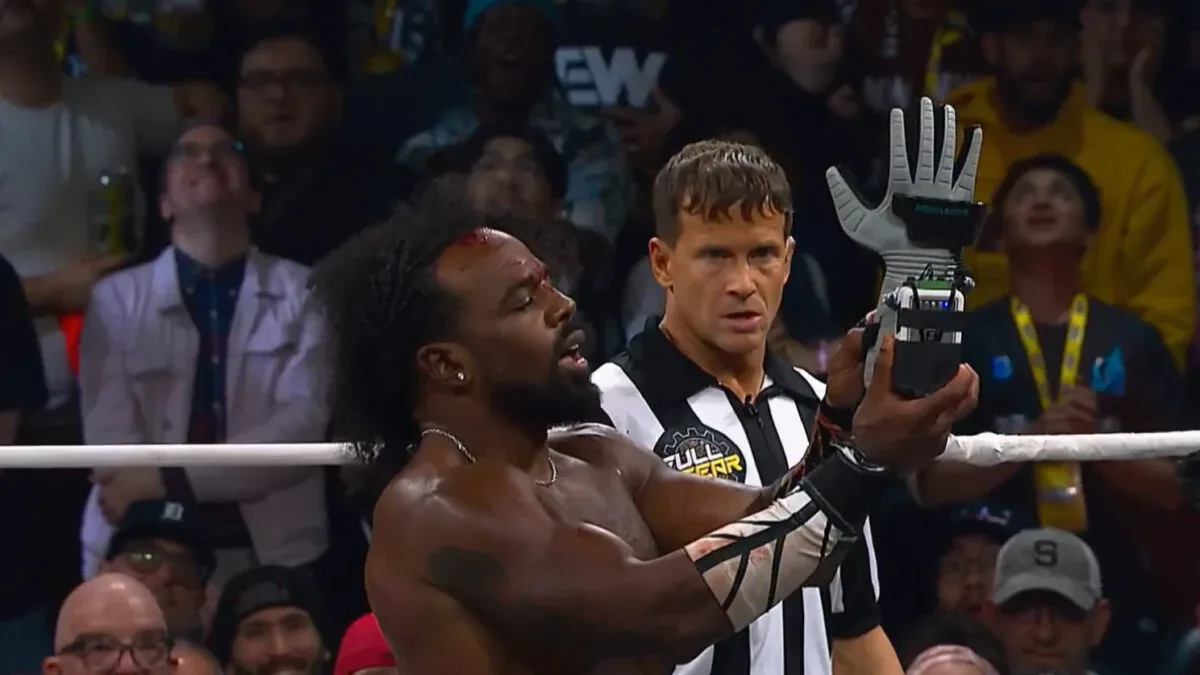
Austin Creed found a way to make one of gaming’s most famously impractical accessories feel right at home in the chaos of AEW Full Gear.
In a Texas Death Match for the AEW World Trios Championship, Creed unveiled a Nintendo Power Glove, strapped it on at ringside and delivered a dramatic Street Fighter-inspired Shoryuken to Brody King. The moment mixed a deep-cut piece of video game history with the kind of wild weapon-based violence expected from a match with no limits on punishment.
Creed teamed with Kofi Kingston and Swerve Strickland against Hangman Page, Brody King and the masked Bandido in the six-man championship bout. By the end of the bruising encounter, Creed, Kingston and Strickland had emerged victorious to win the AEW World Trios Championship. Yet even amid a match filled with painful-looking spots and an array of foreign objects, the Power Glove sequence immediately stood apart.
A retro gaming weapon enters a Texas Death Match
The Power Glove arrived after Creed went to a gym bag near the side of the ring. He pulled out the unmistakable black Nintendo accessory and presented it to the Arizona crowd before fastening its Velcro straps. The reveal drew a major reaction, particularly because the device is as recognizable for its pop-culture legacy as it is for its underwhelming original performance as a gaming controller.
For more background on this topic, read Chris Jericho Lands Gorgeous George Role for Amazon Prime’s Muhammad Ali Limited Series.
Commentary quickly acknowledged what Creed had brought into the fight. “It’s an old school Power Glove,” the call noted, along with the warning that putting it on “could backfire.”
That concern looked justified for a moment. Brody King jawed at Creed and then dropped him with a punch while the glove was being fitted. But the sequence shifted as Creed rose from the crouched position, leapt upward and threw a stylized uppercut modeled after Street Fighter’s famed Dragon Punch.
The Shoryuken came complete with sparks, elevating the presentation beyond a simple punch with a prop attached. King was sent down onto sharp metal, making the tribute to a beloved fighting-game move part of a far harsher wrestling environment. It was an intentionally absurd visual—an NES peripheral used to execute a fiery arcade-game attack—but it also fit the anything-goes framework of the stipulation.
Texas Death Match rules removed the usual restraints on weapon use and physical punishment. Furniture, glass and sharp objects are often associated with the stipulation, and this Full Gear contest delivered plenty of the expected brutality. Creed’s Power Glove did not replace that violence; it gave the match a distinctive burst of personality in the middle of it.
Creed’s arsenal blended games, comedy and carnage
The Power Glove was not Creed’s only unconventional contribution to the match. He also brought out a flame-spewing drum barrel with an unmistakably video game-inspired look, as well as a barbed-wire trombone. The weapons underscored a familiar strength of Creed’s wrestling presentation: he can lean into playful and niche pop-culture references without treating the physical stakes as a joke.
That balance was especially notable at Full Gear because the match was not a lighthearted exhibition. It was a nasty, blood-soaked fight, and viewers were struck by the sight of Kingston and Creed taking that level of punishment. Both are strongly associated with colorful, energetic performances and crowd-pleasing comedy, but their work alongside Strickland required them to endure a far more severe setting.
Kingston, Creed and Strickland ultimately outlasted Page, King and Bandido to claim the AEW World Trios Championship. The win puts an unusual trio at the center of AEW’s six-man division: two performers whose shared history is rooted in friendship, spectacle and fandom, joined by one of the promotion’s most intense and unpredictable stars.
That combination helped give the match several different textures. Page, King and Bandido brought a formidable mix of toughness, size, athleticism and resilience. Creed’s team answered with creativity as well as endurance, using the stipulation’s freedom to make the action increasingly chaotic. The championship result mattered most, but the Power Glove ensured that one moment from the match will be remembered well beyond the final bell.
The strange history of Nintendo’s Power Glove
For fans unfamiliar with the accessory, the Power Glove was released in 1989 as a Nintendo-sanctioned product designed by Mattel. It was intended to bring an early form of motion-based control to the Nintendo Entertainment System long before motion controls became commonplace through later technology.
Its ambition was considerable. Players wore the glove and used hand movements, buttons and numerical codes in an effort to control compatible NES games. In practice, the device became notorious for being difficult to use reliably. Only two games were designed specifically around it: Super Glove Ball and Bad Street Brawler. It could also be configured through codes for other NES titles, including Castlevania, Metroid and Donkey Kong.
Its limitations did not stop the Power Glove from becoming a cultural artifact. The device received perhaps its most famous exposure in the film The Wizard, where a young gaming rival proudly introduces it with the line, “So bad.” The phrase was intended as praise, and it helped make the glove an enduring symbol of late-1980s video game cool—even if the product itself developed a reputation for falling short of its futuristic promise.
That history made Creed’s use of the glove especially fitting. The object has always carried a strange blend of sincere nostalgia and knowing humor. It is remembered as a bold idea, a marketing icon and an artifact of an era when video games were rapidly becoming a major part of youth culture. By bringing it into a championship death match and treating it as the trigger for a Shoryuken, Creed transformed all of that baggage into a wrestling payoff.
Video game fandom has long been part of Creed’s identity
Creed has never hidden his passion for gaming and the wider culture surrounding it. His use of the Power Glove was not a random one-night visual; it was consistent with a persona and creative history that has repeatedly embraced video game references.
During his WWE years with Kingston and Big E in The New Day, Creed was part of a group that regularly incorporated their interests into their presentation. The trio wore gear influenced by Yoshitaka Amano’s Final Fantasy artwork and paid tribute to Dragon Ball Z, among other references. Their work showed that wrestling attire and entrances could function as a direct conversation with fans who followed games, animation and genre entertainment alongside professional wrestling.
The overlap between wrestling audiences and gaming audiences has continued to grow. Major promotions increasingly recognize that their performers do not have to keep those interests separate from their on-screen identities. References that once might have been seen as too niche can now create immediate crowd recognition, especially when used with the clarity and confidence that Creed displayed at Full Gear.
The broader entertainment landscape reflects the same connection. A recent Street Fighter film has included wrestling names such as Cody Rhodes, Roman Reigns and Hirooki Goto, showing how naturally the worlds of combat sports performance, wrestling spectacle and fighting games can intersect. Creed’s Shoryuken was a smaller-scale moment than a film role, but it may have been just as direct for the fans in the building: a wrestling move built around the visual language of a classic fighting game.
A championship win with a signature highlight
Full Gear’s Texas Death Match demanded commitment from all six wrestlers, and the AEW World Trios Championship changed hands after Creed, Kingston and Strickland survived the punishment. The result gives their partnership immediate credibility, since they captured gold in one of the most physically punishing formats available.
For Creed, however, the Power Glove sequence supplied the image that defined the night. Wrestling has always thrived on props that become extensions of a performer’s personality. Some are threatening, some are comedic, and the best can be both. The Power Glove was a nostalgic novelty on its way to becoming a weapon, a punchline that became a spark-filled finishing flourish against one of the most imposing men in the match.
Creed did not simply bring a retro controller to ringside. He used it to turn a lifelong-looking fandom into a decisive moment on pay-per-view, then left Full Gear with championship gold alongside Kingston and Strickland. For a device immortalized as “so bad,” the Power Glove’s latest appearance was very good for the new AEW World Trios Champions.

Darryl Polo
Darryl Polo is a passionate wrestling fan covering WWE, AEW, TNA and beyond. He loves great rivalries, breakout stars and the moments that keep fans talking long after the bell. How we work.