
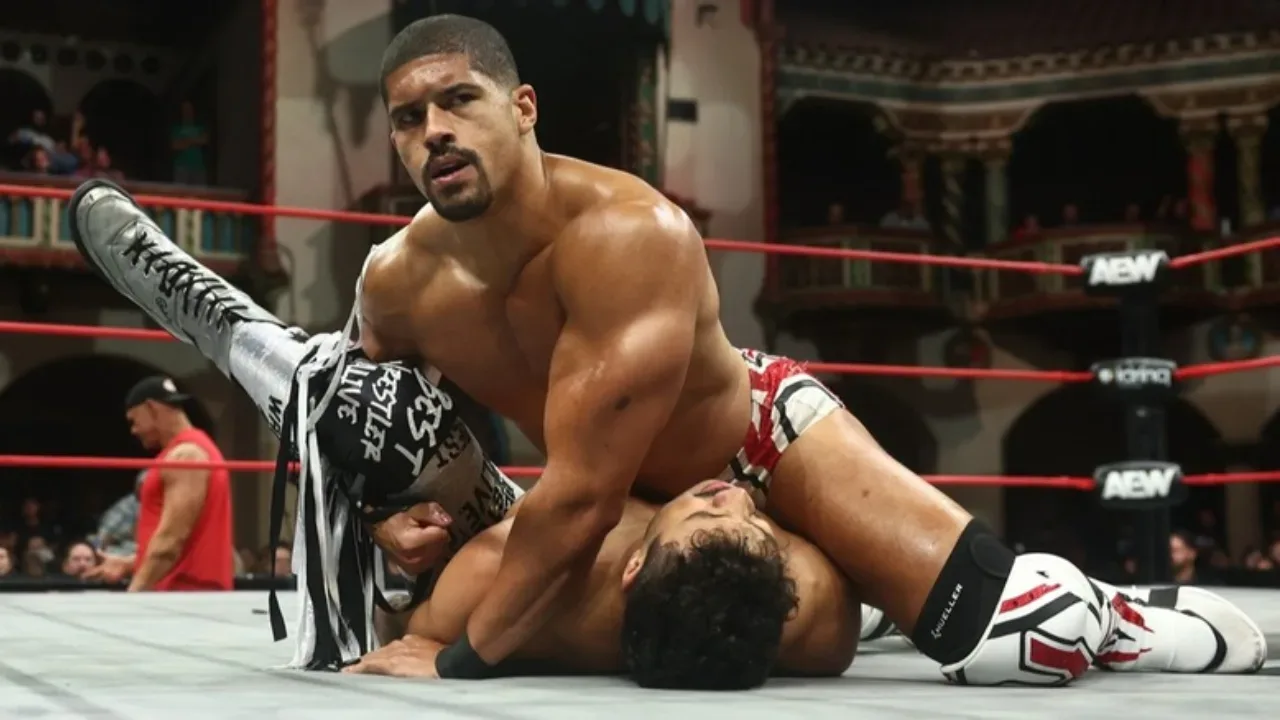
Anthony Bowens has offered a clearer explanation of what he believed his AEW singles run was building toward before the creative direction changed. The former AEW World Tag Team Champion said the uneven early presentation of his solo character was not meant to be the final destination. Instead, it was designed to establish a growing frustration that would eventually push him into a heel turn.
Bowens said the concept centered on a performer who returned with confidence, optimism and a larger-than-life presentation, only to repeatedly fall short in major moments. Rather than immediately abandoning that confidence, the character was intended to become increasingly delusional, resentful and desperate for recognition. The proposed evolution would have led into a persona called “The Pride of Pro Wrestling.”
“What I was working towards last year was being a heel,” Bowens said. “Creative switched and it ended up going into a brief kind of Acclaimed reunion. But that’s what I think people don’t understand. They think that the return was a flop, which it wasn’t. It was made to be that way so that I can go off the deep end, blame Billy for my not being able to win the big matches, blame the fans for choosing Caster over me, adding to his delusion of being ‘The Best Wrestler Alive’ and then I would go into what ‘The Pride of Pro Wrestling’ was.”
The comments provide context to a period that drew criticism from some fans who expected Bowens’ transition away from The Acclaimed to produce a more immediate singles breakthrough. Bowens and Max Caster spent years as one of AEW’s most recognizable tag teams, with Billy Gunn becoming an essential on-screen ally during their rise. Together, Bowens and Caster held the AEW World Tag Team Championship and built a connection with crowds through their entrances, catchphrases and chemistry.
For more background on this topic, read Anthony Bowens Reveals He Is Managing a Slightly Torn Right Meniscus.
A move into singles competition naturally changed expectations. For Bowens, however, the losses and the awkward confidence were supposed to be part of a deliberate story rather than evidence that the act had failed. He described a character returning as a “corny superhero,” convinced he was on the verge of becoming a major singles star despite being unable to win the matches that would validate that belief.
That disconnect, Bowens explained, was intended to drive the story. Fans cheering Caster and participating in his familiar clap would have become another source of irritation for Bowens’ character. Billy Gunn’s role as mentor and coach would also have become a target as Bowens looked for someone else to blame for his inability to get past the biggest obstacles.
“I came back as this corny superhero… Thinking that I’m gonna be the next big thing, but, I lost the big matches,” Bowens said. “Everybody was cheering for Caster and doing his clap and all of a sudden, you saw me starting to get a little bit more cocky despite losing and then why am I not winning? ‘Billy, you’re supposed to be coaching me. Bringing me to the top. You’re not doing your job, and the fans, after all I do for you, you’re cheering for the person that you hated?’”
In Bowens’ view, the idea had a personal foundation that could have made the eventual turn feel more grounded. He said he has often felt overlooked by fans despite the work he has done representing AEW in various settings. The planned character would have amplified those real emotions, turning them into the motivation for a wrestler who believed he was not being properly appreciated by either the audience or the company around him.
That was also the intended meaning behind “The Pride of Pro Wrestling.” Bowens stressed that the phrase was a playful use of language but was not specifically about his identity as a gay man. The core of the character, he said, was an AEW ambassador who felt ignored and was prepared to go to extreme lengths in pursuit of the praise and recognition he believed he had earned.
“The Pride of Pro Wrestling is an ambassador to the company that feels like he’s being overlooked and he will do anything to get his flowers,” Bowens said. “That’s really what it was.”
Bowens said he saw considerable potential in portraying the desperation behind that search for admiration. A heel turn would not simply have been a cosmetic change in attitude. It would have reframed his earlier defeats, his continued bravado and his tension with Gunn, Caster and the audience as stages of a slow unraveling. The point, as Bowens saw it, was for viewers to recognize the character was becoming more arrogant and more bitter even while his results did not improve.
“I do a lot of work for the company and I always feel like fans kind of overlooked me a little bit,” Bowens said. “They look to these other guys when I’m out making sure I’m flying the AEW flag everywhere so, I wanted to bring those emotions to the character and I had such fun ways to building that desperation of wanting people’s admiration.”
The program did not move forward in the manner Bowens described. He said the creative changed, resulting in a brief reunion involving The Acclaimed rather than the planned descent into villainy. Because the arc did not progress to its next chapter, Bowens believes many viewers were left with the impression that the singles return itself had simply not worked.
“Unfortunately, we were kind of left with — because it didn’t progress — we were kind of left with people going, ‘Oh, he came back and his character flopped,’” Bowens said. “It’s like, yeah, that was the purpose.”
That distinction is important for evaluating the run. Wrestling storylines often rely on an eventual payoff to redefine events that initially appear unsuccessful. A wrestler losing important matches while projecting excessive confidence can look directionless if the planned turn never happens. Had Bowens blamed Gunn for failed coaching, resented fans for embracing Caster and fully embraced the “Best Wrestler Alive” delusion, those earlier beats may have been viewed as intentional seeds rather than a stalled push.
Instead, Bowens eventually became associated with The Opps, the group involving Samoa Joe, HOOK, Katsuyori Shibata and Action Andretti. While discussing that alliance, Bowens spoke warmly about the opportunity to work alongside performers he respects and, in several cases, considers close friends.
Joe’s presence stood out to Bowens because of the former world champion’s standing in professional wrestling. Bowens previously had the chance to work closely with Gunn, another veteran whose experience was valuable to The Acclaimed’s development, and said being around Joe created another major learning opportunity.
“Being with somebody like Samoa Joe, who is a professional wrestling legend, so well respected, one of the best to ever do it,” Bowens said. “I got lucky I got to work with Billy and now I get to work with Joe.”
Bowens also highlighted the personal connection among several members of the group. He said he, HOOK, Dante Martin and Darius Martin of Top Flight were part of a real-life friend group known as The Lads, a name he believes was given to the group by Tony Khan. Action Andretti was later added to that circle. For Bowens, having elements of those friendships reflected on television made the opportunity especially rewarding.
“To be able to have bits of that friendship put on television for people to see and get to work with your friends is really cool,” Bowens said. He additionally pointed to Shibata’s reputation, calling the Japanese wrestling legend someone audiences—and opponents—would not want to “mess with.” Bowens said having Shibata in his corner also offered another chance to learn from an accomplished veteran.
Bowens’ wording about The Opps indicated some uncertainty about what comes next. “I’m with The Opps now and hopefully — well, I was with The Opps — we’ll see how things work out,” he said. That uncertainty arrives after a report in early October stated that Bowens had become a free agent.
For now, Bowens’ comments offer a retrospective on a character direction that did not receive the opportunity to reach its proposed conclusion. Rather than seeing that singles period solely as a failed attempt to separate from The Acclaimed, Bowens sees it as an incomplete story: a proud, overlooked performer absorbing loss after loss, searching for validation and preparing to place responsibility everywhere but himself. Whether that version of “The Pride of Pro Wrestling” ever returns in a future setting remains to be seen.

Darryl Polo
Darryl Polo is a passionate wrestling fan covering WWE, AEW, TNA and beyond. He loves great rivalries, breakout stars and the moments that keep fans talking long after the bell. How we work.