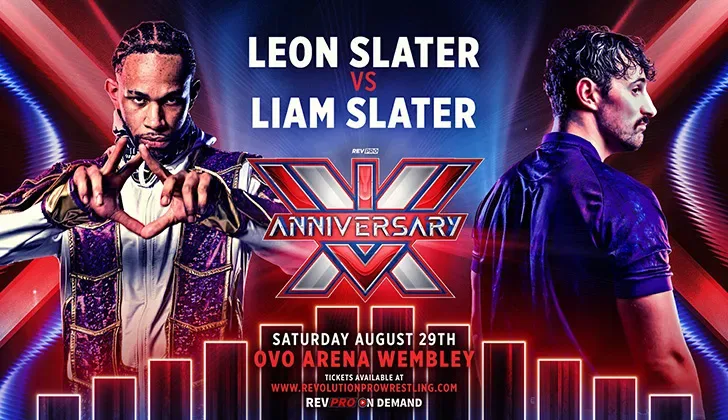
Revolution Pro Wrestling promoter Andy Quildan has addressed the decision to withhold a Leon Slater match from the MyAEW presentation of RevPro’s 14th Anniversary show, explaining that the move was intended to prevent complications rather than create controversy.
The match involving TNA Wrestling’s Leon Slater was not included when the anniversary event aired on MyAEW. It did, however, air through RevPro’s own stream. Quildan has now discussed the thinking behind that split in distribution, stressing that he received no direct instruction to black out the bout but elected to do so in an effort to keep the situation straightforward for all parties.
It was a notable omission from a major annual event for RevPro, particularly because Slater’s profile has continued to rise through his work with TNA Wrestling and appearances on the wider international wrestling scene. The absence of the match on one platform naturally generated questions about whether there had been a restriction placed on its availability, what that might mean for future RevPro broadcasts, and whether the promotion could face similar decisions again.
Quildan did not offer a firm answer on whether matches will be blacked out from MyAEW in the future. Instead, he framed the incident as a learning experience for RevPro as it navigates relationships with multiple companies and manages the practical realities of presenting talent associated with other promotions.
For more background on this topic, read Frankie Kazarian Details His Real-Life Commitment to AJ Styles’ Son Avery in TNA.
Quildan Says There Were No Direct Instructions
The key detail from Quildan’s comments is that the blackout was not described as a requirement delivered directly to RevPro. He said there were “no direct instructions” regarding the Leon Slater match, but he chose to act proactively because he wanted to eliminate the possibility of an issue before, during, or after the show.
“I’m not sure, to be honest. I was trying to make everyone’s life as easy as possible. My role, as an independent wrestling promoter, has always been to get the match in the ring to try and have foresight. You try to envision every single problem that could occur before it becomes a problem. And the last thing we want is for anything to become an issue on the day, or post-show, or anything like that.”
That explanation places the decision in the broader context of independent promotion. RevPro regularly operates in a landscape where wrestlers can hold affiliations with larger organizations while also appearing for independent companies. Booking the match is only one part of that process. Once a bout is recorded and scheduled for distribution, questions can extend to where it will be shown, how long it will remain available, and whether its inclusion on a given platform could become sensitive for any involved party.
Quildan’s comments indicate that RevPro was attempting to anticipate those concerns rather than reacting to a demand. His approach was based on caution, but he also recognized that caution can have an unintended effect when fans notice that a specific match is missing from a broadcast.
Promoter Admits The Blackout May Have Drawn More Attention
In hindsight, Quildan said he is not certain that the choice achieved its intended goal. Instead of allowing the situation to pass without discussion, removing the match from MyAEW created an obvious gap for viewers and made the decision itself a topic of conversation.
“And it’s crazy; with the benefit of hindsight, maybe we did the wrong thing, because that almost created more attention on the situation. I think, as we do with everything, we have to learn, we have to evolve, we have to adapt and move forward.”
That is an important acknowledgment from the RevPro promoter. In modern wrestling distribution, omissions are often just as visible as inclusions. A fan who follows a card, knows a match took place, and then finds it absent from a streamed version of the event is likely to ask why. Even when a promotion’s intention is to avoid a potential business concern, a blackout can invite speculation about the very issue it was meant to sidestep.
Quildan did not indicate that RevPro has reached a permanent policy on the matter. His uncertainty over whether future matches could be treated in the same way leaves open the possibility that the promotion will handle similar circumstances differently going forward. What is clear is that he views the matter as part of an ongoing process of adjustment, not as a settled rule for RevPro programming.
For viewers, the distinction between the MyAEW broadcast and RevPro’s own stream also matters. The match was not removed from existence or kept from RevPro’s audience altogether. It aired on RevPro’s platform, while being excluded from MyAEW. That difference suggests the issue centered on the presentation and distribution route rather than the match having taken place at the 14th Anniversary show.
Maintaining Relationships Is Central To RevPro’s Approach
Quildan also made clear that he does not want RevPro drawn into promotional politics. His stated objective is to keep the company in a position where it can work constructively with as many wrestling organizations as possible.
“I don’t want to be involved in any wrestling politics. I always say, we are open to do good business with anyone. I know in business it’s almost impossible, especially when there’s so much tribalism that goes around, but I want to be on the good side of everyone. And I want everyone to know that when they do business with us, we will do good business and we will try and do best by the company, and I don’t want anything to be received as, we’re trying to sneak people into places.”
Those remarks outline the balancing act facing RevPro. The company’s identity has long been tied to presenting major matches, bringing in talent with experience across the international wrestling industry, and giving its audience cards that feel significant beyond a single promotion’s borders. Maintaining that kind of environment requires trust with talent and companies alike.
At the same time, promotional affiliations can make decisions around footage more complicated than decisions around live bookings. Quildan’s concern appears to have been that the inclusion of the Slater match on MyAEW could be interpreted in a way that created friction or raised questions about RevPro’s intentions. His emphasis that RevPro was not attempting to “sneak people into places” speaks directly to that concern.
The promoter’s stated preference is not to choose sides amid wrestling’s frequent fan-driven tribalism. Rather, he wants RevPro to be known as a reliable business partner that considers how its actions may affect the companies with which it works. In this instance, that meant making a conservative call despite the lack of a direct instruction requiring it.
What The Situation Means Going Forward
There is no announced change to RevPro’s broadcast policy, and Quildan did not say that future matches involving wrestlers affiliated with other promotions will automatically be withheld from MyAEW. His answer was deliberately noncommittal: he is not sure whether a similar blackout will happen again.
That leaves RevPro with a practical question to evaluate after the response to the 14th Anniversary show. If the goal is to prevent misunderstandings and protect working relationships, the company will need to decide whether a blackout accomplishes that aim or whether it simply creates an avoidable point of public discussion. Quildan’s own hindsight suggests he understands the latter risk.
There are also two audiences to consider. Fans watching through MyAEW expect a complete version of a promoted event, while viewers using RevPro’s own stream had access to the Leon Slater match. Any future distinction between platforms may therefore require careful consideration, particularly when a bout has been advertised or has significance because of the wrestler involved.
For now, the clearest conclusion is that RevPro’s decision was preventative, not the result of a publicly stated mandate. Quildan sought to avoid potential problems, preserve positive relationships, and keep RevPro outside of inter-promotional disputes. Yet he has also conceded that the attempted solution may have heightened attention around the match rather than reduced it.
The Leon Slater blackout has therefore become more than a simple programming omission. It is an example of the challenges independent promotions face when their events sit at the intersection of live wrestling, streaming distribution, talent affiliations, and relationships with larger companies. RevPro’s next steps will show whether Quildan’s conclusion leads to a revised approach, but he has made one point clear: the promotion intends to learn from the situation and continue moving forward.
Darryl Polo
Darryl Polo is a passionate wrestling fan covering WWE, AEW, TNA and beyond. He loves great rivalries, breakout stars and the moments that keep fans talking long after the bell. How we work.