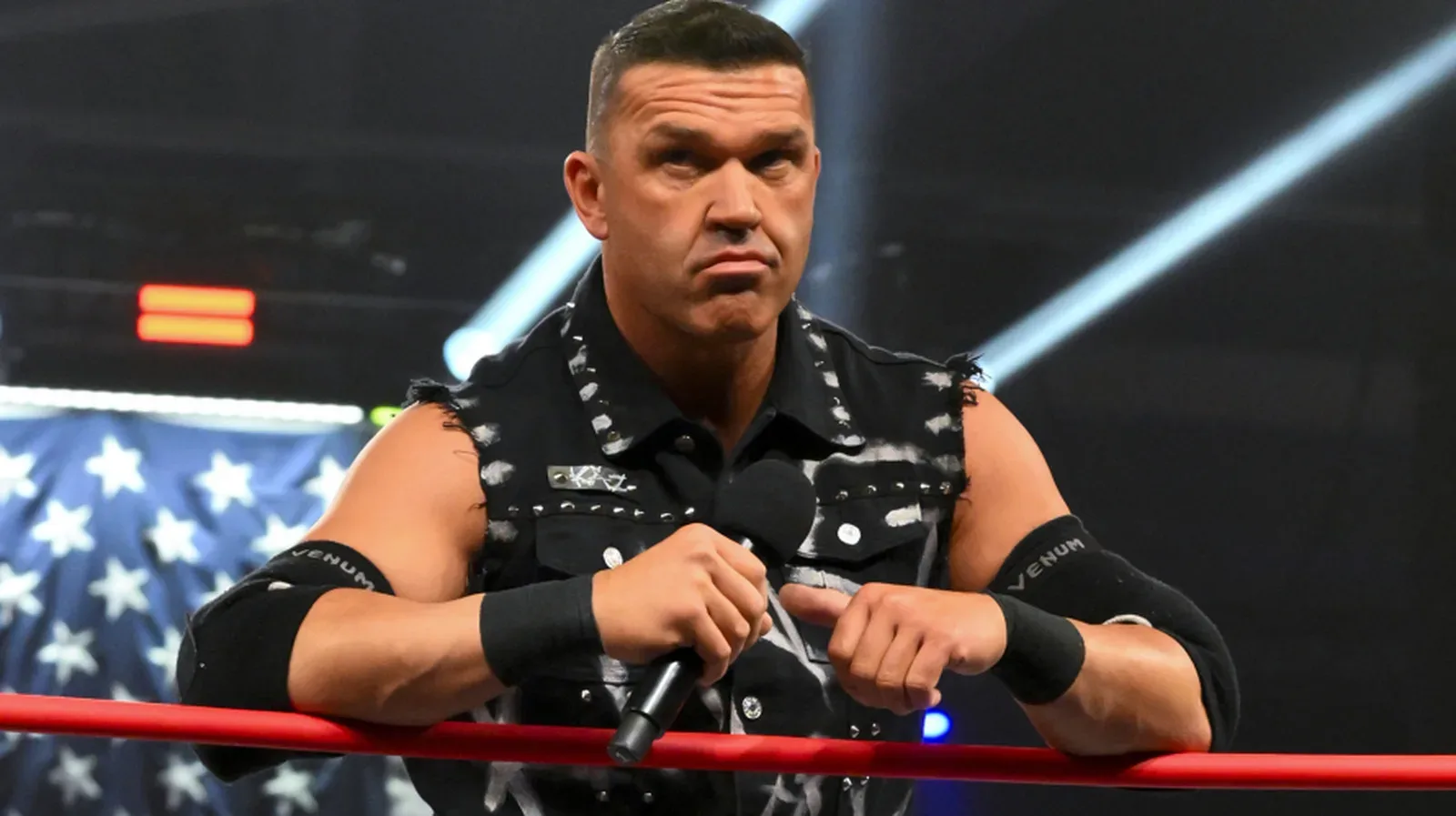
Frankie Kazarian’s developing alliance with Avery Styles on TNA programming is built around an uneasy on-screen message: the young newcomer needs someone experienced at his side before the locker room takes advantage of him. Behind that angle is a far more personal reality for Kazarian, who says he made a direct promise to Avery’s father, AJ Styles, before the situation ever reached TNA television.
Avery Styles, the son of the retired in-ring great AJ Styles, announced his signing with TNA at Lockdown. The same event established Kazarian as Avery’s mentor and apparent protector. Kazarian congratulated the second-generation talent while making it clear that TNA’s environment can be difficult to navigate, particularly for someone just beginning his professional career. Since then, Kazarian has remained close to Avery in the storyline, even positioning himself as the person who will decide when Avery is ready to compete in a TNA ring.
Speaking on Busted Open Radio, Kazarian explained that the television dynamic was preceded by a meaningful conversation with AJ Styles. Their history as friends made the prospect of working with Avery feel significant, but Kazarian said he wanted AJ to understand exactly where he stood.
“AJ and I talked about this before it became a reality,” Kazarian said. “I told AJ in no uncertain terms like, ‘Dude, I got his back.’ He’s like, ‘I know you do. That’s why I’m glad he’s going there.’”
For more background on this topic, read Ricky Sosa Welcomes Avery Styles to TNA: ‘We Can All Grow Together’.
That exchange gives TNA’s current story a different layer. Kazarian is not merely playing the role of a veteran trying to attach himself to a high-profile surname. He is publicly presenting himself as a guide for a young wrestler whose family connection naturally brings attention, while privately recognizing the responsibility that comes with helping a longtime friend’s son navigate the beginning of his career.
A Familiar Name, but an Early Career
The Styles name has immense weight in professional wrestling. AJ Styles built a career across multiple major promotions and became one of the defining performers of his generation. That legacy ensures Avery will be noticed wherever he appears. It also means every movement, decision and early performance will invite comparisons that most newcomers do not have to face.
Kazarian’s comments indicate that he is well aware of the balance involved. Avery may have a recognizable surname and an obvious athletic connection to his father, but he is still only a few months into his own pro wrestling journey. The task is not to rush him into the biggest possible moments simply because fans know who his father is. At the same time, TNA must allow him enough opportunity to establish his own identity and demonstrate that he belongs in the environment.
That tension has become central to Kazarian’s portrayal on television. His refusal to immediately let Avery wrestle can be interpreted as controlling or manipulative, especially in a wrestling storyline where the veteran mentor is often revealed to have self-serving motives. Yet Kazarian’s real-life explanation makes clear that pacing is an issue he is taking seriously away from the cameras as well.
He said his goal is to prevent Avery from exposing too much too quickly, while also making sure the newcomer does not arrive in TNA looking unprepared. It is a practical concern for any young wrestler, but the spotlight surrounding Avery makes it especially important. A debuting prospect must show enough to capture interest. Showing everything too soon, however, can limit the room available for growth, development and future progression.
Kazarian Sees AJ Styles in Avery
For Kazarian, the experience has been particularly surreal because he knew Avery long before Avery began pursuing wrestling. Kazarian recalled that the last time Avery had ridden in his car, he was only three years old. Now, years later, the two are traveling and sharing a ring as colleagues.
The veteran has also already seen signs that Avery has inherited traits from AJ Styles. Kazarian and Avery recently teamed together for an independent federation in Georgia, giving Kazarian a closer look at the young wrestler’s physical instincts in a live match setting.
“I’ve gotten to know Avery,” Kazarian said. “He’s on the road. Him and I, we tagged together for an independent federation in Georgia. And my God, there’s so much of his old man in him, just the way his body moves, the way he takes bumps and stuff. You guys will spot it immediately, too. It’s uncanny.”
Kazarian’s observation is notable not because it guarantees Avery will follow precisely in AJ’s footsteps, but because it comes from someone with an extensive shared history with AJ. Kazarian has enough familiarity with the elder Styles to recognize details that casual viewers may miss: the way a wrestler moves through transitions, the instincts displayed when taking impact, and the natural rhythm that can be difficult to teach.
Those similarities will inevitably fuel excitement among fans. They may also create another challenge for Avery. Being compared to a legendary parent can provide a platform, but it can make it harder for a young wrestler to be evaluated strictly on his own progress. Kazarian’s mentorship gives the storyline a mechanism to address that pressure. He can encourage Avery to learn from his father’s influence without allowing the young talent to be defined only by it.
Lockdown Established the Direction
TNA Lockdown served as the important first chapter in this partnership. Avery’s signing announcement immediately positioned him as a new figure to watch, and Kazarian’s appearance alongside him shaped the initial narrative. Kazarian offered congratulations, but his focus quickly shifted to warning Avery about the people around him.
That is a natural message for Kazarian to deliver. As a former TNA World Champion with a long career in the business, he has the credibility to speak about the realities of a competitive locker room. He can portray himself as someone who understands the political and professional dangers awaiting an inexperienced performer. Whether that protection remains entirely sincere within the storyline, or whether Kazarian’s methods eventually become a problem for Avery, remains an open question.
For now, the angle has room to develop gradually. TNA does not need to force Avery into an immediate major match to make the story compelling. The mentor-and-protégé relationship can build through training, tag team appearances, disagreements over readiness and the inevitable test of whether Avery will follow Kazarian’s advice. Each step can reveal more about Avery as a performer while also keeping fans guessing about Kazarian’s true intentions on screen.
The fact that Kazarian is stressing patience outside the ring makes the slower approach especially logical. Avery has already begun gaining road experience, including the Georgia tag team outing with Kazarian, but television exposure presents a different level of scrutiny. Careful timing may allow the newcomer to gain confidence and refine his work before being placed in situations that demand more than he is ready to deliver.
A Veteran’s Responsibility
Kazarian’s role is also a reminder of how valuable veteran guidance can be for wrestlers entering the industry with major expectations attached to them. Technical ability and athletic potential are only parts of the process. Young talents must learn how to work in front of different crowds, how to pace a match, how to communicate with opponents, how to handle travel, and how to manage the constant attention that accompanies a nationally visible promotion.
In Avery’s case, he has a father with extraordinary experience in all of those areas. But Kazarian’s presence provides something distinct: a current active performer working alongside him in the same promotion and participating in the day-to-day reality of the road. Their association allows TNA to turn that real mentorship into an ongoing story rather than treating Avery’s arrival as a one-night announcement.
AJ Styles’ trust in Kazarian appears to be at the heart of it. Kazarian did not describe the opportunity as a casual favor. He described a direct commitment to look after Avery. That promise may be reflected in every warning and every decision Kazarian makes on TNA television, even as the dramatic nature of wrestling leaves plenty of room for the relationship to become more complicated.
Avery Styles is still at the earliest stage of what could become a long career. TNA Lockdown established his arrival, while Kazarian’s mentorship has supplied the framework for what comes next. The most important issue will not be whether Avery can evoke memories of AJ Styles; Kazarian has already said the resemblance is unmistakable. It will be whether he can develop at the proper pace, earn his own place in TNA, and eventually step beyond the protection of the veteran standing beside him.
For Kazarian, that process is both storyline business and personal responsibility. The veteran’s message is straightforward: Avery has someone watching his back. How long Avery needs that protection, and what it costs him to accept it, should shape the next phase of their TNA story.
In pictures
Darryl Polo
Darryl Polo is a passionate wrestling fan covering WWE, AEW, TNA and beyond. He loves great rivalries, breakout stars and the moments that keep fans talking long after the bell. How we work.