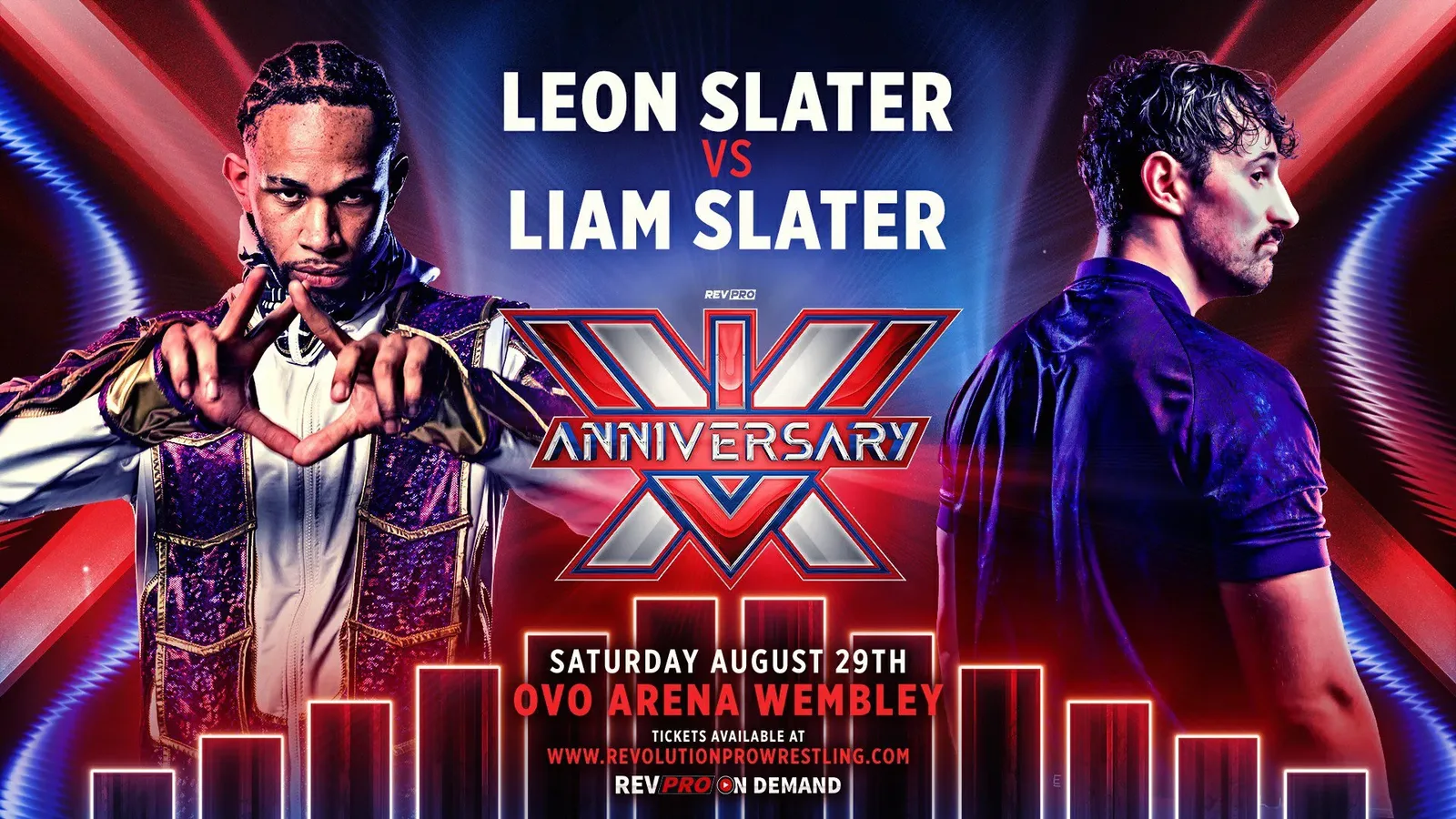
RevPro owner Andy Quildan has reflected on the decision to leave Leon Slater vs. Liam Slater off the MyAEW broadcast of the promotion’s anniversary event in August, admitting that the effort to avoid potential complications may ultimately have created more attention around the situation.
The match took place live during RevPro’s anniversary show but was not included when the event was made available through MyAEW. That omission quickly became a talking point among fans, with early speculation centering on whether TNA Wrestling had played a role in the bout being withheld from the broadcast.
Quildan later clarified that he made the decision himself. Speaking in a recent interview, the RevPro promoter explained that his thinking was rooted in trying to make the process easier for every party involved rather than becoming involved in any unnecessary dispute. However, he also acknowledged that the result has caused him to reconsider whether that approach was the correct one.
“I’m not sure, to be honest. I was trying to make everyone’s life as easy as possible,” Quildan said. “My role, as an independent wrestling promoter, has always been to get the match in the ring to try and have foresight. You try to envision every single problem that could occur before it becomes a problem. And the last thing we want is for anything to become an issue on the day, or post-show, or anything like that.”
For more background on this topic, read Andy Quildan Reflects On RevPro’s Decision To Black Out Leon Slater Match On MyAEW.
The explanation provides important context to a situation that had initially been interpreted by some viewers as a possible issue between promotions. Leon Slater has become one of the most closely watched young names in British wrestling, while also appearing in TNA. With modern wrestling partnerships, talent agreements, broadcast rights, and fan expectations often overlapping, even the absence of a single match from a streamed event can invite extensive speculation.
For Quildan, the priority was attempting to anticipate a problem before it could affect the live event or the subsequent release of the show. Independent promoters regularly operate in a space where wrestlers may have commitments to multiple companies, and where a match that is straightforward to book for a live crowd can involve added questions once footage is distributed through a streaming platform.
Quildan did not identify a specific outside demand or detail any particular restriction that led to the decision. Instead, he focused on the broader responsibility he feels as a promoter: ensuring the match can happen and trying to identify difficulties before they become a larger issue.
Still, he conceded that removing the Slater vs. Slater match from the MyAEW presentation may have had the opposite effect of what was intended.
“And it’s crazy; with the benefit of hindsight, maybe we did the wrong thing, because that almost created more attention on the situation,” Quildan said. “I think, as we do with everything, we have to learn, we have to evolve, we have to adapt and move forward.”
That assessment speaks to the challenge of handling uncertainty in an environment where information travels quickly and fans closely monitor the relationships between wrestling companies. If a match takes place in front of a live audience but does not appear on the eventual broadcast, the gap naturally becomes a subject for discussion. In this case, the decision to omit the contest created questions that may not have existed had it simply been presented alongside the rest of the event.
The match is now available to watch for free on YouTube, ensuring that viewers who missed it on the original MyAEW release can see Leon Slater and Liam Slater’s encounter. Its eventual availability also means the issue is no longer about whether the bout can be viewed, but rather why it was initially excluded from the broadcast presentation.
Quildan’s approach to wrestling relationships
Beyond the specific decision involving the Slater match, Quildan emphasized that RevPro’s larger goal is to preserve constructive working relationships throughout professional wrestling. RevPro has long operated as one of the key independent promotions in the United Kingdom, and its ability to feature talent from different parts of the industry is central to both its identity and its business model.
Rather than taking sides in promotional rivalries or allowing fan-driven tribalism to dictate decisions, Quildan said he wants RevPro to be a company that can work productively with anyone. That philosophy is particularly significant at a time when talent can appear across independent events, major televised promotions, international companies, and streaming services in a relatively short period.
“I don’t want to be involved in any wrestling politics,” Quildan said. “I always say, we are open to do good business with anyone. I know in business it’s almost impossible, especially when there’s so much tribalism that goes around, but I want to be on the good side of everyone.”
Quildan’s comments distinguish between the competitive nature of wrestling and the practical realities facing a promotion like RevPro. Companies may compete for attention, ticket sales, subscriptions, and talent, but independent organizations often need to maintain flexibility. A healthy relationship with wrestlers, representatives, and other promotions can determine what matches are possible and how a card comes together.
For RevPro, the objective is not simply to secure appearances. It is also to conduct business in a way that reassures partners that their interests will be respected. Quildan said he wants companies and individuals who work with RevPro to feel confident that the promotion will act responsibly.
“And I want everyone to know that when they do business with us, we will do good business and we will try and do best by the company, and I don’t want anything to be received as, we’re trying to sneak people into places,” Quildan said.
The wording is revealing because it addresses a concern that can emerge whenever a wrestler associated with one promotion appears elsewhere. In an increasingly connected wrestling landscape, appearances can be interpreted in many ways by fans, especially when there is limited public information regarding permissions, distribution arrangements, or the terms surrounding a particular booking.
Quildan’s position is that RevPro does not want to create the impression that it is using talent in a way that sidesteps another company’s interests. His comments also suggest that the choice surrounding the MyAEW broadcast was made with that wider reputation in mind. Even if the decision attracted more discussion than expected, the intent was to prevent RevPro from becoming a source of friction.
A learning moment for RevPro
The immediate consequence of the omission was a wave of speculation, including assumptions that TNA had directed the match to be removed. Quildan taking ownership of the decision changed the framing of the story. Rather than a confirmed inter-promotional conflict, it became an example of a promoter making a cautious call and then openly considering whether that caution had been misplaced.
That candor may be the most notable aspect of his latest remarks. Quildan did not insist that the matter had been handled perfectly. Instead, he accepted that hindsight can expose flaws in a decision, particularly when the intended outcome is to minimize attention and the final result produces a larger conversation.
There is also a practical lesson for promotions releasing content after the fact. Live wrestling and on-demand wrestling are not always identical products. Matches can be adjusted, omitted, or rearranged for a variety of reasons, but absent a clear explanation, fans will often fill in the blanks themselves. In an era of immediate social media discussion, even a decision made with careful intentions can become more conspicuous than the issue it was meant to avoid.
For the fans interested in the match itself, the availability of Leon Slater vs. Liam Slater on YouTube provides a straightforward resolution. The bout can now be watched without the question of its broadcast absence preventing viewers from seeing it.
For RevPro, the episode appears set to stand as a point of reflection rather than a lasting barrier. Quildan’s stated commitment is to learn from the situation, adapt where necessary, and continue positioning the company as a dependable partner across the wrestling industry.
His comments make clear that RevPro’s focus remains on putting matches together, serving its audience, and conducting business in a way that keeps doors open. In this case, the decision surrounding the Slater match did not unfold as quietly as intended. But Quildan has acknowledged that outcome, explained the thinking behind it, and indicated that the promotion will carry those lessons forward.
Darryl Polo
Darryl Polo is a passionate wrestling fan covering WWE, AEW, TNA and beyond. He loves great rivalries, breakout stars and the moments that keep fans talking long after the bell. How we work.