
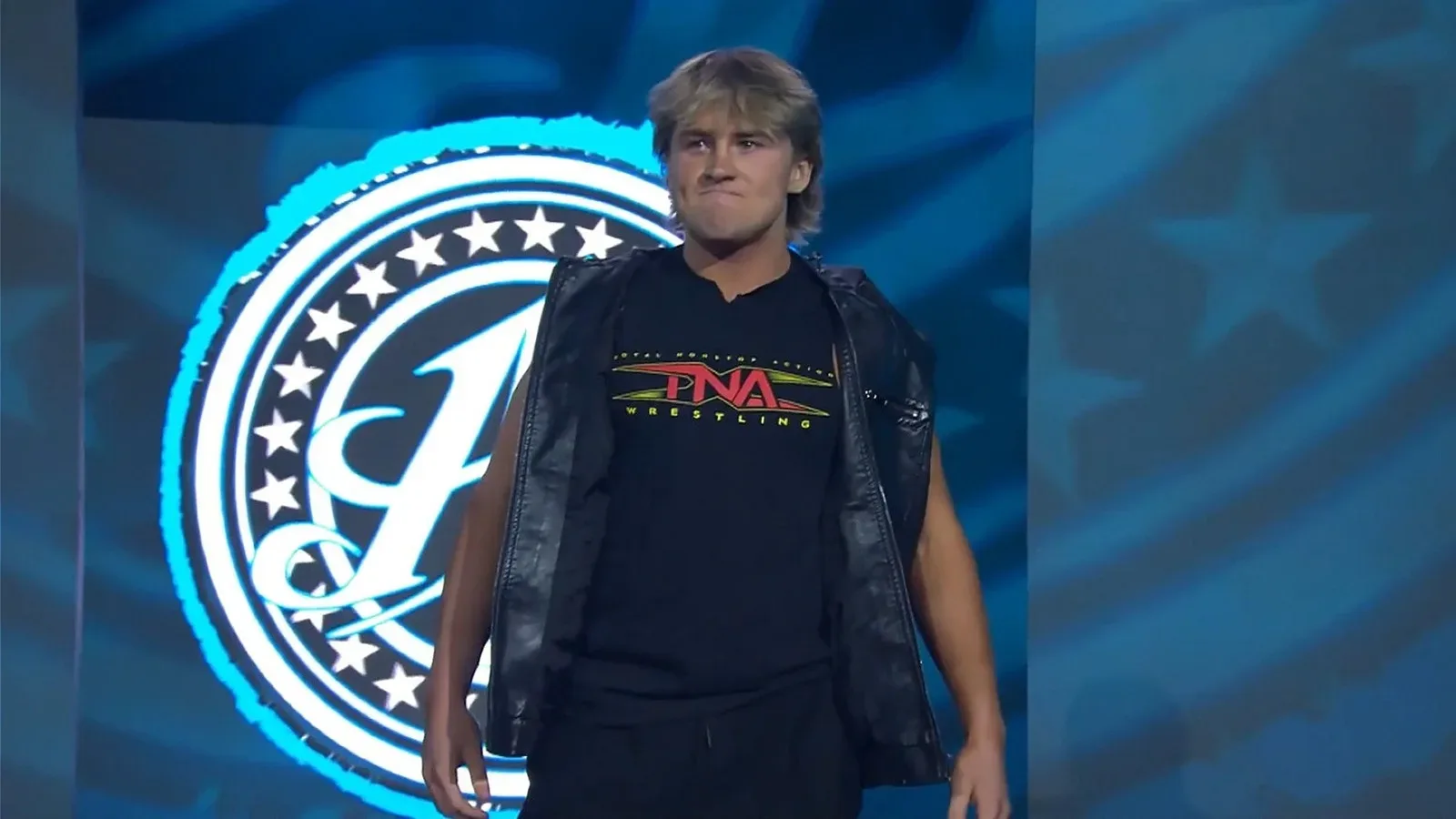
AJ Styles sees a clear value in Avery Styles’ early move into TNA: television experience.
The younger Styles, AJ’s second-eldest child, has begun building his own career in professional wrestling through independent appearances and a recent agreement with TNA. For AJ, who stepped away from in-ring competition earlier in 2026 following his WWE Royal Rumble match against GUNTHER, the important part of that opportunity is not simply the visibility that comes with joining a national promotion. It is the chance for Avery to learn the demanding structure of wrestling made for television.
Speaking on The AJ Styles Show, Styles explained that Avery will continue working independent dates while also competing in TNA. The former world champion specifically pointed to the experience gained by wrestling within a televised environment, where performers must make their matches work inside rigid production windows.
“Oh, he’s going to do independents and he’s definitely doing TNA. TNA gets him the reps that he needs on television,” Styles said on The AJ Styles Show. “You need these reps on television because you have to hit times. You have a certain time limit to hit these things before commercial breaks and then you have a certain time after you come back that you got to hit.”
For more background on this topic, read Kurt Angle Explains Why TNA’s Six-Sided Ring Was a Difficult Adjustment.
Why television timing matters to AJ Styles
Styles’ comments underline one of the less visible skills involved in becoming a polished television wrestler. A performer can have athletic ability, charisma, conditioning, and a firm grasp of the fundamentals, but TV wrestling requires those elements to be delivered within a production format that has its own precise demands.
Commercial breaks, segment transitions, entrances, interviews, video packages, live crowd reactions, and the overall running order all affect what happens in the ring. Matches are not merely built around the two or more wrestlers involved. They have to fit the needs of a complete program.
That can require a wrestler to reach a key point in a match before the broadcast cuts away, maintain audience interest through a break, and then return with enough remaining time to build toward the finish. It can also mean adjusting in real time when an entrance runs longer than expected, when crowd noise changes the pacing, or when a producer provides updated instructions.
For a developing talent, that kind of repetition can be invaluable. Independent wrestling can offer a wide range of opponents, venues, and styles, and AJ Styles made clear that Avery will remain active in that setting. But TNA provides an additional layer: the need to execute in a setting where timing is connected to an ongoing television product.
“So, being at TNA will help him hit his times,” Styles added on The AJ Styles Show.
It is a practical lesson from someone whose own career has included years of high-profile television wrestling. AJ Styles has worked in environments where timing, pacing, crowd engagement, and production needs all carried enormous importance. His assessment of Avery’s next step is therefore focused on development rather than simply the prestige of a recognizable promotion.
Avery Styles can combine TNA exposure with independent work
The approach outlined by Styles gives Avery a potentially useful balance at the start of his career. Continuing on the independent circuit allows a young wrestler to gain ring time and face different kinds of opponents. Every match can present a new challenge, whether that means adapting to a different crowd, adjusting to a different building, or working alongside wrestlers with varying levels of experience.
TNA, meanwhile, offers the distinct challenge of appearing on a televised wrestling show. The lessons AJ highlighted are not limited to the final bell. Wrestlers must understand how to make entrances count, where to position themselves for cameras, how to build a match around breaks, and how to deliver a satisfying segment in the allotted time.
There is also an important difference between simply knowing that a match should be concise and understanding the rhythm required to meet an exact time cue. A wrestler may need to slow down to let a moment breathe, accelerate when time is shortened, or alter the layout of a match while preserving the logic of the story. Those are skills earned through experience.
AJ Styles’ emphasis on “reps” speaks to the reality that these instincts are developed through doing the work repeatedly. A young wrestler can study television matches and learn from coaches, but performing under the pressure of a broadcast format is another step entirely.
For Avery, TNA’s platform provides an opportunity to begin developing those instincts while still retaining the broader learning opportunities of independent wrestling. It is not an either-or path in AJ’s view. The two environments can complement one another.
Frankie Kazarian’s role on TNA programming
Avery Styles has also entered TNA television with an on-screen connection to Frankie Kazarian, an established TNA name and a longtime friend of AJ Styles. Kazarian has been presented as a mentor or adviser to Avery, creating an immediate storyline framework for the younger wrestler as he finds his place on the roster.
That relationship has not been portrayed as entirely straightforward. Kazarian’s advisory role has included him speaking on Avery’s behalf rather than allowing Avery to fully speak for himself. The dynamic suggests a potentially growing issue between the two, with a match down the line appearing to be a possible destination for the story.
The angle also gives Avery something that many newcomers need when arriving on television: a defined relationship with an established personality. Rather than being introduced without context, Avery is connected to both Kazarian and, by extension, the history that Kazarian shares with AJ Styles.
That does not mean Avery’s presentation has to remain tied to others. In fact, the tension within the current story appears built around the question of when he will assert himself. If Kazarian continues speaking for him or attempting to control his path, Avery will have a natural reason to push back and establish more of his own voice.
For a newer performer, that kind of storyline can provide a focused way to develop character work in front of a television audience. It creates stakes that go beyond a single match result while also allowing the audience to learn who Avery is through his reactions to Kazarian’s behavior.
AJ Styles’ perspective is rooted in the craft
There is an understandable temptation to view Avery Styles’ wrestling journey primarily through the lens of his father’s name. AJ Styles is one of the most accomplished wrestlers of his generation, and Avery entering the business naturally brings attention and expectations. AJ’s own comments, however, frame the situation in terms of fundamental professional growth.
He did not describe TNA as a shortcut. He described it as a place where Avery can gain television reps and learn the discipline of hitting specific time marks. That is a measured outlook, centered on the technical demands of the profession.
It also reflects a lesson AJ Styles clearly considers important enough to pass along. Timing is often the framework that allows everything else in a wrestling match to work. A well-executed sequence can lose impact if it arrives too early or too late. A crowd can be ready for a closing stretch, but the match still needs to arrive there at the appropriate point. On television, those artistic decisions must coexist with the practical needs of a live production.
Experienced wrestlers can make that balance look effortless. They understand when to hold a reaction, when to move to the next part of the match, and when a finish needs to begin. The goal for Avery will be to develop that same awareness through the opportunities now available to him.
The next stage for Avery Styles in TNA
Avery Styles’ immediate TNA direction remains tied to Kazarian and the increasingly complicated mentor dynamic between them. Whether that relationship ends in a direct confrontation or takes another turn, it has given Avery a visible starting point on the promotion’s programming.
At the same time, AJ Styles’ comments offer a broader view of what Avery should be taking from the experience. The most valuable takeaway may not be any one storyline or match. It may be the repeated process of working on television, learning the production rhythm, and becoming comfortable with the exacting pace of a nationally presented wrestling show.
Independent dates will continue to provide Avery with opportunities to refine his in-ring foundation. TNA can add the education that comes from working to the clock, navigating commercial breaks, and performing in a format where every segment has a specific place in the show.
For AJ Styles, that is the lesson he wants his son to absorb. TNA is not only a stage for Avery Styles to be seen. It is a setting where he can learn one of wrestling television’s most essential professional skills: how to make every second count.
In pictures

Darryl Polo
Darryl Polo is a passionate wrestling fan covering WWE, AEW, TNA and beyond. He loves great rivalries, breakout stars and the moments that keep fans talking long after the bell. How we work.