
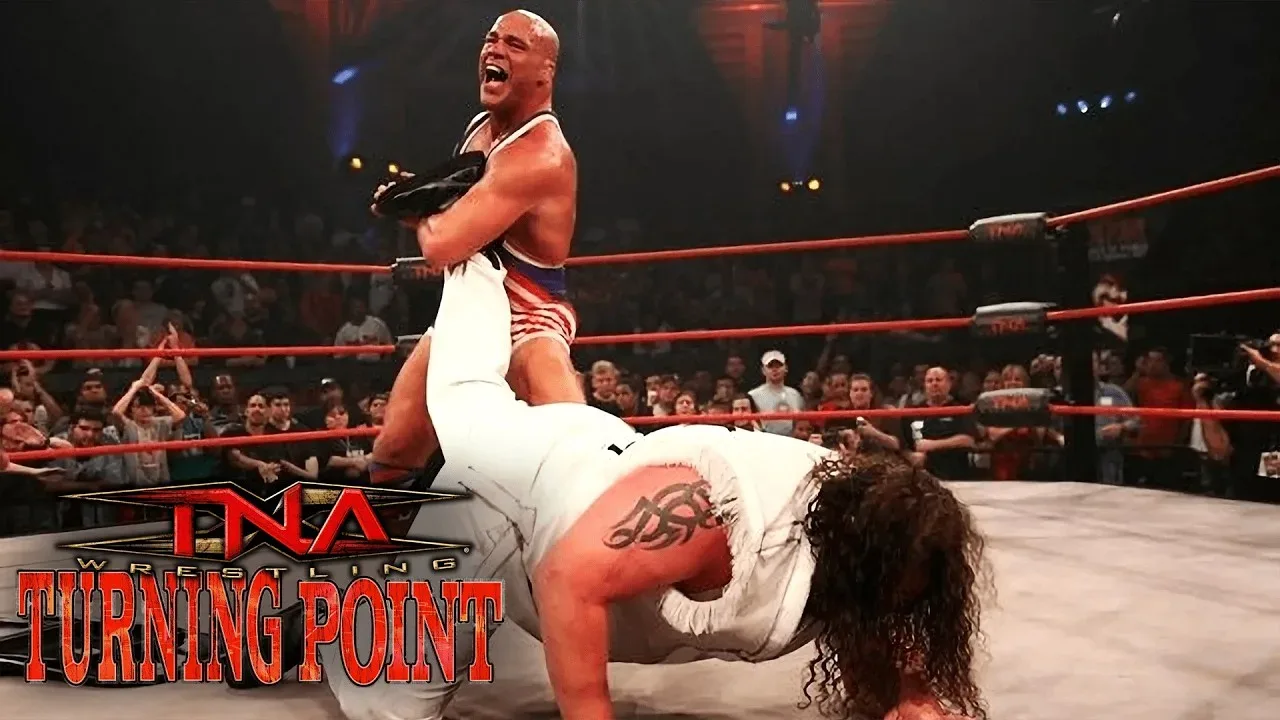
Kurt Angle has offered a detailed look at the physical adjustment required to wrestle in TNA’s distinctive six-sided ring, explaining why its construction could be particularly punishing for wrestlers who spent a great deal of time taking bumps in the center of the canvas.
The six-sided ring remains one of the most recognizable visual elements in TNA history. It was used during two separate stretches: first from 2004 until 2010, then again from 2014 through 2018. While the presentation gave the company an immediate point of difference from promotions using the traditional four-sided ring, the design also created a different in-ring experience for the talent working inside it.
Speaking in a 2025 interview with GTV Network, Angle said the transition was not simple when he arrived in TNA. The Olympic gold medalist ultimately adapted to the setup and found aspects of it appealing, but he stressed that the ring’s stiffness was the major obstacle.
“The reason why it was so terrible is it’s really stiff,” Angle said. “The ring’s really stiff because it’s a lot smaller. So if you have a longer ring, the plywood’s longer. It gives a little bit more of a bounce, and I think that’s the reason why AJ didn’t like it is because he did so much flying around the ring and landing on his back in that middle of that ring, and that’s really stiff.”
For more background on this topic, read Frankie Kazarian Explains Decision To Halt Avery Styles’ First TNA Match Against AJ Francis.
A Ring That Changed More Than the Look of the Show
For viewers, the six-sided ring changed the silhouette of TNA programming. The extra corners made the action feel visually different, provided a recognizable backdrop for the company’s X-Division style and helped distinguish the promotion during a period in which it was seeking to establish a clear identity in the North American wrestling landscape.
For wrestlers, though, the design was not merely cosmetic. Angle’s comments point to the practical differences between the ring configurations. A smaller ring and the way it was constructed could make the mat feel less forgiving, especially in the middle. That is significant for any wrestler, but it carries an obvious added concern for performers whose offense involves frequent dives, springboard attacks, aerial maneuvers and hard landings.
AJ Styles was among the defining names of the era in which the six-sided ring became synonymous with TNA. His athletic and high-flying approach made him a central figure in the promotion’s presentation, and Angle believes that style helps explain why Styles was not a fan of the setup. The issue, in Angle’s view, was not simply that a six-sided ring looked or felt unfamiliar. It was the cumulative impact of repeatedly landing on a particularly firm surface.
That distinction is important. Professional wrestlers routinely adapt to different venues, ring sizes, ropes, turnbuckles and canvases throughout their careers. Yet even relatively small changes in a ring’s give can alter how a wrestler takes a flat-back bump, how much force is absorbed on landing and how confidently a performer can execute certain movements. A ring that offers less bounce can make a long match or a demanding schedule more taxing over time.
Angle Eventually Found Benefits in the Design
Although Angle acknowledged the difficulty of adapting to the ring, he did not present the six-sided concept as entirely negative. In fact, he said he came to appreciate one of its most obvious structural differences: the additional corners.
“But I didn’t mind having it,” Angle said. “I actually gave you more choices to shoot somebody into a corner. You have six sizes instead of four. But, you know, it took a little bit of an adjustment. It wasn’t that easy when I first entered into TNA. But you get used to it after a while.”
Angle’s point about the corners reflects the way ring geometry can influence match planning. With six corners rather than four, wrestlers have more destinations to work with when sending an opponent across the ring. That can create different pathways for movement, open up fresh setups for attacks and allow performers to vary familiar sequences. In a promotion built around presenting a contrasting product, those details could contribute to the feeling that TNA’s matches had their own rhythm.
The difference also extended to how wrestlers had to orient themselves. Ring positioning is one of the basic skills of professional wrestling, whether a performer is setting up a rope-assisted move, finding a corner for a whip, locating an opponent or ensuring they are in the proper place for a sequence. Changing from four points of reference to six requires adjustment, particularly for talent whose instincts were developed over years in conventional rings.
Angle’s assessment is therefore balanced: the ring was difficult at first, it could be hard on the body, and it was especially challenging for a wrestler working a high-impact aerial style. At the same time, he felt it offered creative advantages and became manageable with experience.
The Six-Sided Ring’s Place in TNA History
TNA’s relationship with the six-sided ring unfolded across two major chapters. The company initially adopted it in 2004, and it remained part of the presentation until 2010. The design later returned in 2014 and stayed in use through 2018.
Across those periods, the ring became tied to major moments and many of the talents who shaped the company’s reputation. It was an integral part of the environment in which wrestlers such as Angle and Styles competed, and it became an enduring image for fans who associate TNA with a more unconventional approach to televised wrestling.
Its eventual retirement was linked to the physical wear and tear experienced by wrestlers. That history gives added context to Angle’s remarks. His explanation of the stiffness does not stand as a purely aesthetic critique or a matter of individual preference. It speaks directly to the broader concern that a ring’s design can have consequences for the people taking bumps in it night after night.
Wrestling rings are designed to absorb and distribute impact, but they are not soft surfaces. Every version of a ring brings its own feel, and every wrestler has different preferences based on their style, size, injury history and the offense they perform. For a technical wrestler such as Angle, the additional corners could offer useful strategic options. For someone whose matches included constant flying and repeated back landings, the limited give in the middle could be a far more pressing concern.
Why the Debate Continues
The six-sided ring still prompts discussion because it represents both an identity choice and a safety consideration. On one side, it was unmistakably TNA. The unusual shape made the promotion instantly identifiable and gave its television product a look that was separate from the standard visual language of much of the industry. On the other, wrestlers had to work within the physical limitations that came with that choice.
Angle has previously addressed the possibility of TNA bringing the six-sided ring back at some point in the future. His latest comments illustrate why any discussion around a potential return will likely include both perspectives. Fans may remember the ring as an emblem of a particular era, while wrestlers and officials must consider the realities of construction, impact and long-term wear on the roster.
There is no single answer that applies to every performer. Angle said he adjusted and did not mind the ring after becoming accustomed to it. His comments regarding Styles, however, underscore that the same setup can be experienced very differently by another athlete. A performer’s style is central to that calculation.
Ultimately, Angle’s recollection captures the trade-off at the heart of TNA’s most famous ring design. The six-sided layout created more corner options and a distinctive presentation, but it demanded an adjustment from wrestlers and could be unforgiving when it came to impact. For Angle, getting used to it was possible. The process, however, was anything but immediate.

Darryl Polo
Darryl Polo is a passionate wrestling fan covering WWE, AEW, TNA and beyond. He loves great rivalries, breakout stars and the moments that keep fans talking long after the bell. How we work.