
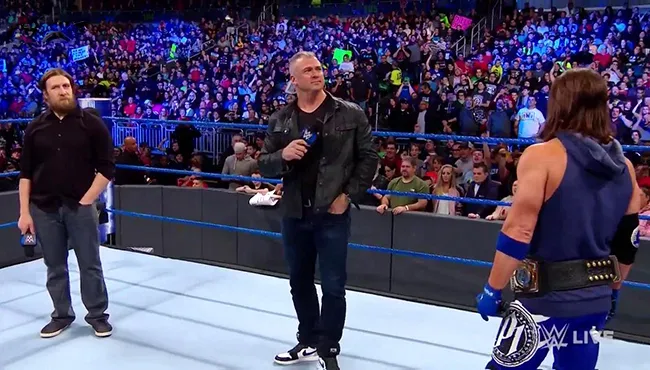
AJ Styles has looked back on one of the more unusual WrestleMania matchups of his WWE career, saying that he and Shane McMahon exceeded the expectations of fans who questioned what the pairing could deliver on the biggest stage.
Styles faced McMahon at WrestleMania 33 in 2017, a match that placed one of the most accomplished in-ring wrestlers of his generation opposite a longtime WWE executive and occasional performer. The build centered on conflict between Styles and McMahon, but much of the conversation heading into the event focused on whether the match could live up to a prominent spot on a WrestleMania card.
For Styles, the answer came down to McMahon's dedication and their shared preparation. He praised McMahon as a perfectionist and described their match as a major success.
“I mean, the guy, he’s a perfectionist. And so the matchup that we had was pretty unbelievable,” Styles said. “We had an unbelievable match. A lot of people I think they underestimated what we could do in there, and at WrestleMania we showed him exactly what Shane McMahon and AJ Styles could do. I mean it was absolutely fantastic.”
For more background on this topic, read Booker T Looks Back on Earning WWE Trust Through Early Programs With Steve Austin, The Rock and Kurt Angle.
A WrestleMania Match Built Around Skepticism
The Styles-McMahon match was an especially notable chapter in Styles' WWE run because of the contrasting paths that brought the two men to the ring. Styles had arrived in WWE in 2016 with a reputation built across multiple promotions and on the international stage. By WrestleMania 33, he had already won the WWE Championship and established himself as one of the promotion's most reliable major-match performers.
McMahon, meanwhile, had been a recognizable WWE personality for decades. While he had previously competed in high-profile bouts, including matches that demanded dangerous stunts and elaborate production, he was not presented as a full-time in-ring wrestler. That distinction led many fans to view the WrestleMania 33 contest as a matchup whose outcome would rest heavily on Styles' ability to structure the action around McMahon's strengths.
Styles' comments make clear that he does not see the bout as a case of merely carrying an inexperienced opponent through a celebrity-style WrestleMania attraction. Instead, he emphasized McMahon's pursuit of precision and the work that went into making the contest feel significant. Their match had to accommodate the expectations attached to Styles while also allowing McMahon to deliver the kind of memorable WrestleMania spectacle audiences associate with his appearances.
The result was a match remembered for its athletic sequences, character-driven conflict, and a dramatic finish that saw McMahon attempt a high-risk leap from the ring structure. Styles ultimately won the contest, but the broader takeaway from his perspective is that the two performers answered the doubts surrounding the pairing. He believes their WrestleMania outing showed exactly what they were capable of accomplishing together.
Styles Pushes Back on the Bullet Club Leadership Label
Styles also addressed a long-discussed part of his career before WWE: his time in New Japan Pro-Wrestling's Bullet Club. The faction became one of professional wrestling's most influential groups of the 2010s, with its presence helping connect audiences across Japan, North America, and the independent wrestling scene.
Because Styles was one of the faction's most recognizable stars during his New Japan tenure, he has frequently been identified by fans as a leader of Bullet Club. Styles, however, offered a more nuanced view of that label. He said he never personally claimed to be the group's leader and stressed that the faction's philosophy was not built around following one person.
“See, everybody thinks I was the leader of the Bullet Club. I never said that I was a leader of the Bullet Club,” Styles said. “You could say I was the leader of the Bullet Club, but our thing when I was in the Bullet Club is that we didn’t follow anybody, including whoever the leader was. So, we were the Bullet Club.”
That distinction speaks to the identity Bullet Club projected during Styles' time with the group. The faction's appeal was not simply that it had a clear chain of command. It was an outlaw collective built on swagger, disruption, and a shared refusal to fit conventional expectations. Individual personalities were central to the group's popularity, and its members could stand out on their own while still strengthening the broader Bullet Club brand.
Styles' explanation does not deny why many viewers associate him with leadership. He was an important face of Bullet Club during a major period for both the faction and New Japan. But he framed the group's internal dynamic as something broader than one member directing the others. In his telling, Bullet Club functioned around a collective attitude: the group did not exist to follow anyone, even a designated leader.
That perspective also helps explain why Bullet Club has remained such a durable subject in wrestling conversations. Its history includes different eras, shifting personnel, and evolving interpretations of what the name represents. Styles remains one of the central figures connected to its rise, even as he resists reducing that period to a simple leadership designation.
The Significance of Beating Jinder Mahal in the UK
Styles additionally reflected on his WWE Championship victory over Jinder Mahal on SmackDown in the United Kingdom in November 2017. The title change was a major moment in his WWE career, not only because it returned him to the championship picture, but because it occurred outside the United States.
Styles noted that the championship had never changed hands overseas before that occasion. He called the victory a huge moment and explained why winning in the UK carried particular personal meaning for him.
“Oh, wow. Well, I mean you I know you said besides winning the title, I mean, that was the first time the heavyweight championship had ever changed hands overseas,” Styles said. “So when I beat Jinder Mahal, I mean, I got to talk about it. It was a huge moment, and I made a name for myself in the UK, being over so much, you know, different indies and stuff like that. So the fact that I kind of felt like I was one of them, you know, one of their guys, and to win the heavyweight championship here was a great moment.”
The setting mattered to Styles because his connection with UK audiences predated his WWE arrival. Before joining WWE, Styles spent years building his name through independent wrestling and international appearances. That background made him a familiar figure to fans who had followed wrestling beyond WWE's own programming, and he said that familiarity helped make the title win feel especially meaningful.
The championship match also represented a sharp turn in the rivalry with Mahal. Mahal had held the WWE Championship for much of 2017, while Styles entered the contest as a former champion looking to regain the title. Styles' win immediately altered the direction of the championship scene and reinforced his position as a top-level performer on SmackDown.
For Styles, though, the memory is tied to more than the belt itself. He singled out the location, the historic nature of the title change, and the feeling of being embraced by an audience that had seen his work long before he became a WWE main-event fixture. It was a moment where his pre-WWE history and his WWE success met in the same ring.
From In-Ring Career to a WWE Behind-the-Scenes Role
Styles wrestled his final match earlier this year at the Royal Rumble, where he lost to Gunther. He was later inducted into the WWE Hall of Fame as part of the Class of 2016 and has since moved into a behind-the-scenes role with WWE.
His reflections on WrestleMania 33, Bullet Club, and the 2017 United Kingdom title victory cover distinctly different stages of a career defined by adaptability. The Shane McMahon match showed his willingness to embrace a WrestleMania challenge that many initially viewed with skepticism. His Bullet Club comments revisit a period when he was an essential figure in a faction that changed wrestling's wider landscape. The Jinder Mahal victory recalls a WWE milestone that connected directly to the international audience Styles had cultivated for years.
Across all three subjects, Styles' comments return to a consistent theme: perception did not always match the reality of the work. Fans may have underestimated a WrestleMania pairing with McMahon. They may have simplified Bullet Club's structure by placing a single leader at its center. And the UK title win may be remembered primarily as another WWE Championship reign, but Styles sees it as a landmark overseas moment with deep personal significance.
Those memories remain important markers in a career that has moved from the ring into a new WWE role, while preserving the accomplishments and relationships that made Styles one of his era's defining performers.

Darryl Polo
Darryl Polo is a passionate wrestling fan covering WWE, AEW, TNA and beyond. He loves great rivalries, breakout stars and the moments that keep fans talking long after the bell. How we work.