
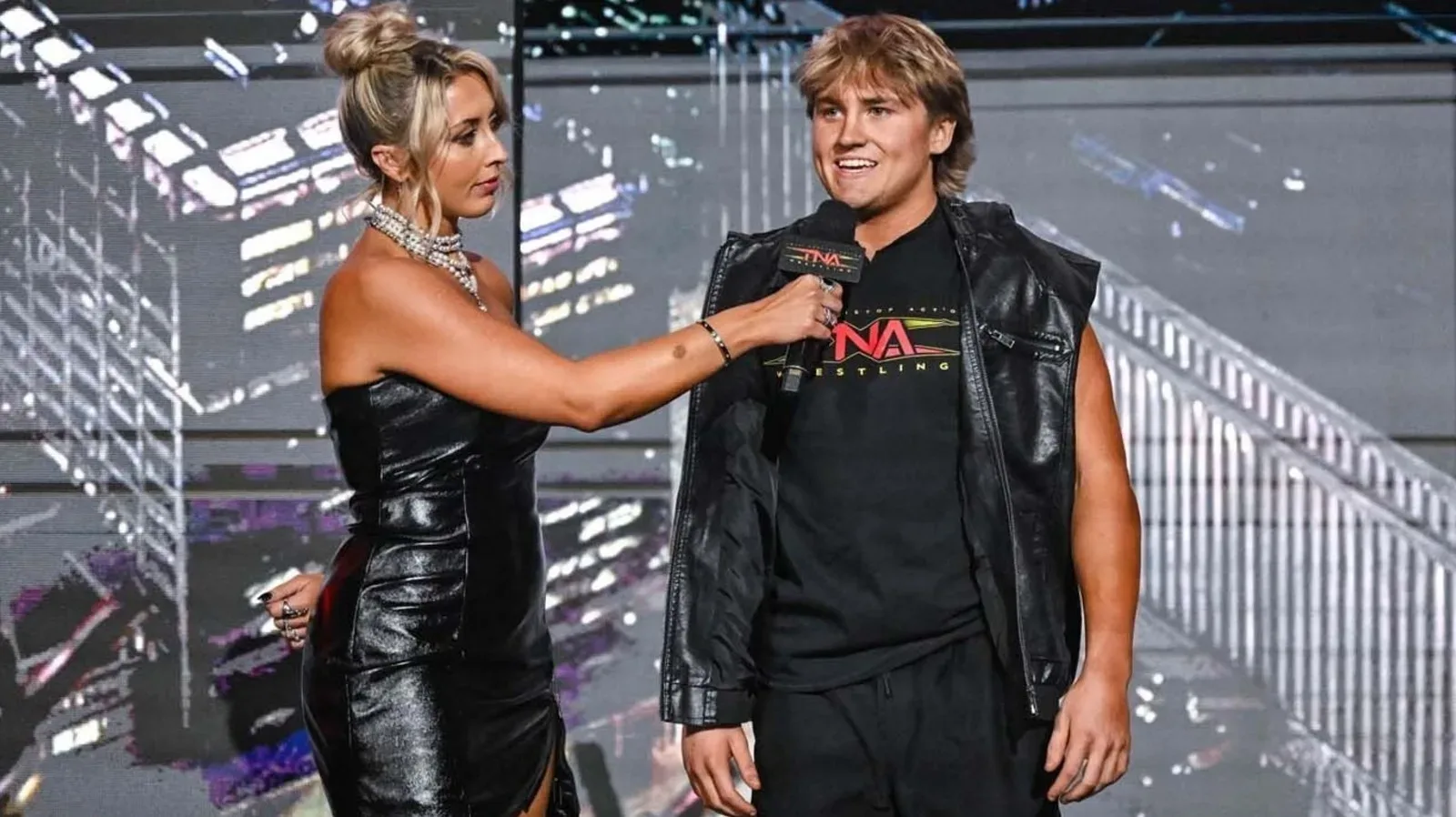
AJ Styles knows better than most how difficult the earliest stages of a professional wrestling career can be. Long before becoming a WWE Hall of Famer and one of the most recognizable performers of his generation, Styles was developing his craft one match, one promotion and one lesson at a time. Now, with his son Avery Styles beginning that same journey, “The Phenomenal One” is confronting a different challenge: learning how to offer guidance without demanding too much, too soon.
Avery has already made his in-ring debut and signed with TNA Wrestling, a particularly meaningful destination considering the central role the company played in AJ Styles’ own rise. His next major step is set for Bound for Glory, where he will make his TNA debut as one of 20 competitors in the Call Your Shot Gauntlet match.
The opportunity puts Avery in a prominent match environment early in his time with the promotion. It also gives the younger Styles a chance to gain experience alongside a broad field of talent in a match built around endurance, timing, adaptability and survival. For AJ, however, the focus is not simply on the size of the stage. It is on making sure his son is given the time required to grow.
AJ Styles recognizes the pressure he puts on Avery
Speaking with Cody Rhodes on What Do You Wanna Talk About?, AJ Styles candidly discussed his approach to evaluating Avery’s work. The veteran acknowledged that his standards can be demanding, especially because he sees the areas where his son can improve and wants him to progress.
For more background on this topic, read Matt Hardy Says He Could Keep Wrestling After Jeff Hardy Retires.
“Well, I mean, I think I’m a little hard on him. I’m probably the worst. Because I’m sure some of the things he’s like, ‘I can’t do anything right. Everything I do is wrong.’ And it’s because I expect it to be better.”
That honesty is notable coming from a performer with AJ Styles’ background. He has competed at the highest level across multiple major promotions and has built a career around exceptional athletic ability, precision and the capacity to adapt his style to different opponents and environments. A son entering the same industry will naturally face comparisons, especially while using the Styles name and beginning his TNA tenure in a company closely connected to his father’s legacy.
AJ made clear that he has had to check his own expectations. Rather than judging Avery as though he should already possess the polish of an established wrestler, Styles said he tries to remember what his own work looked like while he was still learning.
“And I have to take a step back and remember what it was like for me. And if I would just go back and watch some of my old stuff, it was absolutely terrible. I’d realize that it just takes time.”
It is an important perspective for any wrestler entering the profession, but it carries particular weight in Avery’s case. The path can appear shorter when a young talent has a famous parent, yet the actual process of developing ring awareness, confidence, character work and a distinct connection with audiences cannot be skipped. AJ’s comments underline that he understands the difference between access to opportunity and readiness for long-term success.
Learning from mistakes without overloading a newcomer
Styles said he is actively trying to balance criticism with encouragement. Rather than pointing out every weakness after a match, he wants to recognize the positives and avoid burying Avery beneath a list of corrections. That does not mean AJ is lowering his standards. Instead, it means he is considering how a new wrestler can best absorb feedback while continuing to build confidence.
“So I try to say, ‘Well, this was good and this was good,’ and reserve the right to maybe don’t tell him everything that was bad, which was a lot.”
The remark was delivered with the self-awareness of a father who knows his son may be receiving a more detailed review than most newcomers. Yet it also reflects a practical truth about professional wrestling: every young performer has flaws, and many of them can only be corrected through repetition. A wrestler needs matches, different opponents and the freedom to make mistakes before those lessons become instinctive.
For Avery, the Call Your Shot Gauntlet offers one of those learning opportunities immediately. The format brings 20 wrestlers into the same contest, requiring participants to adjust to changing circumstances and opponents throughout the match. It is not simply an individual showcase. It demands awareness of positioning, elimination sequences, pacing and the unique rhythm of a crowded match.
Bound for Glory will therefore be a significant setting for Avery’s official arrival in TNA, but it should not be treated as a finished-product moment. AJ’s own words indicate that he views this stage as the beginning of a much longer education. His son is entering a business where experience is earned over time, and where the ability to adapt is often just as valuable as the ability to execute impressive moves.
Avery Styles is still searching for his own identity
One of the most difficult parts of being the child of a celebrated wrestler is avoiding the temptation, or expectation, of becoming a copy. Avery currently uses elements associated with his father’s work, something AJ openly recognizes. That is understandable for a young performer whose earliest exposure to wrestling came through watching one of the industry’s most accomplished stars.
Still, AJ believes Avery must ultimately move beyond imitation. The veteran sees a wider concern within wrestling, where performers can become too closely identified with somebody else’s style rather than finding the traits that make them individually valuable.
“And listen, the biggest problem that a lot of people have right now is they end up being like someone else. And I know that he is doing a lot of my stuff, but in time, he will realize that he’s able to do other stuff.”
That distinction may prove crucial as Avery builds his career. Using familiar offense can help a young wrestler find a foundation, particularly when he is learning from someone with AJ Styles’ experience. But a lasting career requires more than recognizable moves. It requires discovering what feels natural, identifying the right opponents and situations, and developing a presentation that audiences can connect to on its own terms.
AJ wants his son to encounter a variety of wrestling styles and promotions as part of that process. The message is not that Avery should abandon what he has learned from his father. Rather, it is that his education should be broad enough to reveal the tools he possesses beyond those early influences.
That approach mirrors the versatility AJ himself demonstrated throughout his career. His body of work was shaped by adapting to different settings and different types of opponents. He did not become known only for one environment or one formula. For Avery, exposure to new styles may be the route to discovering which aspects of his own game are strongest.
Bound for Glory presents a major early test
Avery’s TNA debut at Bound for Glory will come under considerable attention, both because of the event and because of his family name. The Call Your Shot Gauntlet match creates an immediate chance to be seen in a high-profile setting, but it also brings the sort of pressure that can test a newcomer’s composure.
There will be no expectation that Avery has every answer at this point in his career, and AJ’s assessment makes that clear. His son is still learning, still making mistakes and still working toward the point where his in-ring identity becomes unmistakably his own. What matters now is continued development and the willingness to take lessons from every experience.
AJ Styles may be a critical observer of Avery’s work, but his comments also reveal a father determined to help his son navigate a demanding profession realistically. He knows the value of high expectations. He also knows that even a future great can look rough at the beginning.
At Bound for Glory, Avery Styles will take another step in a journey that will inevitably invite comparisons to AJ. The more important story, though, will be how he uses the opportunities ahead to become something distinct: not a replica of “The Phenomenal One,” but a wrestler capable of defining what the Styles name means in his own generation.
In pictures

Darryl Polo
Darryl Polo is a passionate wrestling fan covering WWE, AEW, TNA and beyond. He loves great rivalries, breakout stars and the moments that keep fans talking long after the bell. How we work.