
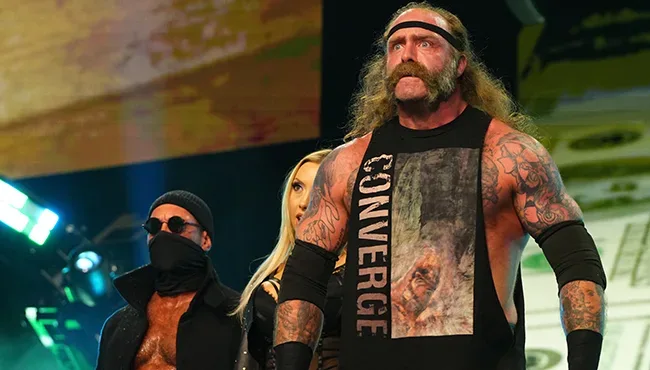
Andy Williams, the professional wrestler known as The Butcher during his run in All Elite Wrestling, has died at the age of 48 following a medical emergency at an independent event.
Williams collapsed during the Enjoy Five-Year Anniversary show on Friday and was transported to a hospital. The Allegheny County Medical Examiner’s Office has confirmed his death. Further details surrounding the incident have not been publicly disclosed.
The news is a heartbreaking loss for two communities in which Williams built a powerful and distinctive legacy. In wrestling, he developed into a memorable tag team force as one half of The Butcher and The Blade. Outside the ring, he was widely known as the guitarist and a founding member of the influential metal band Every Time I Die.
Williams’ wrestling career did not follow a conventional path, but that journey helped shape the physical, hard-hitting presence that eventually made The Butcher stand out on a national stage. He initially trained through Renegade Wrestling Association, though he was forced to step away from training for a period. When he returned to pursuing professional wrestling, he trained with Josh Barnett and later with Grapplers Anonymous.
For more background on this topic, read Maple Leaf Pro Wrestling Relaunches Can-Am Dojo as MLP Academy With Josh Alexander as Head Coach.
At Grapplers Anonymous, Williams trained under Jesse “The Blade” Guilmette, who would become not just a close associate in the ring but his longtime tag team partner. The two developed their partnership on the independent circuit, bringing together their contrasting looks and shared intensity to form The Butcher and The Blade.
A Journey From Independent Wrestling to AEW
Williams began working independent wrestling events in 2015. He built experience in an era when independent wrestling offered performers opportunities to create their identities before audiences that valued originality, toughness, and a willingness to stand apart. His background in metal music was impossible to separate from his presentation. Williams looked unlike most wrestlers, carrying himself with the presence of a bruiser who seemed built for a violent brawl.
His growing profile brought him to notable independent events, including the first Joey Janela’s Spring Break in March 2017. Over time, The Butcher and The Blade became more established as a tandem, gaining recognition for their aggressive style and for the immediate visual impact of their act.
That work ultimately led to a major opportunity when The Butcher and The Blade arrived in AEW in November 2019. Their debut was designed to make an impression, as they entered alongside The Bunny and immediately positioned themselves as a dangerous new presence in the company’s tag team division.
For Williams, the AEW signing represented an important milestone after years spent developing on the independents while maintaining his prominent career as a musician. The Butcher had a presentation that felt distinct within AEW: imposing, tattooed, physical, and fully suited to the rougher edge of the tag team scene. Alongside The Blade, he brought a sense of menace that allowed the pair to work naturally as antagonists against many of the promotion’s established teams.
The Butcher and The Blade remained associated with AEW from their 2019 arrival through June of this year, when their contracts expired. Their time in the company included a variety of television appearances and feuds, and their tenure ensured that Williams reached an audience far beyond the independent wrestling circles where he had initially honed his craft.
The Butcher’s Lasting In-Ring Identity
Williams’ identity as The Butcher was built around more than a name or a striking entrance. His style emphasized force and physicality, while his appearance gave the character an immediate authenticity. He did not need a complicated explanation to make audiences understand what The Butcher was supposed to be. The visual alone communicated danger.
That effectiveness was especially valuable in a tag team setting. Guilmette’s The Blade and Williams’ The Butcher were different figures, but their partnership created a cohesive unit. The act became even more recognizable with The Bunny at their side, and the trio’s AEW introduction remains the defining moment of their presentation for many viewers.
Williams also represented a type of performer whose route to wrestling’s national stage was shaped by experience outside of the business. His established life in music, his return to wrestling training after time away, and his eventual rise through the independent scene gave his career a different texture from that of wrestlers who entered the industry at a younger age and followed a more traditional developmental route.
He found a way to translate a lifetime of performance into a wrestling character that felt legitimate. Whether a fan first encountered him on an independent card, during an AEW tag team match, or through his music, Williams left a recognizable impression.
A Major Presence in Heavy Music
Before and throughout his wrestling career, Williams was an important figure in heavy music. He was a founding member and guitarist for Every Time I Die, the metal band formed in 1998. The group released nine albums before breaking up in January 2022.
Every Time I Die developed a substantial following over its long run, and Williams’ work in the band was central to the public identity he carried well before he became known to national wrestling audiences. His success in music made his eventual wrestling rise particularly notable. Rather than treating wrestling as a brief novelty outside of his band work, Williams committed himself to training, working the independent circuit, and growing into a performer capable of earning a spot in a major promotion.
The connection between Williams’ two careers was also apparent in the way fans responded to him. His music background added to The Butcher’s aura, but it never replaced the work he put into becoming a professional wrestler. He trained, returned after an interruption, worked independents, formed a trusted partnership with Guilmette, and reached AEW through that progression.
Remembering Andy Williams
Williams’ death has come as a shock, particularly given the circumstances surrounding the medical emergency at Friday’s event. At this time, the public information remains limited. It is important to respect the privacy of Williams’ loved ones as they process an immense loss, while avoiding speculation about details that have not been released.
His legacy will be felt by the people who shared rings, locker rooms, stages, rehearsal spaces, and years of friendship with him. It will also be felt by fans who watched The Butcher and The Blade carve out their place on the independents and in AEW, as well as listeners who followed Every Time I Die across nearly a quarter-century of music.
At 48 years old, Williams leaves behind a career defined by reinvention, commitment, and a willingness to pursue a difficult second calling after already accomplishing so much in another creative field. His progression from wrestling training to independent appearances, his partnership with The Blade, and his AEW run showed an artist determined to make the most of every opportunity in front of him.
Andy Williams will be remembered as a guitarist, a band founder, a wrestler, and the intimidating force behind The Butcher. More importantly, he will be remembered by those closest to him as a friend, colleague, and loved one. Condolences go out to Williams’ family, friends, former bandmates, wrestling peers, and fans during this devastating time.
Darryl Polo
Darryl Polo is a passionate wrestling fan covering WWE, AEW, TNA and beyond. He loves great rivalries, breakout stars and the moments that keep fans talking long after the bell. How we work.