
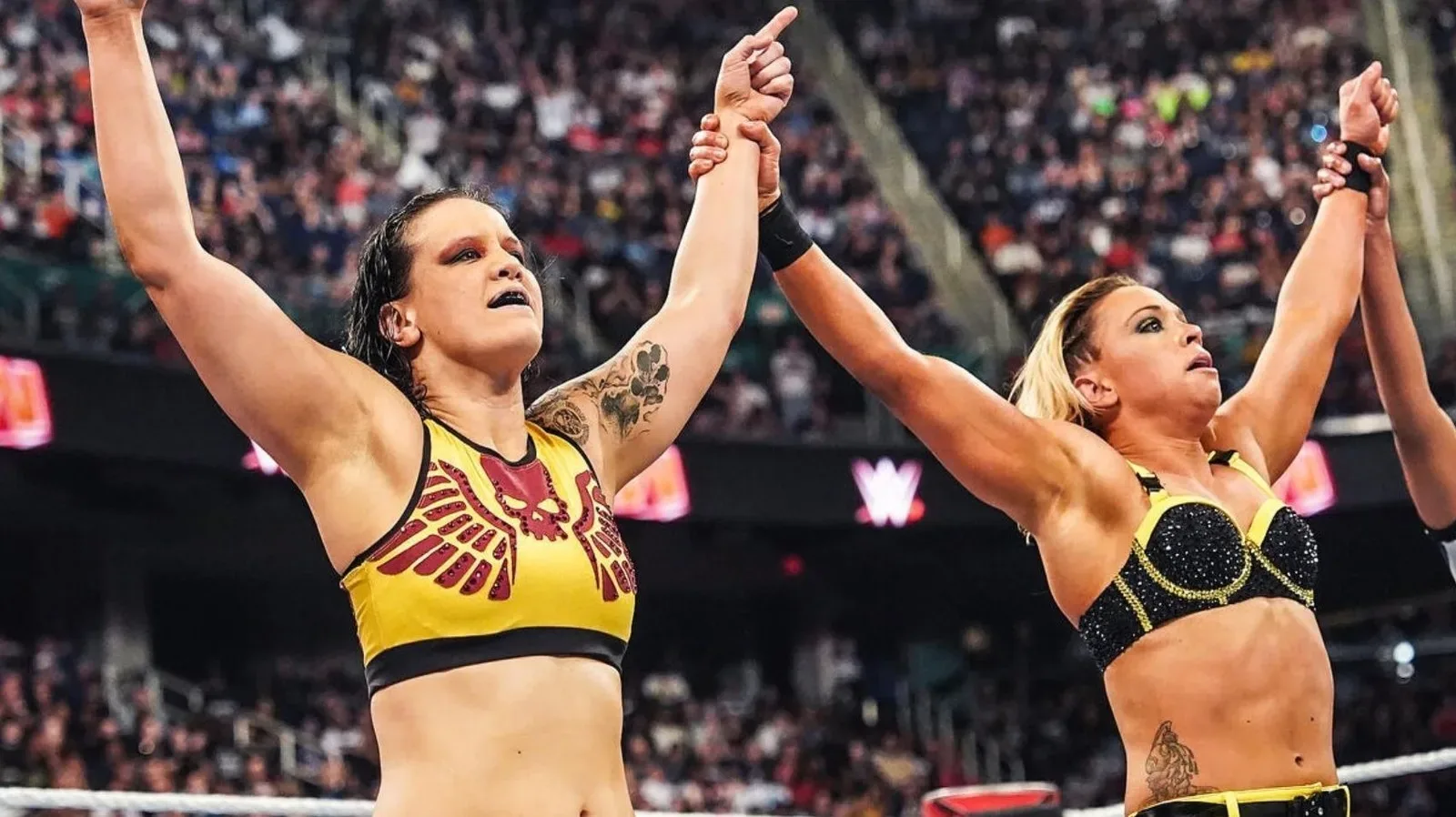
Zoey Serrano has offered a candid look back at one of the more unusual faction names from her WWE run: Pure Fusion Collective.
Serrano, who competed in WWE as Zoey Stark, was part of the three-woman group with Shayna Baszler and Daria Rae, who was then known as Sonya Deville. The act brought together three established performers with different backgrounds and distinct in-ring identities, but its name quickly became a major talking point among fans. For Serrano, the issue was not simply that the phrase sounded unconventional. She believed it made the group harder to understand from the beginning.
Speaking on Insight with Chris Van Vliet, Serrano said the members themselves went through an extended process of suggesting possible names before WWE settled on Pure Fusion Collective. By the end of that process, she said the trio was largely ready for a decision, even if the final choice did not give them the clear identity they had hoped to establish.
“One of the worst ones that I do remember was ‘Banshee,’” Serrano said on Insight with Chris Van Vliet. “I don’t remember the names that we pitched, because it was like a month-long process, us sending names in, them saying, ‘No, we don’t really want that, but here’s another list of names.’ ‘No, we don’t really like these, how about these names?’ We were going back-and-forth so much where I think all of us were like, ‘Pick a name, because this is getting ridiculous.’”
For more background on this topic, read LA Knight Urges Fans To Respect Former Partner’s Privacy After Online Contact.
The comments put a spotlight on a part of wrestling presentation that can be easy to overlook but is often crucial to a new faction’s success. A group name has to be memorable, recognizable and ideally capable of explaining the act’s shared purpose in only a few words. It becomes the phrase commentators repeat, the term fans search for and the branding attached to merchandise, entrances and storylines. When a name does not immediately communicate what a group represents, performers can spend valuable time trying to define the concept rather than allowing their work to do that naturally.
A name the group struggled to define
Pure Fusion Collective was a particularly difficult title because each of its words carried a broad meaning, while the complete phrase did not offer an obvious description of the women’s alignment, tactics or shared philosophy. Serrano said the group hoped it could overcome the issue through its presentation, but she felt the name ultimately had the opposite effect.
She explained that Paul “Triple H” Levesque wanted the faction name to include “fusion,” “pure,” or both. The wrestlers were then allowed to determine what the letter “C” would mean. Their answer became “Collective,” though Serrano made clear that it was more a matter of arriving at a usable choice than discovering a name the trio strongly embraced.
“We’re like, ‘Okay, ‘collective?’ I guess?’” Serrano said on Insight with Chris Van Vliet. “We wanted to try and make it work and not let the name define us, but I felt like that name kind of defined us. It was just confusing. We didn’t know what it was, how would fans know what it was?”
That question gets to the heart of Serrano’s criticism. Wrestling audiences frequently give a group its identity through reactions, chants and the shorthand they develop around its members. But a faction still benefits from entering television with a concise, understandable premise. A name can signal danger, status, unity, rebellion or a specific athletic identity before a single match takes place. Serrano’s view is that Pure Fusion Collective did not provide that immediate foundation.
Her comments do not suggest the trio refused to work with the name or chose not to embrace the assignment. Quite the contrary, Serrano said the performers attempted to make it work and to avoid allowing the branding to dictate how they were perceived. Still, she believes the name shaped the public perception of the group in a negative way because it prompted confusion rather than curiosity.
Finding the common thread
Serrano also questioned the basic reasoning behind pairing the three performers together. Baszler has a well-established MMA background, while Rae also has combat-sports experience. Serrano said she believed the intended direction may have been MMA-related, but she did not share that same background.
That did not mean the performers lacked qualities that could complement one another. Serrano brought a powerful, athletic style, Baszler’s reputation was built around submissions and aggression, and Rae had long been presented as an authoritative and versatile figure. Yet creating a faction involves more than collecting talented individuals. The audience needs a reason to see them as a unit, whether that is a common history, a tactical alliance, a mission, a shared enemy or a clear hierarchy.
In Serrano’s recollection, that through line was not entirely clear to her. If the idea was to present an MMA-adjacent group, the differences in the members’ backgrounds made the concept more complicated. If the aim was simply to unite three dangerous competitors, the name did not plainly communicate that either. This is why Serrano’s frustration with the branding cannot be separated from her uncertainty about the group’s larger purpose.
Faction construction is one of the most delicate balancing acts in WWE. The right combination can elevate every member, create fresh matchups and give performers a platform to reveal new sides of their characters. The wrong fit, or an unclear presentation, can make even skilled wrestlers appear as though they were placed together without a fully formed vision. Serrano’s reflections suggest she felt Pure Fusion Collective faced that challenge almost immediately.
Baszler and Serrano have continued as a team in TNA
The discussion carries added relevance because Serrano and Baszler are once again aligned, this time in TNA. Their renewed partnership gives the two performers another opportunity to build on their chemistry outside of the WWE framework that produced Pure Fusion Collective.
Their shared history is an obvious advantage. They have already worked together in a prominent group environment and understand the strengths each can bring to a partnership. Serrano’s remarks also show why a more direct presentation may matter to her. A team does not necessarily need an elaborate slogan or an abstract label to make an impact. Consistency, competitive credibility and a clear reason for standing together can often accomplish more than a complicated branding exercise.
For Baszler, the connection to MMA has long been an important part of her wrestling identity. For Serrano, her athleticism and intensity have been key traits throughout her career. Those characteristics can complement each other without requiring a faction name that attempts to combine every aspect of their identities into a single phrase. The challenge is not to erase their differences, but to present those differences as reasons they are more formidable together.
The importance of first impressions
Pure Fusion Collective remains a memorable WWE name, though not for the reasons Serrano or the other members likely would have preferred. It generated immediate discussion, but the discussion centered on what it meant and why it was chosen. In wrestling, that kind of attention can be difficult to convert into sustained interest if the group’s purpose remains vague.
Serrano’s account also offers a rare performer-level perspective on the creative process behind a television act. Fans often see the finished entrance, the gear, the commentary language and the matches, but they do not always see how much negotiation and revision can happen before those elements reach the screen. In this case, the name was apparently the product of a lengthy back-and-forth, with the performers submitting ideas, receiving alternative options and eventually being asked to settle on the meaning of its final letter.
That process may have produced a name, but Serrano feels it did not produce clarity. Her central point is straightforward: if the wrestlers themselves were uncertain how to explain the label, it was unreasonable to expect audiences to instantly understand it.
As Serrano and Baszler continue their work together in TNA, their WWE experience as part of Pure Fusion Collective remains a useful lesson in the value of presentation. Talent and ring ability are indispensable, but a faction’s identity must be equally easy to recognize. Serrano believes the name became an obstacle to that goal, and her comments make clear that the trio’s struggle was not a lack of effort. It was the difficulty of making an unclear concept feel natural once it had already been introduced.
In pictures

Darryl Polo
Darryl Polo is a passionate wrestling fan covering WWE, AEW, TNA and beyond. He loves great rivalries, breakout stars and the moments that keep fans talking long after the bell. How we work.