
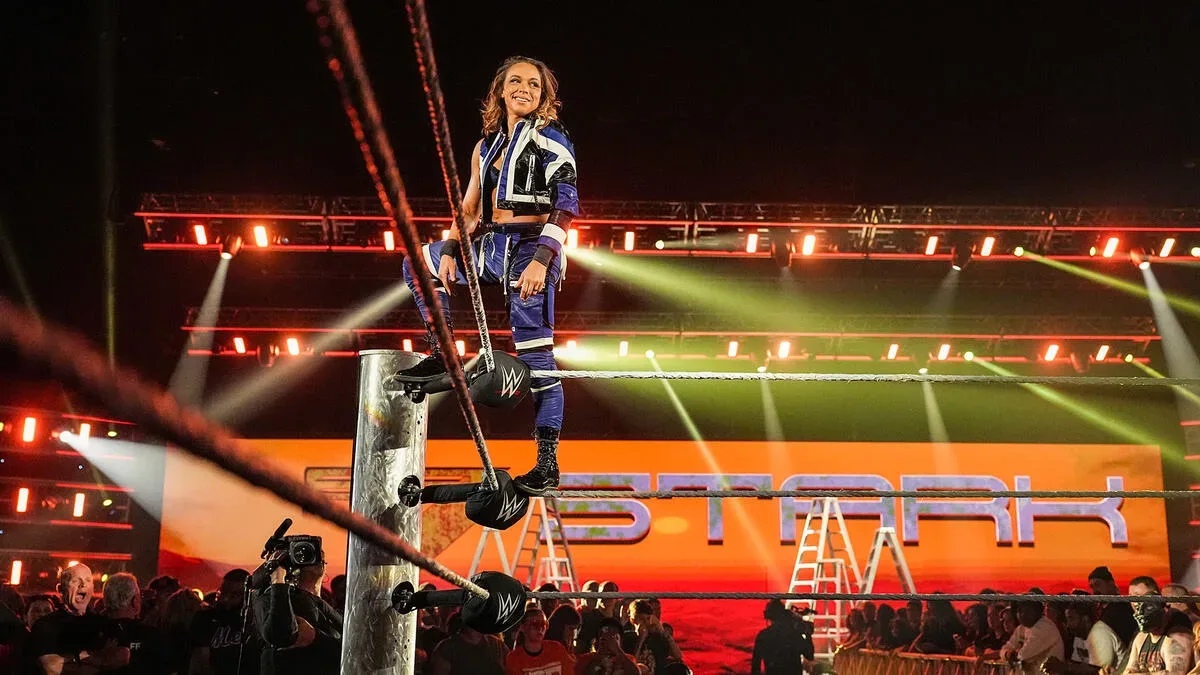
Zoey Serrano believes the most important change women’s wrestling needs is straightforward: more time to wrestle.
In a recent installment of her Zoey 1001 series, Serrano addressed the question of what she would alter about women’s wrestling if she had the opportunity. Rather than focusing on the subject many viewers may have expected, Serrano turned the discussion toward match length, time cuts, and the preparation female wrestlers make when they know plans can change after they have already entered the ring.
Serrano has worked across the independent wrestling scene as well as WWE and TNA. Her comments arrive during continued discussion around the amount of television and match time allocated to women’s divisions in major promotions. That conversation has been particularly visible in recent weeks as fans have assessed how women’s matches are structured and where they are positioned on wrestling programming.
For Serrano, the issue is not simply whether women receive a place on a card. It is whether they are given enough uninterrupted time to tell a complete story, build momentum, and show what they can do once the bell rings.
For more background on this topic, read Corey Graves Remembers PAC as Friend, Partner and ‘The Absolute Best in the Ring’.
“I feel like a lot of you are going to think I’m going to say the over sexualization of women’s wrestling. That’s not it,” Serrano said. “I understand that there is a time and a place for that. I get it. What I feel like should change is the amount of time that women are given to wrestle.”
Serrano Focuses on Time, Not Assumptions
Serrano’s answer directly pushed back on the assumption that her criticism would center on how women are presented. She made clear that she understands there can be a place for certain kinds of presentation in wrestling. Her concern, instead, is the opportunity performers receive to establish a match in front of an audience.
That distinction matters. A wrestler can be featured in a segment, appear in a storyline, or be included on a show and still have limited time to compete. Serrano’s point is centered on the wrestling itself: the ability to work through a planned match, react to the audience, and give viewers a fuller representation of the division.
Match time affects nearly every component of a bout. It can determine how much room there is for an opening exchange, a character-driven moment, a shift in momentum, a sustained comeback, and a finish. When time is reduced, wrestlers may need to remove pieces that help a match feel complete. A shorter contest is not automatically a lesser contest, but frequent late changes can make it more difficult for talent to execute the version of the match they prepared.
Serrano said she feels women’s time is cut with notable regularity.
“It seems like any time that we go out there, our time gets cut without fail,” Serrano said. “I can’t say 100%, but we’ll say a good 90, 95%.”
She did not present the issue as something that never affects male wrestlers. In fact, Serrano explicitly acknowledged that time constraints and adjustments can affect men as well. Her argument was that women experience those changes more often, creating a recurring challenge for performers who are trying to maximize a limited window.
Why Backup Plans Matter in the Ring
One of the clearest details in Serrano’s comments was her explanation of how wrestlers prepare for the possibility of a time cut. She said women in the locker room commonly develop multiple versions of a match rather than relying on one fixed outline.
That preparation is a practical part of professional wrestling. A bout may need to be altered because a prior segment runs long, a live production schedule changes, or an instruction comes through during the match. Serrano described wrestlers having a Plan A, Plan B, and Plan C so that they can make a rapid adjustment without losing control of the bout.
“We always have more than one plan. We have plan A and plan B and plan C just to protect ourselves,” Serrano said. “That way, if we get into the ring and we hear, ‘hey, you got to go home now,’ … we’ll just jump right to plan C.”
In wrestling terminology, being told to “go home” means it is time to move to the planned finish. Serrano’s description highlights the pressure involved in receiving that message unexpectedly. The wrestlers have to transition quickly, preserve the logic of the match, reach the ending safely, and make the finish land for the crowd—all while knowing that material they intended to use may have to be abandoned.
The need for multiple plans also demonstrates the adaptability expected of wrestlers. Being able to condense an outline in real time is a valuable skill, especially in television environments. However, Serrano’s point is not that performers cannot make those changes. It is that the repeated expectation to do so can place women at a disadvantage when they are seeking the same chance to create memorable matches and establish their abilities.
Making the Most of Limited Opportunities
Serrano said the women she has worked alongside understand the challenge and prepare accordingly. When time is limited, every decision becomes more important: which moments to prioritize, which portions of the match can be removed, and how to retain the essential story before the finish.
“When you’re only given so much time, you’ve got to make the most of it,” Serrano said. “And that’s what a lot of us do.”
That reality can shape how audiences perceive a division. Fans often judge a match based on its pace, its story, and whether its participants were able to build to a satisfying conclusion. Yet the audience may not know when a contest has been shortened or when wrestlers have had to bypass elements of their original plan. Serrano’s comments offer the performer’s perspective on why an abbreviated match may be the result of more than creative choice.
Her remarks also point to a broader question within women’s wrestling: what does meaningful investment look like? Championships, high-profile rivalries, television segments, and special-event appearances are all significant. So is time. Consistent time allows wrestlers to develop chemistry, prove their versatility, and give a crowd a reason to follow a feud from one chapter to the next.
Longer matches are not the only path to effective storytelling, and Serrano did not suggest that every women’s bout needs to follow the same format. Instead, she focused on the need for women to have sufficient time and on the feeling that their allotted time is especially vulnerable when a show needs to be adjusted.
A Continuing Conversation for Women’s Divisions
Debate over women’s wrestling has evolved considerably as more promotions have built deeper women’s rosters and as performers have gained more prominent opportunities. The conversation is no longer limited to whether women should be included in a wrestling card. It also concerns consistency, creative direction, match placement, and whether the time provided reflects the importance promotions place on their female talent.
Serrano’s answer adds a direct in-ring perspective to that debate. She did not speak in broad abstractions. She described a working reality in which performers expect to be ready for a reduced timeframe and keep alternate match structures available in case they are told to end early.
Her comments emphasize that opportunity in wrestling is often measured not only by being visible, but by being trusted with enough time to perform. A division can feature talented wrestlers and compelling rivalries, but the full value of those elements can be limited if the matches are regularly compressed.
As discussion around women’s wrestling continues, Serrano’s message is a simple one. The women are prepared to adapt, and they are prepared to make the most of what they are given. What she wants to see change is how much they are given in the first place.

Darryl Polo
Darryl Polo is a passionate wrestling fan covering WWE, AEW, TNA and beyond. He loves great rivalries, breakout stars and the moments that keep fans talking long after the bell. How we work.