
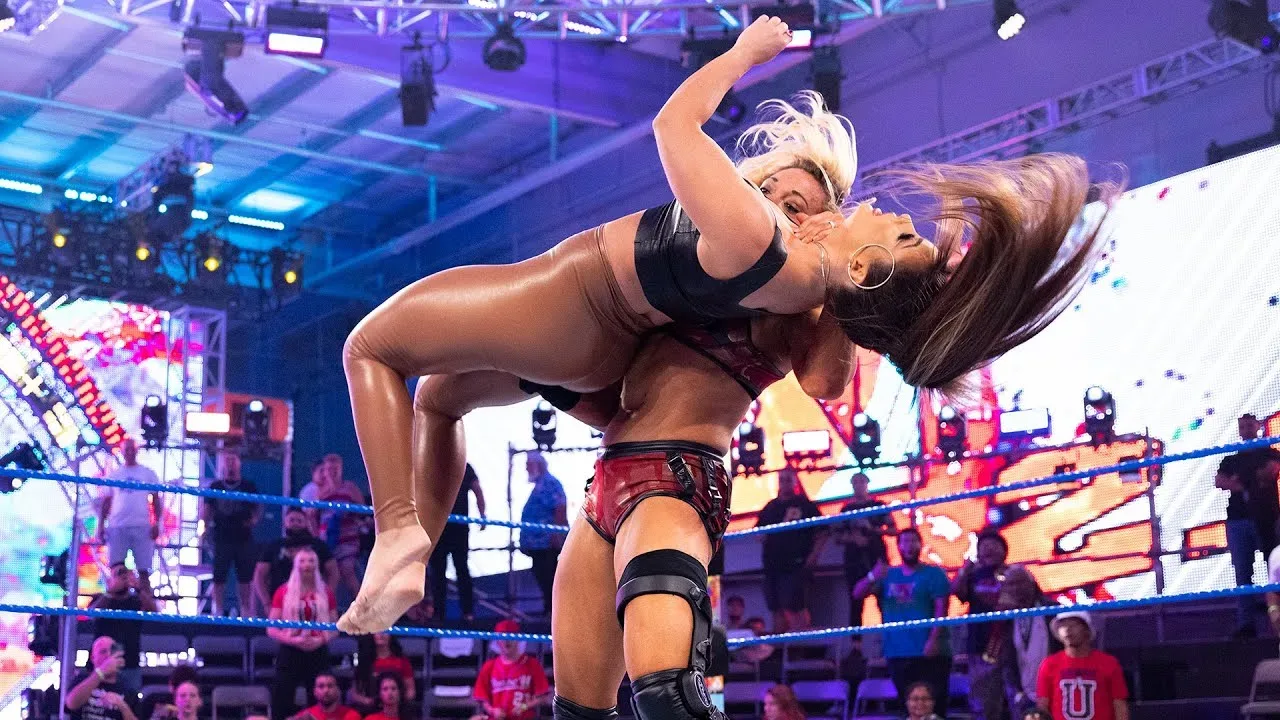
Zoey Serrano has pulled back the curtain on the development of the Z-360, explaining that the move emerged from a desire to create something distinct while also making sure it could be performed in a practical and sustainable way.
The Z-360 has become closely associated with Serrano’s presentation in the ring. The move sees her flip an opponent before driving them into a knee to the head, combining a visually striking rotation with a decisive finishing impact. As is often the case with memorable wrestling offense, however, the final version was not the first version Serrano attempted.
Speaking in a recent interview, Serrano credited Las Vegas wrestler Matt Vandegriff for playing the central role in bringing the idea together. Vandegriff, whom Serrano described as highly innovative and especially comfortable with flips and other athletic techniques, helped transform an early concept into the version she ultimately adopted as her finisher.
“I knew I just wanted something different,” Serrano said, adding that Vandegriff “pretty much came up with the idea.”
For more background on this topic, read Zoey Serrano Names Kiera Hogan, Jada Stone and Xia Brookside as TNA Dream Opponents.
That goal is understandable for any wrestler building an identity. A finishing move needs to do several jobs at once. It needs to be visually recognizable, credible as a match-ending maneuver, compatible with a performer’s strengths, and repeatable under the varied circumstances of a live match. A move can look spectacular in theory but still prove unsuitable if it is too difficult to set up, too taxing to execute, or overly dependent on one wrestler doing all of the work.
Serrano’s initial approach presented precisely that kind of problem. Her earliest version involved cradling an opponent before attempting the flip. While the concept was ambitious, she quickly found that the mechanics put too much strain and responsibility on her own body.
“At first it started off with me like cradling the person and then trying to flip them,” Serrano explained. “But then I was like, I was throwing out my back almost just because it’s like, there’s no hope, you know, like they can’t base, they can’t do anything. It’s all on me at that point.”
That realization led to the adjustment that defined the finished Z-360. Rather than beginning with Serrano carrying the full burden of the setup through the cradle, Vandegriff suggested working from a standing position. That change gave the opponent a more normal base before the rotation and knee strike, allowing the move to function more naturally as a cooperative wrestling sequence.
In professional wrestling, cooperation is not a weakness in a move’s design; it is one of the foundations of good execution. The best offense gives both wrestlers clear responsibilities. The attacking wrestler still has to establish timing, positioning and impact, while the receiving wrestler has to be in the right place and provide the appropriate base or rotation. When those responsibilities are balanced, a maneuver can look more explosive while also being easier to repeat consistently.
For Serrano, the standing setup offered that balance. She described the revised concept as a more conventional base leading into a moonsault-style rotation and knee. The adjustment did not lessen the move’s visual ambition. Instead, it gave the Z-360 a structure that allowed it to work.
Vandegriff suggested, “Maybe they’re just standing and you just base them for normal, like moonsault into the knee.”
The suggestion was tested directly with Vandegriff taking the move. Serrano said the result immediately made the potential of the new version clear.
“When we tried it on him, it worked perfectly and he took it so well,” Serrano said. “I was like, I think that that’s it. That’s my move.”
That moment of recognition is significant. Wrestlers may spend considerable time experimenting with holds, strikes, throws and aerial offense before finding the one move that feels like a true signature. The process can involve adapting an existing idea, combining elements that fit a wrestler’s athletic style, or discarding an early version that simply does not work in practice. Serrano’s account of the Z-360 belongs firmly in that tradition: an initial concept, a problem identified during training, a technical revision, and a successful test that gave the performer confidence she had found the right answer.
A finisher built around adaptation
Serrano’s comments also underline the importance of adapting rather than forcing a concept to remain unchanged. The first cradle-based version may have reflected the broad visual image she had in mind, but it created a physical issue she could not ignore. Continuing with a setup that was already causing trouble for her back would not have served the long-term purpose of creating a reliable signature maneuver.
Instead, the move evolved. Serrano retained the desire for something different and retained the key image of flipping an opponent into a knee, but changed the route used to get there. That distinction matters. A wrestler does not have to abandon a creative objective simply because the first mechanical approach proves ineffective. Sometimes the strongest version of a move is the result of refining the foundation while preserving the original identity.
The Z-360’s story is therefore not only about athleticism. It is also about problem-solving. Serrano recognized that the original design was putting too much of the workload on her, and Vandegriff offered an alternative that allowed the opponent to participate in the base. The eventual result gave Serrano a move she felt could represent her.
Vandegriff’s involvement is equally notable because Serrano was clear in giving him credit. She identified him as a wrestler from Las Vegas, Nevada, and praised his innovative approach as well as his ability with flips and tricks. Training partners and fellow wrestlers often contribute to the development of ring offense in ways that audiences may never see. They test ideas, identify issues, help refine positioning, and take the first attempts at maneuvers before those moves ever appear in front of fans.
In this case, Vandegriff was not merely present for a trial run. Serrano said he was responsible for the core idea that solved the problem with the original setup. His willingness to take the revised move also gave Serrano the proof she needed that the Z-360 could work as intended.
Why signature moves matter
A finishing move is more than a highlight in a match. It can become part of a wrestler’s vocabulary and an immediate signal to the audience that a bout may be nearing its conclusion. The strongest finishers often have a name that is easy to remember, a silhouette that can be recognized quickly, and enough flexibility to be performed against a range of opponents.
The Z-360 has a name that directly identifies it with Serrano, and its combination of rotation and a knee strike gives it a distinctive visual character. Just as importantly, Serrano’s explanation indicates that it was developed with repeatability in mind. The standing base was not simply a cosmetic change. It was the practical solution that turned an exciting idea into a move Serrano could claim as her own.
There is also value in fans knowing how a signature maneuver came together. The finished move can seem effortless when it lands during a match, but the path to that point is usually built on training, adjustment and trust. Serrano’s recollection makes that process clear without diminishing the move’s impact. If anything, it adds another layer to the Z-360 by showing that its final form was earned through experimentation.
Serrano also discussed potential opponents in TNA during the same interview. Her comments on the Z-360, though, offer a focused look at the work behind one of the most personal aspects of a wrestler’s in-ring identity. The move began as a search for something different, encountered an obstacle in its first form, and found its answer through collaboration with Vandegriff.
For Serrano, the successful test settled the question. The revised maneuver was not just an idea anymore. It was the Z-360.

Darryl Polo
Darryl Polo is a passionate wrestling fan covering WWE, AEW, TNA and beyond. He loves great rivalries, breakout stars and the moments that keep fans talking long after the bell. How we work.