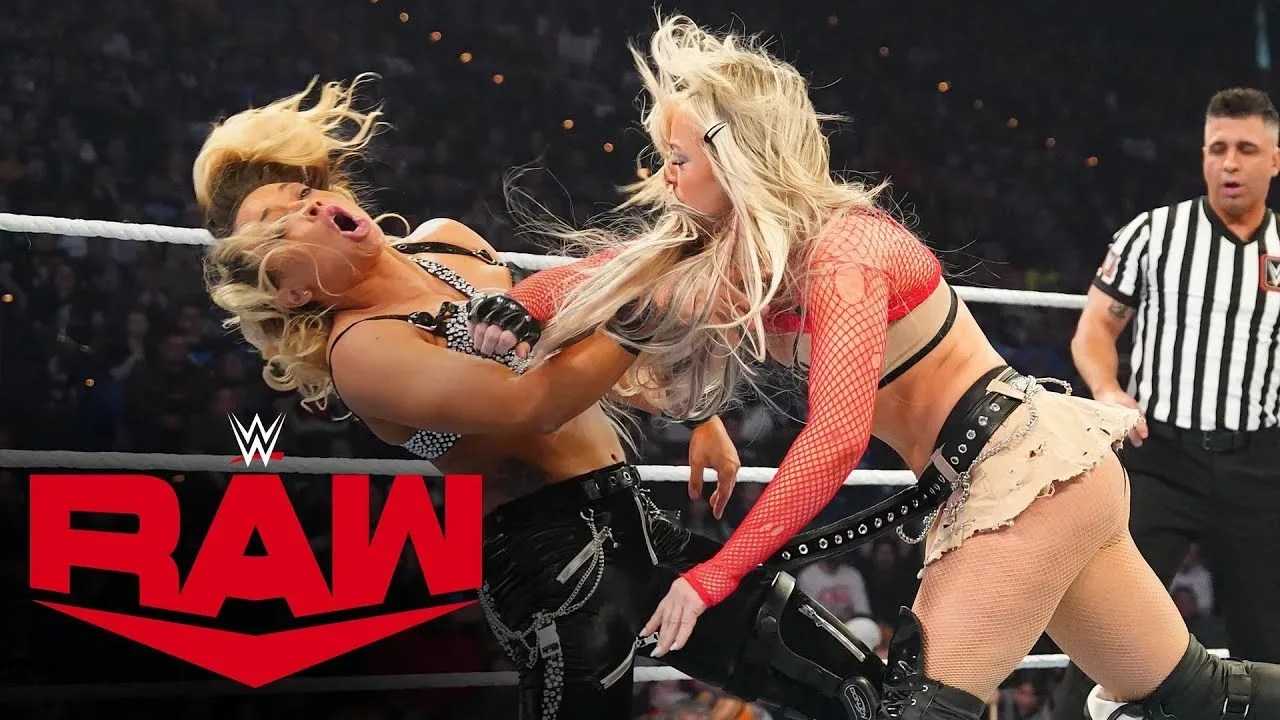
Zoey Serrano has opened up about an unrealized WWE character direction that she believes could have grown out of her social-media interactions with fellow Superstars. Serrano said she repeatedly pushed for a modern version of the Right to Censor concept after using parody censorship edits in posts involving other women on the roster during early 2025.
The idea was rooted in a familiar piece of WWE history. Right to Censor became one of the company’s more memorable early-2000s acts by presenting a self-righteous, anti-explicitness group that objected to the provocative elements of wrestling programming. Serrano’s proposal was not simply to recreate that faction beat for beat. Instead, she saw an opening for a contemporary character who would police and censor other Superstars’ online images and ring gear, using the tone and platforms of modern wrestling fandom to create a different kind of antagonist.
For Serrano, the social-media posts were more than isolated jokes. She believed they demonstrated that the character had a clear identity, a recognizable hook, and a natural way to generate interactions with other WWE talent. She said the response to the exchanges convinced her there was more to explore if WWE gave the idea room to develop on television.
“I wanted to do it so bad. The Right to Censor character,” Serrano said. “I wanted to do a modern day Right to Censor. I came back. I pitched it. I pitched it on many occasions. I tried, guys. I really, really tried because those Twitter interactions were hilarious. They were great. I was having fun with them.”
For more background on this topic, read Zoey Serrano Clarifies Sexuality, Says She Remains an Ally to LGBT+ Fans.
Liv Morgan backed the social-media experiment
A key part of Serrano’s recollection was the role Liv Morgan played in encouraging her to take the concept beyond an idea. Morgan was among the performers whom Serrano included in her censored-image posts, but Serrano said Morgan was supportive rather than put off by the bit.
In Serrano’s telling, Morgan viewed the approach as a possible path toward defining a stronger on-screen personality. WWE is often at its best when a performer has a simple, consistent perspective that can inform promos, matches, rivalries, and even online content. A censorious character could have given Serrano an immediate point of view: someone who disapproved of the presentation embraced by many of the division’s stars and felt entitled to impose her standards on everyone else.
“Liv Morgan told me to do it,” Serrano said. “She pulled me aside, and she’s like, ‘You really just need a character and I feel like this is the route for you. Why won’t you just try it? Just try it on Twitter. Let’s just see what happens.’”
Serrano said she went directly to Morgan before putting together her first post. The exchange, as she described it, included Morgan giving feedback about where the censor bar should be placed and then encouraging Serrano to publish it.
“I went to her for my first post,” Serrano explained. “I’m like, ‘Alright, I’m going to put this. What do you think?’ She’s like, ‘Yeah, that’s great. Now just do the censor right here.’”
Serrano initially sought reassurance before sharing it, but Morgan urged her to go forward. “What’s the worst that’s going to happen? Just post it,” Morgan told her, as Serrano recalled. Serrano said Morgan gave her explicit permission to use the image.
Serrano says consent was central to every post
While the comedy of the gimmick relied on censoring another wrestler’s look, Serrano stressed that she did not treat fellow talent as unwilling props for a social-media angle. She said she made a point of messaging the person involved before uploading a post, including Rhea Ripley when applicable, to ensure everyone was comfortable with the joke.
That detail is significant because the concept was built around commenting on the public presentation of other women in WWE. The character’s intended hypocrisy and judgmental attitude could have created conflict, but Serrano said she wanted the performers involved to know what she planned to post before it went live. Her approach was to secure approval first and then let the online interaction play out within the boundaries the talent had discussed.
“I would for sure message Rhea, like, ‘Hey, I’m going to make this post,’ or message whoever to make sure the girls are okay with it before I actually do it,” Serrano said. “I’m always going to make sure the other person’s okay with it before I say something.”
That kind of communication can be especially valuable in WWE, where social media increasingly functions as an extension of the on-screen product. A post can advance a rivalry, reveal a character trait, invite fan discussion, or give a developing idea a low-risk trial run. Serrano’s censorship posts appear to have been designed with that potential in mind, creating a visual gag that also communicated a possible persona in seconds.
A character with built-in conflict for WWE’s women’s division
The appeal of Serrano’s proposed direction is easy to understand. A modern Right to Censor-inspired character would have had a ready-made reason to confront virtually anyone. The gimmick could target attire, entrance presentation, interviews, social-media posts, fan behavior, or any other aspect of WWE culture that the character deemed inappropriate. That broad premise would have created a flexible foundation for both short-term programs and longer-running personality work.
It also would not have required a direct replica of the original faction. Wrestling concepts evolve when performers find a way to make them their own, and Serrano’s use of online censorship gave the pitch a contemporary wrinkle. Instead of relying solely on speeches about morality, the character could have used edited photos, posts, and public admonishments to establish herself as an irritant before bringing those complaints to WWE programming.
In an environment where performers are regularly asked to maintain a distinct voice across television and digital platforms, the idea had practical advantages. The audience would immediately understand why Serrano was posting what she posted. Her targets would have easy opportunities to respond. The eventual match stakes would be straightforward: the women being criticized could fight to shut down Serrano’s attempted policing of their image and identity.
Serrano remains disappointed that the larger proposal did not become a WWE direction. She felt the material had already proven it could be entertaining and said the current wrestling landscape made the concept particularly viable.
“I wanted to do it and I really feel like it was a missed opportunity, especially with what wrestling is today,” Serrano said.
The value of social-media character building
Serrano’s comments underline how much character development can begin outside the ring. Not every online bit needs to become a televised storyline, but social platforms offer wrestlers a way to test their instincts in real time. Fans can quickly signal whether a concept is memorable, whether it creates reactions from peers, and whether it gives a performer a voice that feels different from the rest of the roster.
For an idea such as Serrano’s, the online format may have been particularly useful because the censorship itself was visual and immediate. A fan scrolling past the post would not need a lengthy explanation to understand the joke. At the same time, repeated posts could establish a pattern: Serrano was not merely making a one-off edit, but positioning herself as somebody with a problem with how others chose to present themselves.
There is also an important difference between a social-media gag and a sustained WWE character. The latter needs escalation, rivalries, and the ability to remain interesting after the first surprise wears off. Serrano’s account suggests she was prepared to pursue that next step, having pitched the idea on multiple occasions rather than treating it as a temporary online diversion.
Whether WWE ever revisits a version of the concept remains unknown. Serrano did not indicate that the character is currently planned or that a new pitch has been accepted. What is clear is that she saw genuine potential in the premise, had support from Morgan while testing it online, and approached the posts with the consent of the women involved.
For now, the modern Right to Censor concept stands as one of WWE’s what-if character ideas: a digital-age variation on an old-school heel framework that Serrano believes could have connected because it was tailored to how wrestling audiences engage with talent today.
Darryl Polo
Darryl Polo is a passionate wrestling fan covering WWE, AEW, TNA and beyond. He loves great rivalries, breakout stars and the moments that keep fans talking long after the bell. How we work.