
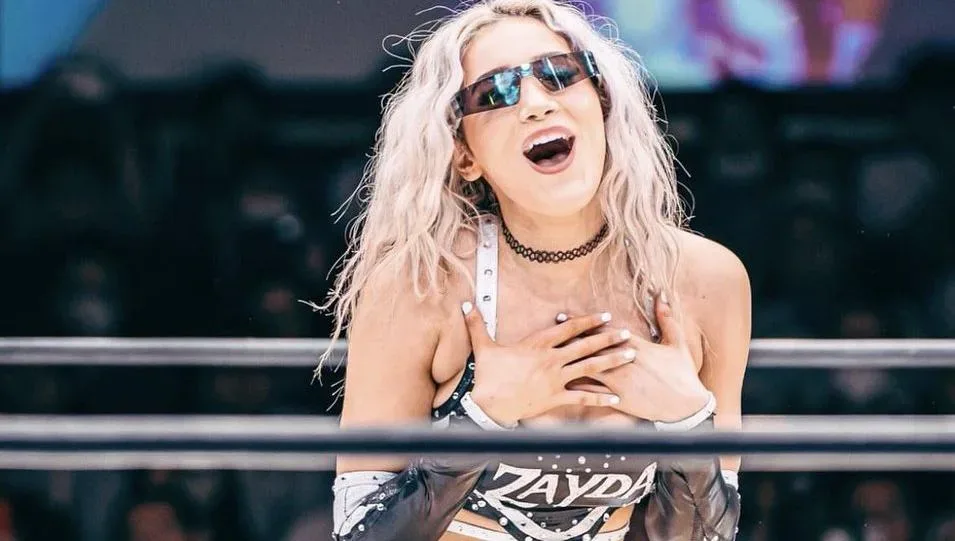
Zayda Steel says the significance of becoming the first Arab woman to compete in All Elite Wrestling goes far beyond a personal milestone.
Steel, who is signed to both AEW and Ring of Honor and has appeared for each promotion, spoke about her background and the importance of visibility during a recent interview with MuscleManMalcolm. The young wrestler explained that her heritage is not always immediately apparent to viewers, but it is central to both her identity and the message she wants her career to convey.
“It means a lot. I mean, I say all the time, representation matters,” Steel said. “A lot of people might look at me and think I’m some white blonde girl, right? I’m not. I’m from Morocco. Both my parents are from Morocco. I’m Arab. My family’s Muslim.”
For Steel, speaking openly about that identity is not simply about correcting assumptions people may make based on her appearance. It is about making sure that young fans who share elements of her background can recognize themselves in a wrestler performing on a major national platform.
For more background on this topic, read Zayda Steel Praises Tony Khan’s Passion for Wrestling in AEW Role.
AEW has grown into a prominent destination in the modern wrestling landscape, while its connection with Ring of Honor gives developing talent another significant stage on which to build experience and establish an identity. Steel’s work across those environments has provided her with an opportunity to reach audiences at different points in her career, while also carrying a distinction that she says has deep personal value.
Steel wants young fans to see what is possible
Steel said that she makes a point of discussing her Moroccan and Arab roots because she hopes her visibility can have an effect on someone watching from home. Her goal is not limited to being recognized as a pioneer; she wants that recognition to translate into belief for future wrestlers and fans.
“What you see is what you don’t get, actually, because I’m not what I look like, and I try to say as much as possible,” Steel said. “Because, you know, maybe there’s a little Arab girl out there that’s like, ‘wow, Zayda’s champion. Maybe I can be champion one day.’”
That image is at the heart of Steel’s remarks. She is looking beyond the immediate reaction to her own career and toward the possibility that another generation will grow up with examples that were harder to find when she was younger. In wrestling, where performers often become larger-than-life figures for audiences, the ability to see somebody with a similar heritage succeed can carry particular weight.
Steel was candid in saying that she did not have many examples of Arab or Middle Eastern women in wrestling while she was growing up. She mentioned Layla, Aliyah and Jinny as names worthy of recognition, but emphasized that the overall number of visible Arab and Middle Eastern women performers remained limited.
“Because I’m going to be honest, I didn’t really get that growing up,” Steel said. “There wasn’t much representation on the woman’s side. Shout out Layla and Aliyah and Jinny. But there really wasn’t many Arab girls or Middle Eastern girls out there. So I want to make it just to show them that they can.”
A milestone with meaning beyond the ring
Steel’s comments underline a reality that extends beyond any one match, show or championship pursuit. Professional wrestling has always relied on connection between performers and audiences. Fans invest in wrestlers because of their athletic ability and charisma, but also because their stories, backgrounds and ambitions can create a sense of familiarity or aspiration.
For someone who grew up seeing few women with an Arab or Middle Eastern background in prominent wrestling roles, Steel’s position in AEW represents an opportunity to help broaden that picture. Her remarks did not frame representation as the entirety of her professional identity. Rather, she presented it as an important part of who she is and a responsibility she is willing to embrace as her profile continues to develop.
That distinction matters. Steel wants to succeed as a wrestler and eventually reach championship-level achievements, while also understanding what such accomplishments could symbolize to fans who have had limited opportunities to see themselves reflected on wrestling television. The prospect she described—an Arab girl watching and believing she can become a champion—is one that connects Steel’s individual ambitions with a wider legacy.
AEW’s women’s division has continued to feature performers from a range of countries, cultures and backgrounds. Steel’s place within the company and her status as its first Arab woman competitor add another chapter to that evolution. Her concurrent work with Ring of Honor also gives her a platform to continue developing in front of audiences who follow both brands.
Moroccan heritage remains central to Steel’s message
Steel’s explanation was especially notable because it addressed the gap between perception and personal background. She acknowledged that some people may see a blonde wrestler and make assumptions about her identity. By describing herself as Moroccan, Arab and from a Muslim family, Steel made clear that those assumptions do not tell the full story.
Her decision to discuss that openly can help provide context for fans who may only know her through her in-ring appearances. Wrestlers frequently tell stories through character work, rivalries and promos, but Steel’s comments show another side of how a performer can connect with an audience: by sharing the real-world experiences that shape their perspective.
There is also an important difference between simply occupying a historic position and actively using that position to encourage others. Steel’s words indicate that she intends to do the latter. She recognizes the significance of being AEW’s first Arab woman competitor, but her focus is forward-looking. She wants the next young fan with similar roots to have more representation than she did.
That can be a meaningful contribution regardless of how long it takes for a fan to pursue wrestling, athletics or any other ambition. Seeing somebody from a similar community reach a national platform can change what feels attainable. Steel’s hope is that her presence can provide that kind of encouragement.
Looking ahead in AEW and Ring of Honor
Steel remains at an early stage of a career that already includes work in AEW and Ring of Honor. Her comments did not offer a timetable for a specific title chase or identify a particular opponent she wants next. Still, she made her broader competitive ambition clear through the example she offered: she wants young fans to be able to see her as a champion and believe they can reach that level as well.
That ambition fits naturally with the way Steel discussed representation. Success in the ring would be a personal achievement, but it would also amplify the visibility she believes is so important. A championship is not the only measure of impact in wrestling, yet it remains one of the clearest symbols of a performer reaching the top of a division.
For now, Steel’s message is straightforward. She is proud of being the first Arab woman to compete in AEW, proud of her Moroccan family background, and determined to be visible about the identity that may not be obvious to everyone at first glance. She wants future Arab and Middle Eastern girls to have examples that she felt were scarce during her own upbringing.
As Steel continues her work across AEW and Ring of Honor, that purpose will remain part of her story. Her career is still being written, but she has already articulated what she hopes its impact will be: proving to the fans watching that there is room for them in professional wrestling, and that they can pursue the same dreams of becoming champions.

Darryl Polo
Darryl Polo is a passionate wrestling fan covering WWE, AEW, TNA and beyond. He loves great rivalries, breakout stars and the moments that keep fans talking long after the bell. How we work.