
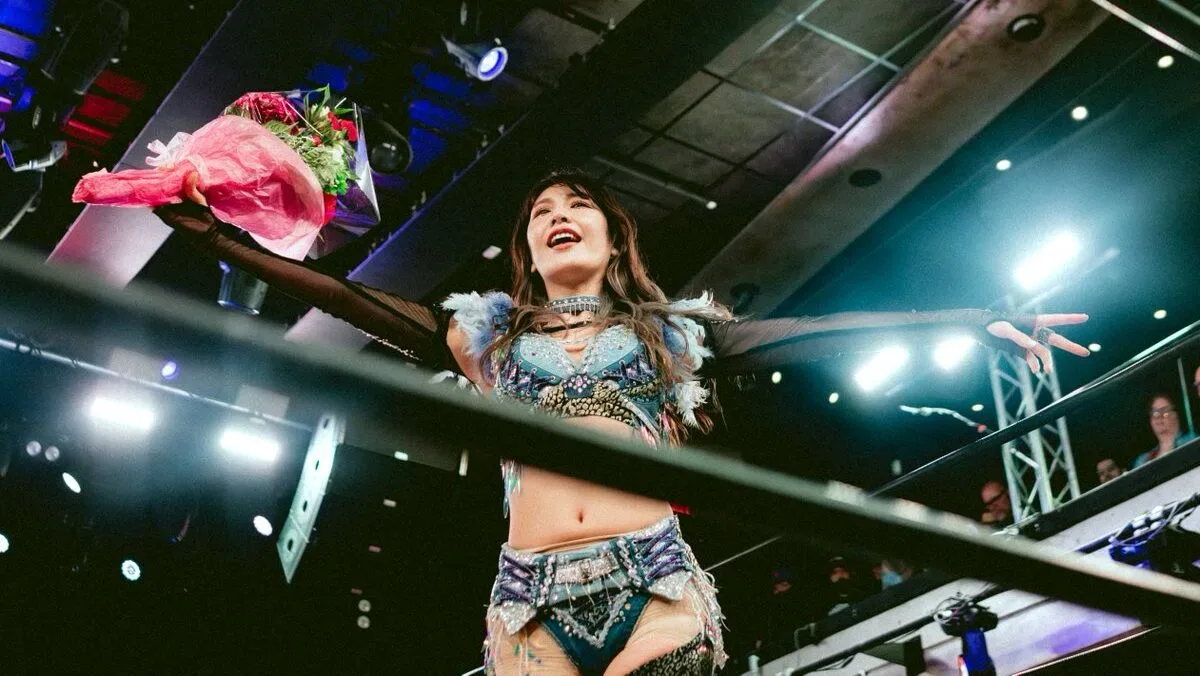
Yuki Kamifuku is approaching the end of a defining chapter in her life, and she is doing so with a mixture of certainty, gratitude and understandable fear.
The 33-year-old Tokyo Joshi Pro-Wrestling standout is currently on her retirement tour ahead of her final match on December 26 at Korakuen Hall. Kamifuku has been part of TJPW since starting her in-ring career in 2017, building a résumé that includes reigns as International Princess Champion and Princess Tag Team Champion. Now, after nearly a decade in the promotion, she is preparing to leave active competition behind.
Kamifuku has made clear that the choice is her own, and that she does not look at retirement as an impulsive decision or one driven by dissatisfaction. Instead, she views this period as the right moment to step away while she still feels capable of giving everything she has to the company and its audience.
Her final months with TJPW will naturally carry an emotional weight. Retirement tours often place a wrestler’s full career into focus, inviting fans to revisit championships, rivalries, partnerships and the personal growth that unfolded in public. For Kamifuku, however, the immediate goal is not simply to celebrate past accomplishments. She wants to remain present, continue representing Tokyo Joshi as she always has and ensure her departure feels true to the principles that have guided her career.
For more background on this topic, read Washington Commanders Safety Tyler Owens Delivers Spinebuster-Style Hit Against Eagles.
Kamifuku began considering retirement in May
Kamifuku said her thoughts about retiring began around the beginning or middle of May 2026. The timing coincided with her decision to challenge Yuki Arai, a detail that underscores how her exit plans developed while she was still focused on competing at a meaningful level.
She compared the decision to a gamble, describing it as the kind of moment where continuing could potentially lead to further success but could also cause everything to unravel. That uncertainty did not lead her to hesitate. Rather, it helped solidify her belief that retirement now is a chance to make a decisive choice on her own terms.
“I started thinking about retirement around the beginning or middle of May this year, around the same time as deciding to challenge (Yuki) Arai. The peak was… just a hunch. It’s just like playing slot machines. If I keep going, I might win, or everything might fall apart… So right now, I’m going all in. I guess I’ll find out if this decision was the right one on the day I retire.”
That framing captures a key part of Kamifuku’s outlook. Retirement does not come with complete certainty about what follows, but it does offer her the ability to choose the timing rather than wait for circumstances to make the choice for her. She is leaving with the belief that she has reached the point she wanted to reach, rather than trying to prolong a career solely because she might be able to continue.
Kamifuku also stressed that she has long treated her place in Tokyo Joshi with urgency. She said she has given her all to the promotion while maintaining the mentality that she needed to be ready for her run to end at any time. That mindset has allowed her to assess retirement through intuition and personal readiness, not just through a list of accomplishments or a predetermined number of years in the ring.
“Not just today or yesterday, but for a long time now, I’ve been giving it my all against Tokyo Joshi, ready to quit at any moment… so that even if I’m told tomorrow, ‘You’re fired,’ I’d be prepared. I think deciding when it’s a good time to stop or how long I can keep going is based on my own intuition, so personally, I feel like this is about right. I have absolutely no regrets.”
For a wrestler nearing a final bell, “no regrets” can be one of the most difficult sentiments to express honestly. The profession is built around sacrifice, constant physical demands and the pursuit of a next opportunity that is never guaranteed. Kamifuku’s comments indicate she has considered those realities and has come to peace with the moment she has selected.
Leaving at her peak is part of the plan
Kamifuku did not describe retirement as giving up. In fact, she sees it as an effort to leave at a high point.
She acknowledged that every wrestler will ultimately have to stop, making the timing of that decision especially important. In her view, now is the best time to draw a line under her active career. There is also a clear sense that she wants people to remember the way she departed, not only the years she spent competing.
“I’m going to quit someday anyway, so I truly believe that if I’m going to quit, now is the best time to do it. I think I had a desire to have someone say, ‘That was a cool way for her to quit…’ That’s why I’m quitting at my peak, so the timing just happened to be right now.”
It is a revealing statement from a performer who has made a distinct impression within TJPW since 2017. Kamifuku’s career has included championship success, but her value to the promotion also extends to her identity as a longtime member of its roster. Her retirement is not merely the departure of a former titleholder; it marks the exit of someone whose entire in-ring journey has been connected to Tokyo Joshi.
That history makes the final stretch particularly significant. Kamifuku did not arrive in TJPW after years spent establishing herself elsewhere. TJPW has been the setting for the whole of her professional wrestling career, from her first match through every stage of development that followed. Her farewell match at Korakuen Hall will therefore serve as a closing moment for both an individual career and a longstanding relationship with the promotion.
She does not want a singles match for her farewell
While the final match is set for December 26, Kamifuku has expressed a preference about its format. She does not want her farewell to be a singles bout, though she would like the ability to decide who is involved.
Her reasoning centers on keeping the occasion recognizably Tokyo Joshi Pro-Wrestling. Rather than shaping the match around a conventional one-on-one retirement spotlight, Kamifuku wants a simpler presentation that reflects the company and the team environment she has experienced throughout her career.
“Since it’s a farewell to Tokyo Joshi Pro-Wrestling, I’d like it to be really simple—just Tokyo Joshi as usual. If I were to be picky, I don’t want to have a singles match, but I would like to decide the match myself. Just like always, I won’t compromise my principles or tell lies—I’ll remain a member of the team working hard alongside everyone else.”
That preference is consistent with the way Kamifuku speaks about her remaining time in TJPW. She is not looking to create distance between herself and the rest of the roster as her retirement approaches. Instead, she wants to continue working alongside her peers and contributing to the promotion’s visibility through the final date.
Her stated hope is that people will remember her as someone whose presence mattered. She wants to help spread the word about TJPW before she leaves and hopes fans will feel that the company was better because she was part of it. It is a humble objective, but one that gives her final tour a direction beyond personal celebration.
The absence of a singles-match preference should not be read as a lack of importance attached to the occasion. If anything, it reinforces Kamifuku’s desire for a farewell that represents the environment she knows best. A match built around Tokyo Joshi as a collective can honor the connections she formed there while allowing her final appearance to feel less like an isolated performance and more like a final shared moment.
The uncertainty after wrestling remains very real
Although Kamifuku is firm in her decision, she has not hidden the anxiety that comes with leaving wrestling behind. She openly discussed concerns about income, losing the identity she has created as a professional wrestler and no longer seeing or relying on the people who have been part of her day-to-day life.
Those concerns are familiar to many wrestlers who face retirement, especially after spending years in a career that can become inseparable from a person’s sense of self. In Kamifuku’s case, the transition is made even more significant by the fact that TJPW has been her wrestling home from the beginning.
“I’m scared, of course—I mean, what about my income? I’ll lose the identity I’ve built as a pro wrestler, and I’ll no longer have that steady paycheck. I won’t be able to see my friends, or rely on the people I’ve depended on—there are plenty of things like that.”
Still, Kamifuku believes the uncertainty is necessary if she is going to discover what comes next. She described herself as someone who can only focus on one thing at a time, meaning she needs to fully close this chapter with Tokyo Joshi before she can properly move into another pursuit.
“But if I don’t quit, I’ll never discover the next version of myself. I’m the kind of person who can only do one thing at a time, so with Tokyo Joshi, I have to draw a line under it before I can move on to the next thing. Even if my life starts over with part-time jobs, I think I’ll be able to pull through as long as I have the courage to quit. No, seriously, I have no plan at all.”
Kamifuku’s admission that she has no set plan makes her candor all the more striking. She is not presenting retirement as a perfectly mapped-out career move with every answer already in place. She is embracing it because she believes courage is required to find the next version of herself.
Before that new chapter can begin, there is one final Tokyo Joshi Pro-Wrestling date ahead. On December 26 at Korakuen Hall, Yuki Kamifuku will step into the ring for the last time as an active wrestler. She enters that night without regret, determined to stay true to herself and hopeful that her goodbye will feel unmistakably like Tokyo Joshi.

Darryl Polo
Darryl Polo is a passionate wrestling fan covering WWE, AEW, TNA and beyond. He loves great rivalries, breakout stars and the moments that keep fans talking long after the bell. How we work.