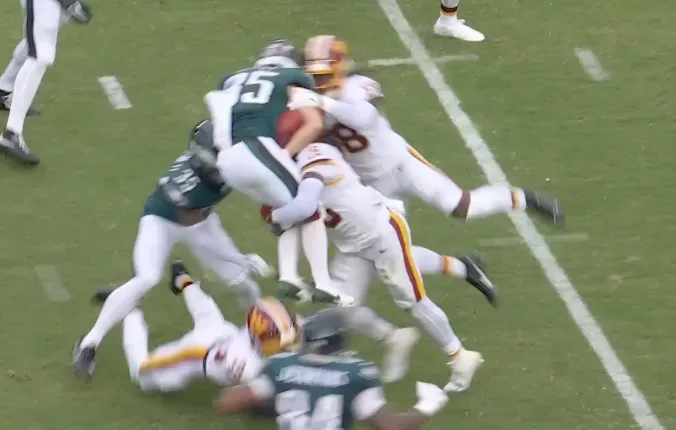
Professional wrestling language found its way onto an NFL highlight reel in Week 1, as Washington Commanders safety Tyler Owens delivered a punishing special teams tackle that looked remarkably similar to a spinebuster.
Owens made the impact play during Washington’s game against the Philadelphia Eagles, charging through two players while closing in on punt returner Britain Covey. As Covey attempted to evade or drive through the approaching defender, Owens met him with force and took him down in a sequence that had the physical shape and sudden impact of a wrestling-style buster.
The collision quickly stood out because it was more than a routine wrap-up tackle. Owens fought his way into position, caught Covey at the moment of contact and drove him down hard. For fans who regularly watch the squared circle as well as the gridiron, the comparison was immediate: the tackle resembled the kind of spinebuster that has long been a staple of heavyweight wrestling offense.
View the referenced post on X
A Football Collision With a Familiar Wrestling Visual
A spinebuster is one of the most visually direct power moves in wrestling. The attacker catches an opponent around the upper body or midsection, lifts or redirects their momentum and drives them forcefully to the mat. Its appeal is rooted in impact. The move is often used to stop an opponent’s charge, reverse momentum in an instant or set up a finishing sequence.
For more background on this topic, read GCW No Signal in the Hills Part 5 Results: Vipress Wins Ultraviolent Title, Joseph Sawyer Retains.
Owens’ tackle carried that same visual energy. Covey was in motion as Owens arrived, and the Commanders safety turned the returner’s movement into a sudden, emphatic takedown. The setting was an NFL special teams play rather than a wrestling ring, but the moment had the kind of clean, explosive timing that makes a spinebuster resonate with an audience.
There is, of course, an important difference between football and professional wrestling. NFL tackles are competitive contact plays made at full speed, while wrestling maneuvers are performed by trained wrestlers working together to execute them as safely as possible. Still, the shared vocabulary is easy to understand whenever a football hit produces a visual that looks like a wrestling move. Fans have long described tackles, slams and blocks using terms associated with wrestling, especially when the action is dramatic enough to feel like it belongs in an arena entrance video.
Owens’ play was exactly that kind of moment. He burst through traffic, reached Covey and delivered a tackle that gave viewers a striking image in a game filled with high-level athletic collisions.
Owens Makes His Presence Felt on Special Teams
The tackle came in Owens’ third NFL season, all of which have been spent with the Commanders. He finished the game with two tackles, but the hit on Covey was clearly the play that generated the most attention.
Special teams often produce some of football’s fastest and most chaotic action. Players have limited time to identify lanes, avoid blocks and reach the returner, all while moving at high speed. A defender who beats multiple blockers and still arrives in position to make the stop can change field position and energize an entire sideline.
That is what Owens did against Philadelphia. Breaking through two players before reaching Covey gave the tackle an added level of difficulty. It was not simply the final collision that made the play memorable; it was the path Owens took to get there. He fought through the initial resistance, stayed on course and then made the kind of forceful stop that can become a season-opening highlight.
For wrestling fans, the sequence also had a familiar storytelling rhythm. Owens overcame interference from multiple players, reached his target and delivered the decisive blow. In a wrestling context, that is the kind of sequence that can bring an audience to its feet before the bell even rings. On the football field, it was a critical special teams effort that showcased Owens’ burst and physicality.
Eagles Escape With a 24-22 Win
Despite Owens’ standout tackle, Philadelphia came away with a 24-22 victory over Washington. Eagles quarterback Jalen Hurts threw three touchdown passes in the win.
The close final score ensured that every major play carried weight, including the special teams moments. Washington was unable to turn Owens’ highlight-reel stop into a victory, but the safety’s effort was one of the game’s most memorable individual flashes.
Opening-week games can establish an early identity for players and teams, even when the schedule has only just begun. Owens’ performance will be remembered first for the spinebuster-like tackle, a play that demonstrated the urgency and aggression needed from a special teams contributor. While the Commanders fell short on the scoreboard, Owens gave the team a moment that stood on its own.
The Spinebuster Remains a Universal Symbol of Power
The reason the comparison works so well is that the spinebuster remains one of wrestling’s clearest symbols of raw power. It does not require an elaborate setup to make an impression. The move is built around one competitor stopping another competitor’s momentum and putting them down with authority.
That simplicity has made it a durable part of wrestling’s move set across generations and promotions. It can be used by a powerhouse to demonstrate superiority, by a veteran to halt a faster opponent or by any wrestler looking for a sudden shift in control. A well-executed spinebuster makes the audience feel the impact immediately.
Sports fans use wrestling terminology because it provides a useful shorthand for action that is difficult to describe otherwise. A hard tackle might be called a spear. A leaping catch might be compared to a flying crossbody. A player who powers through contact may remind viewers of a wrestler breaking free from an opponent’s grip. In Owens’ case, “spinebuster” captures both the mechanics of the collision and the force behind it.
It is also a reminder that wrestling’s influence reaches far beyond wrestling programming. The language, motions and emotional reactions associated with the sport are recognizable to audiences who may not follow every weekly show. When an athlete produces a moment with the shape of a famous wrestling maneuver, the reference travels quickly because the image itself is so familiar.
A Week 1 Highlight That Will Keep Making the Rounds
With the NFL season only one week old, Owens has already created a candidate for one of the year’s most replayed special teams tackles. The hit had everything that makes a clip travel: speed, resistance from blockers, a direct collision and an unmistakable finish.
Whether viewers see it as a textbook football tackle, a ferocious special teams stop or a spinebuster-style takedown, the central point is the same. Owens made a major impact play against the Eagles.
Washington will move forward from the narrow 24-22 loss with a full season still ahead, and Owens will have more opportunities to build on his contributions in his third year with the franchise. But in the immediate aftermath of Week 1, one tackle has placed him at the center of a crossover conversation between football and professional wrestling.
For one play, Tyler Owens did not just bring down Britain Covey. He delivered the kind of sudden, powerful impact that wrestling fans know instantly—and that football fans are unlikely to forget anytime soon.
Darryl Polo
Darryl Polo is a passionate wrestling fan covering WWE, AEW, TNA and beyond. He loves great rivalries, breakout stars and the moments that keep fans talking long after the bell. How we work.