
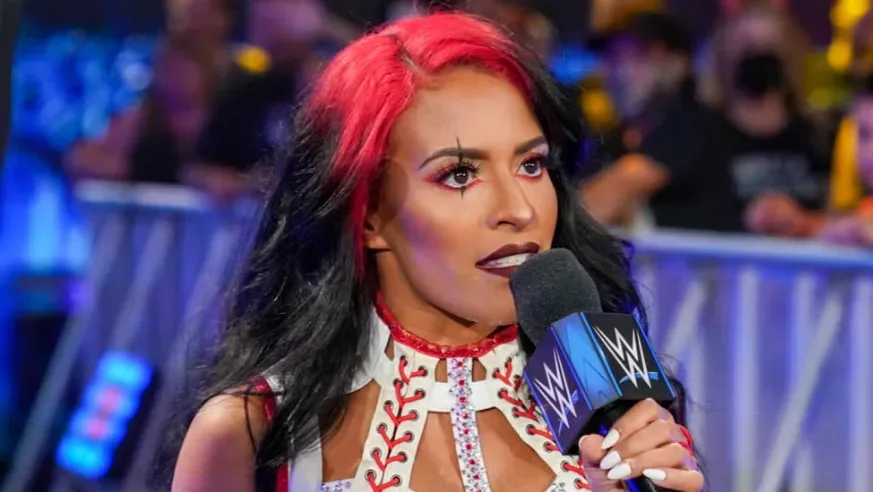
Xelina has addressed the reaction that met some of the visual changes she made during her WWE run, saying she felt a portion of the audience did not understand the character work behind them.
Speaking on an episode of the ZELVX and CHARLIE GIRL podcast, Xelina and Charlie discussed the challenge of evolving a wrestling persona when fans have become accustomed to a particular presentation. For Xelina, hair color and styling were among the details that changed at various points in WWE, and she said those changes sometimes led viewers to question what type of character she was meant to be portraying.
Rather than seeing that response as a sign that the changes had failed, Xelina suggested that the audience reaction could reflect an unwillingness, or inability, to follow a less fixed character approach.
“I did for a while (keeping the orange hair), but then it just became like, ‘We don’t get it. Like, what are you? You don’t understand what kind of character you are.’ I was like, ‘Or you’re just not smart enough to keep up.’ Eventually down the line, you guys will look back and go, ‘Wow, Xelina was actually way ahead of her time.’”
For more background on this topic, read Joe Hendry Explains How an Unconventional Amateur Wrestling Journey Shaped His WWE Rise.
Her comments came during a broader conversation about how performers can make adjustments to their looks without necessarily abandoning the core of their on-screen identities. Charlie shared a similar view, noting that changes to her own hair color during her WWE time had also confused some fans.
Character presentation is more than a single look
Professional wrestling frequently relies on immediate visual recognition. A wrestler’s gear, hairstyle, entrance mannerisms, color palette, music, and body language can all quickly tell an audience who that person is supposed to be. That clarity is especially valuable in a format where talent may have only a few minutes to establish an impression on television.
At the same time, visual consistency can become a limitation if it is treated as the entire identity of a character. Wrestlers evolve through storylines, rivalries, alliances, shifts in confidence, and changes in attitude. Sometimes those developments are delivered through a clear verbal explanation or a major angle. At other times, the performer tries to communicate them in smaller details, including a new hairstyle, a different wardrobe choice, or an altered overall aesthetic.
Xelina’s point is that her changing appearance was not necessarily evidence that she lacked an understanding of her character. In her view, the adjustments were part of the work. The frustration she described came from fans interpreting a change in appearance as proof that the persona itself had become unclear.
That difference matters. A wrestler can preserve certain fundamental traits while changing how those traits are expressed. The person may still be driven by the same goals, carry the same attitude, or occupy the same role within WWE’s storytelling, even if the presentation no longer matches what viewers first expected. Audiences are often asked to read those choices quickly, and not every creative decision will land in the same way for every viewer.
Xelina’s view of the fan response
Xelina did not frame the matter as a simple disagreement over personal preference. Her remarks were more pointed: she believed some fans were not “smart enough to keep up” with what she was doing. It is a deliberately blunt assessment, but it speaks to a familiar tension between wrestling performers and audiences that closely analyze presentation.
Modern fans regularly discuss every visible element of a wrestler’s act. A switch in hair color, attire, social-media tone, entrance behavior, or match style can become a subject of immediate debate. That level of engagement can be rewarding for performers, because it means the audience is paying attention. It can also make experimentation difficult, particularly when viewers expect a wrestler to remain visually consistent unless a major storyline explicitly tells them otherwise.
For Xelina, the criticism appeared to be rooted in expectations about what a coherent character should look like. She recalled reactions that questioned what she was and whether she understood her own role. Her answer was that the audience may have been missing the point, rather than identifying a flaw in the concept.
The comment that people might one day look back and decide she was “way ahead of her time” adds another layer to her perspective. Xelina believes the changes could be reassessed differently with distance. Wrestling presentation often receives that kind of reevaluation. Ideas that initially seem confusing can become more understandable once fans see a performer’s longer creative arc, or once similar stylistic approaches become more common elsewhere in the industry.
The difficulty of subtle storytelling in WWE
WWE operates on a large stage with a broad audience, which creates a difficult balance for anyone trying to communicate character through subtle choices. The product must be accessible to casual viewers while also providing enough depth for fans who follow every show, interview, and visual detail. Those goals do not always align.
A clear change in alignment or motivation is easy to understand when it is presented through a direct confrontation, an attack, a betrayal, or a championship pursuit. More gradual evolution can be harder to establish. A performer may see a change in appearance as a meaningful part of the character’s progression, while viewers may simply see an unexplained alteration.
Neither reaction automatically proves the other side wrong. The performer has direct knowledge of the intended concept, while the audience only receives what makes it onto the screen. If viewers do not connect a visual change to a story development, they can reasonably find it confusing. Conversely, a wrestler can reasonably feel disappointed when details chosen with purpose are dismissed as random or inconsistent.
Xelina’s comments underline that divide. Her experience suggests she viewed her visual changes as part of an evolving creative language. The backlash, as she described it, came from fans wanting a more easily defined or stable version of the character.
Why hair changes draw immediate attention
Hair is one of the most visible aspects of a wrestler’s presentation, particularly for performers whose look has become closely tied to a recognizable color or style. An audience can identify an alteration instantly, even before a wrestler speaks or steps into the ring. As a result, it can become a bigger talking point than smaller changes in personality or behavior.
That can work in a performer’s favor when the goal is to signal that something is different. It can also create confusion when fans attach a specific meaning to one established look and are not given an obvious explanation for its replacement. Xelina said she kept orange hair for a period before moving away from it, and that shift became part of the conversation surrounding her character.
Charlie’s comments indicate that this was not an experience limited to Xelina. Both performers spoke about fans struggling to process hair-color changes within the context of WWE character work. Their discussion reflects a broader creative issue: audiences may demand fresh presentation from wrestlers, but can also resist changes that move too far from an image they already recognize.
Looking back on the final stretch of her WWE run
Elsewhere during the podcast discussion, Xelina also spoke about being miserable toward the end of her most recent WWE run. That revelation provides additional context for the way she now reflects on her creative choices and the public response they received.
She did not connect every aspect of that unhappiness directly to the reaction over her appearance. Still, her comments suggest that the final phase of the run was a difficult period. When a performer is dissatisfied with their situation, public criticism of their character choices can carry even more weight. What may look to fans like a debate over aesthetics can feel much more personal to someone who sees those choices as an important expression of their work.
Xelina’s remarks ultimately offer a defense of experimentation. She is not presenting the various changes to her hair and style as accidental shifts or confusion about who she was meant to be. She is presenting them as intentional choices that some fans failed to interpret in the way she intended.
Whether audiences agree with that assessment will vary. Wrestling is built on a relationship between performer and crowd, and a character only fully succeeds when the presentation communicates something that viewers can understand and react to. But Xelina’s perspective is clear: she sees more purpose in those WWE-era changes than many fans gave her credit for, and she believes time may lead people to view that work differently.

Darryl Polo
Darryl Polo is a passionate wrestling fan covering WWE, AEW, TNA and beyond. He loves great rivalries, breakout stars and the moments that keep fans talking long after the bell. How we work.