
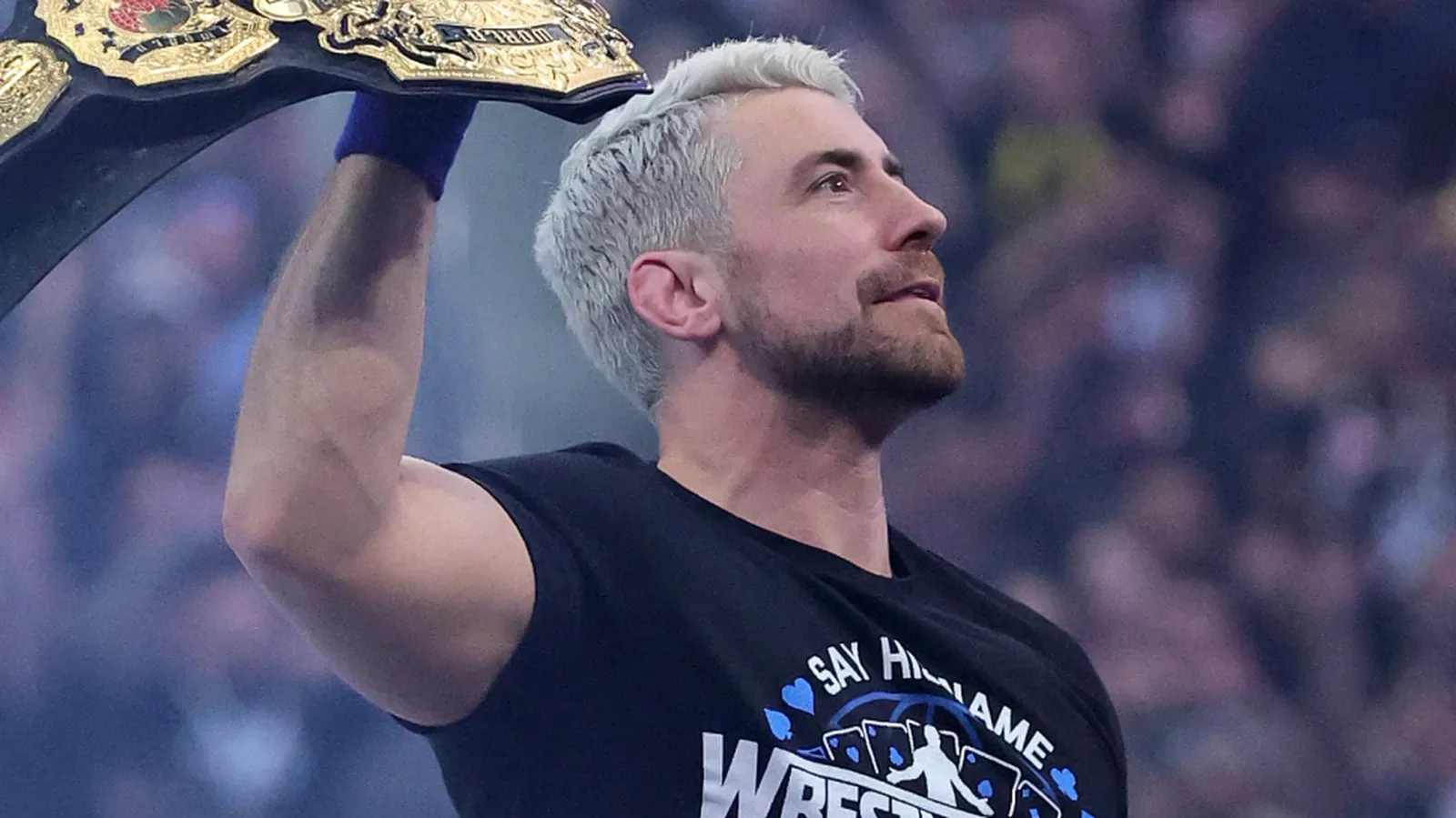
Joe Hendry’s route to WWE has never followed a conventional path. Long before becoming a familiar face to wrestling audiences through his independent work, Ring of Honor appearances, TNA success, and eventual WWE signing in 2025, Hendry was building a combat-sports résumé that pushed him far beyond the standard professional wrestling training environment.
Speaking on Insight with Chris Van Vliet, Hendry discussed his amateur wrestling history and the personal motivation behind it. The WWE star explained that he had already begun pursuing professional wrestling when he realized some people viewed him primarily through the lens of comedy. Hendry has made humor, charisma, and musical presentation important parts of his in-ring identity, but he did not want those strengths to keep people from seeing him as a legitimate competitive threat.
That desire drove him toward serious grappling training, opening a chapter that eventually included a British freestyle wrestling championship, a place on Team Scotland at the 2018 Commonwealth Games in Australia, sessions with future UFC veteran Paul Craig, and the unusual possibility of meeting UFC middleweight champion Robert Whittaker in amateur competition.
Pro Wrestling Ambition Led Hendry Toward Amateur Competition
Hendry described his amateur wrestling journey as distinctly reflective of his personality and career. “I think the thing about my amateur wrestling days is — it’s very me, it’s very unconventional,” he said.
For more background on this topic, read Finn Balor Calls Sami Zayn’s Promo Work ‘Vastly Underappreciated’.
His decision was not rooted in abandoning professional wrestling. Instead, it was an effort to improve the way he was perceived within it. Hendry said he had only recently started wrestling professionally when he felt others were not taking him seriously enough. While he was comfortable bringing comedy into his work, he wanted an added level of credibility and danger behind his performances.
“It all started because I’d just started professional wrestling ... and I found that people weren’t taking me seriously,” Hendry said.
He had some prior experience in judo, providing a foundation for throws, balance, grip fighting, and positional awareness. From there, he decided to develop as a grappler. The transition felt natural to him, particularly during an era when mixed martial arts was still establishing a broader foothold in the United Kingdom.
Hendry recalled visiting MMA gyms roughly 12 years earlier and quickly finding success in grappling sessions. “MMA has progressed massively, but back when this was happening — this was, like, 12 years ago, when MMA wasn’t as big in the U.K., and I would just go to MMA gyms and roast everyone in grappling,” he said.
Those early experiences gave Hendry confidence, but they were only the beginning. He eventually moved into a more serious training setting in Scotland, where the level of competition forced him to test his skill against better-equipped athletes. That progression mattered because it turned an interest initially fueled by professional wrestling ambition into a legitimate commitment to amateur competition.
Training Alongside Paul Craig Offered a Reality Check
Among the opponents Hendry encountered was Paul Craig, the Scottish fighter who later built a notable UFC career. Craig has long been respected for his submission grappling and ability to create dangerous situations from difficult positions inside the cage. For Hendry, working with Craig represented a clear sign that he had moved beyond simply outperforming inexperienced hobbyists at local MMA gyms.
Hendry was candid when discussing how those exchanges went. “I don’t know if I ever took him down, to be honest,” he stated.
That admission highlights the difference between having early natural success and competing in a room full of athletes with high-level technical experience. Rather than presenting his grappling background as an easy rise, Hendry framed it as an unconventional process that included difficult training, elite opponents, and a willingness to challenge himself.
It also helps explain why amateur wrestling became more than a side pursuit. Hendry had entered that world to gain legitimacy and sharpen his arsenal for professional wrestling, but the deeper he went, the more meaningful the amateur side became on its own terms. He was no longer only looking to prove he could grapple. He was preparing to compete at a significant national level.
British Championship Win Became a Defining Personal Moment
Hendry’s competitive trajectory accelerated after he defeated a wrestler who had been scheduled to participate in the Commonwealth Games. That result prompted him to consider entering the event himself. He continued training, committed to the opportunity, and achieved one of the biggest accomplishments of his sporting life before making the trip to Australia.
Competing in freestyle wrestling at his weight class, Hendry won the British Championship. The victory remains especially meaningful because of the immediate emotional impact it had on his family.
“That was one of the greatest days of my life,” Hendry said. “To be able to call my dad on the phone and say, ‘I’m British Champion.’ ... It’s not often that I get emotional. ... I’ll never forget that phone call.”
For an athlete whose professional wrestling presentation is often built around self-belief, memorable catchphrases, and a willingness to make himself the center of attention, the story behind that call offers a more personal perspective. The championship was not simply a credential to use in wrestling promos. It was the product of a demanding commitment to a sport where performance is measured directly by results on the mat.
The British title also helped validate Hendry’s decision to dive into amateur wrestling in the first place. He had set out to add substance to his professional wrestling ambitions. In the process, he became a national champion and earned a route toward one of the Commonwealth’s biggest sporting events.
Commonwealth Games Run Included a Potential Robert Whittaker Match
In 2018, Hendry joined Team Scotland for the Commonwealth Games in Australia. The event created an extraordinary potential matchup: Hendry was initially scheduled to face Robert Whittaker, the Australian UFC standout who was the UFC middleweight champion at the time.
For Hendry, the prospect was surreal. “I was like, ‘I must be living in a simulation, because don’t tell me that the pro wrestler is about to face the UFC Middleweight Champion at the Commonwealth Games,’” he said.
It was a collision of worlds that would have made for an unforgettable chapter in Hendry’s story. A professional wrestler who had pursued amateur competition to become more credible was suddenly preparing for the possibility of facing one of the most accomplished active fighters in mixed martial arts, in Whittaker’s home country.
Hendry understood the scale of the challenge. He said he believed he was heavily outmatched, but he did not approach the situation without some trademark showmanship. Before the potential contest, Hendry contacted UFC veteran Chael Sonnen, another figure known both for his MMA career and his appreciation for professional wrestling. Hendry sought advice, and Sonnen encouraged him to bring some verbal fire to the occasion.
Sonnen even wrote a promo for Hendry to deliver. The match ultimately did not happen, however. Whittaker learned that competing at the Commonwealth Games would require him to vacate the UFC title, removing him from the event and ending the proposed meeting.
The story did not conclude with Hendry emerging victorious in Australia. He laughed while summing up what happened next: “Then I went and got beat by somebody else.”
That blunt assessment fits the tone of Hendry’s wider recollection. His amateur wrestling record includes achievements he treasures, but he did not portray the experience as a flawless sports-movie journey. There were difficult opponents, missed opportunities, and losses alongside the British championship and Commonwealth Games selection.
Why Hendry Ultimately Chose Professional Wrestling
After the Commonwealth Games, Hendry reached a crossroads. Amateur wrestling required continued time, physical energy, and singular focus. Professional wrestling demanded the same, especially for someone determined to establish himself in a crowded industry. Hendry ultimately chose the latter.
He put his full efforts into professional wrestling over the following years, continuing the long climb that had already taken him through the independent scene and into promotions including TNA and ROH. That decision eventually positioned him for his breakthrough with WWE.
WWE’s working relationship with TNA gave Hendry an opening to make an impression on a much larger stage, and he later signed with WWE in 2025. His ascent has made him one of the more distinctive personalities in the company, but the background he described shows that his confidence is supported by extensive athletic work outside the usual wrestling ring.
Hendry’s history in judo, grappling, freestyle competition, and high-level training can all inform the way audiences view his WWE career. Comedy and crowd interaction may be central to his appeal, but they are not the complete picture. His journey included the discipline required to become British champion and represent Scotland at the Commonwealth Games.
That blend is what makes Hendry’s story unusual. He did not take up amateur wrestling as a childhood path that naturally led to professional wrestling. He pursued it after beginning his pro career, partly because he wanted to ensure that opponents, peers, and fans could recognize the competitive edge behind the entertainment.
Years later, with WWE now serving as the latest stage for his career, Hendry can look back on that decision as one that expanded both his athletic identity and his professional wrestling credibility. The path may have been unconventional, but it helped create the performer who now stands in WWE.
In pictures

Darryl Polo
Darryl Polo is a passionate wrestling fan covering WWE, AEW, TNA and beyond. He loves great rivalries, breakout stars and the moments that keep fans talking long after the bell. How we work.