
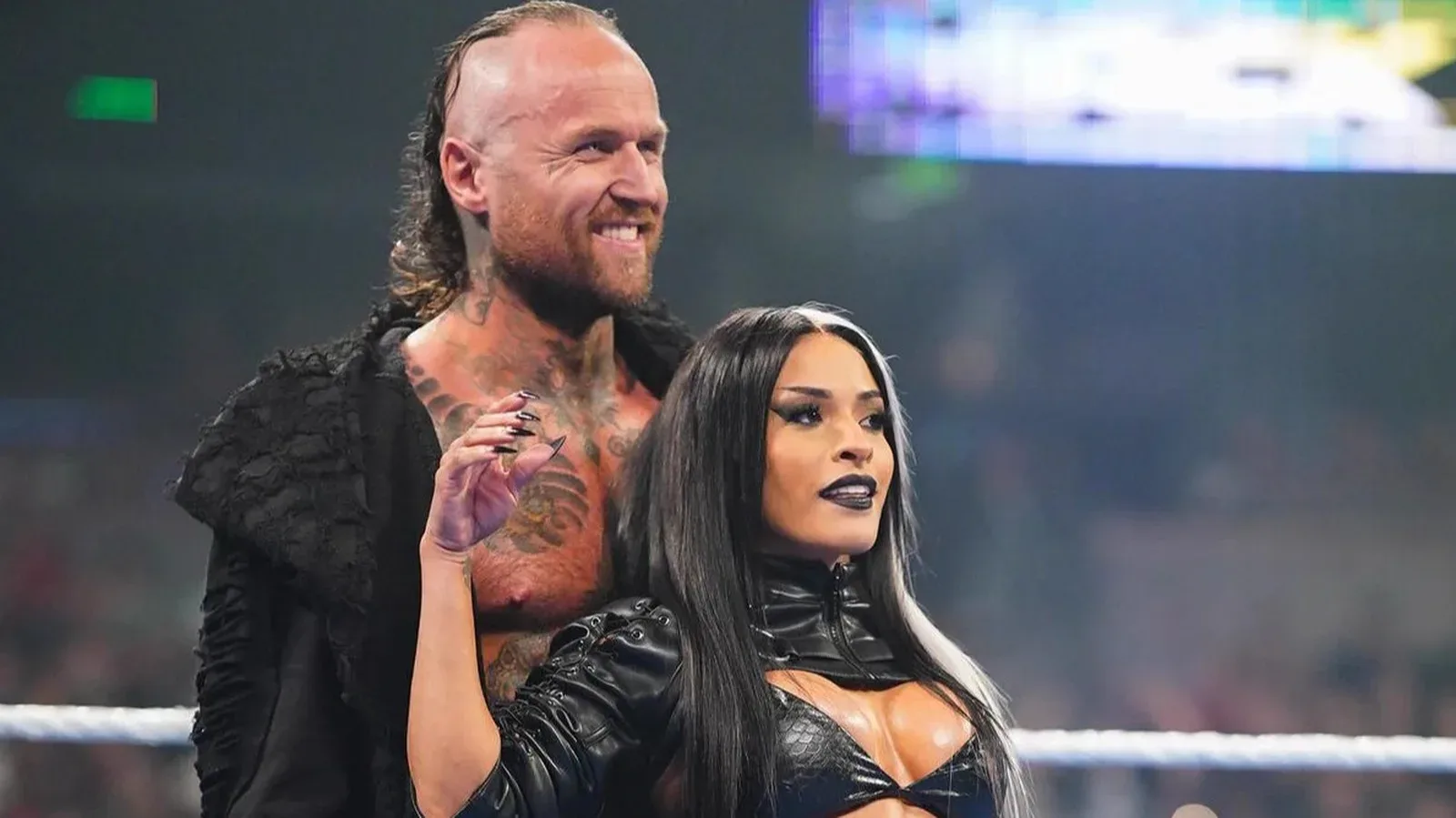
Xelina, formerly known in WWE as Zelina Vega, has opened up about the uncertainty surrounding the direction of her second run with the company and why a renewed on-screen association with Aleister Black was not the outcome she wanted.
Speaking on Ring The Belle, Xelina addressed the mixed messages she felt she received late in that WWE run. While she and Black had previously appeared together on television and are married in real life, she said she was operating under the belief that her future would remain centered on a singles path. Instead, the direction ultimately involved her returning to a managerial capacity with Black.
For Xelina, the issue was not a reluctance to work with her husband. She made clear that she cares deeply for Black and that they did share more than one type of role on screen, including tag matches. Her concern was that stepping back into managing would alter the individual progression she believed she had been working toward.
“The whole thing was always, yes, we’ll be together, but I don’t want to become a manager again. Like, you have to promise me that’s not what’s going to happen. He’s like, ‘No, no, no. It’s not going to happen like that...’ and it did,” Xelina said.
For more background on this topic, read Bully Ray Calls Randy Orton’s Cody Rhodes Segment the Best Promo of His WWE Career.
A Singles Direction Was the Priority
Xelina’s comments frame the situation as one of professional identity as much as presentation. A manager can be a valuable and highly visible part of a wrestling act, but the role is fundamentally different from being positioned as an active singles competitor with her own momentum, matches, and long-term objectives.
That distinction was especially important to Xelina because she believed the next phase of her WWE work would push her forward rather than return her to a familiar place. She described the planned development as something that was supposed to feel like an advancement in her career.
“So, I mean, not that it was just that ’cause we obviously had tag matches and things like that. Those things did happen, but it was supposed to be, like, the thing taking me into this new... it was supposed to be like the f***ing upgrade.”
The comments do not suggest that Xelina viewed appearing alongside Black as inherently negative. Rather, she drew a clear line between being paired with him as part of a broader evolution and being defined primarily as his manager again. In her view, the latter did not match the assurances she had received or the trajectory she expected for herself.
That is a meaningful distinction in WWE, where an on-screen pairing can serve several purposes at once. It can create a combined act, give performers opportunities in mixed or tag-team settings, and provide a character with a natural ally. But it can also shift how each member of the act is perceived. Xelina’s remarks indicate that she wanted any association with Black to coexist with, rather than replace, her own singles ambitions.
Why the Role Carried Extra Weight
Xelina had already been widely associated with the managerial side of professional wrestling during her WWE career. That history made a possible return to the role more consequential than a simple creative adjustment. It carried the possibility that a presentation she had worked to move beyond would once again become the central description of her place on television.
Her interview comments underline the value performers place on having a clear understanding of their role. Wrestling careers often involve changing alliances, teams, character developments, and divisions. Those shifts are part of the medium. Yet a performer’s own expectations still matter, particularly when the proposed direction affects whether they are showcased as a wrestler pursuing individual goals or as the supporting voice and presence for another act.
In Xelina’s telling, the messaging around that issue was not consistent. She said the understanding was that she and Black could be together on screen without her becoming a manager again. When the creative direction moved toward that exact role, it left her feeling that the promised “upgrade” had become something different.
The situation also illustrates why real-life relationships do not automatically determine the best on-screen arrangement. Wrestling promotions regularly have the option of pairing real-life couples, but professional chemistry and personal familiarity do not erase the separate ambitions of the people involved. Xelina’s account makes that point directly: she could be supportive of Black, enjoy working with him, and still want a path that kept her individual wrestling career at the forefront.
Xelina and Black Are Now Free Agents
Xelina and Black were both released by WWE in April as part of the company’s annual post-WrestleMania cuts. Their simultaneous departures ended the WWE chapter discussed in Xelina’s interview and placed both performers back on the independent wrestling landscape.
Since becoming free agents, Xelina and Black have been appearing for independent promotions, including House of Glory and PROGRESS Wrestling. Those appearances offer each wrestler the opportunity to work outside the structure that shaped the final phase of their WWE presentation.
For Xelina, the change also arrives after she publicly articulated a desire to be seen as more than a manager. As an active free agent, she has the chance to pursue bookings and creative situations that reflect that preference. The available information does not establish a specific long-term destination or a defined next step for either Xelina or Black, but their independent appearances make clear that both are continuing to work following their releases.
There is also an understandable interest in whether they will continue to appear together, work separately, or balance both approaches as their post-WWE schedules develop. Xelina’s interview does not rule out working alongside Black. In fact, her comments acknowledge that they had tag matches and other shared on-screen moments. What she objected to was the idea that being beside him would mean surrendering the singles direction she believed was ahead of her.
The Difference Between Partnership and Repetition
At the center of Xelina’s comments is the difference between a partnership and a repetition of an old role. A partnership can allow two performers to be connected while retaining separate identities and objectives. Repetition, from her perspective, would have meant going back to being identified chiefly as Black’s manager.
That perspective is why her use of the word “upgrade” stands out. It conveys that she was not merely seeking a different pairing or a new set of matches. She expected a step forward in how she was positioned. The frustration came from the gap between that expectation and the managerial direction that materialized.
Her account is also a reminder that on-screen outcomes can be judged differently by the people participating in them than by viewers who only see the finished television product. An angle may include tag matches, a prominent pairing, or apparent opportunities for exposure, while the performer involved may still feel it does not represent the evolution they were led to expect. Xelina’s concern was not that she and Black were ever connected on screen; it was that the connection appeared to pull her back toward a role she had expressly said she did not want to resume.
As Xelina continues under her current name, that stated priority provides a useful lens for her next chapter. She wants her work as a wrestler to remain central. Whether she shares the ring or screen with Black in the future, her remarks make clear that she does not want her professional identity reduced to managing him.
For now, both Xelina and Black are active outside WWE, with House of Glory and PROGRESS Wrestling among the promotions on their schedules. Xelina’s reflections on her WWE exit do not diminish her support for her husband. They instead clarify a professional boundary: being part of Aleister Black’s act was not the same thing as pursuing the independent upward move she wanted for herself.
In pictures

Darryl Polo
Darryl Polo is a passionate wrestling fan covering WWE, AEW, TNA and beyond. He loves great rivalries, breakout stars and the moments that keep fans talking long after the bell. How we work.