
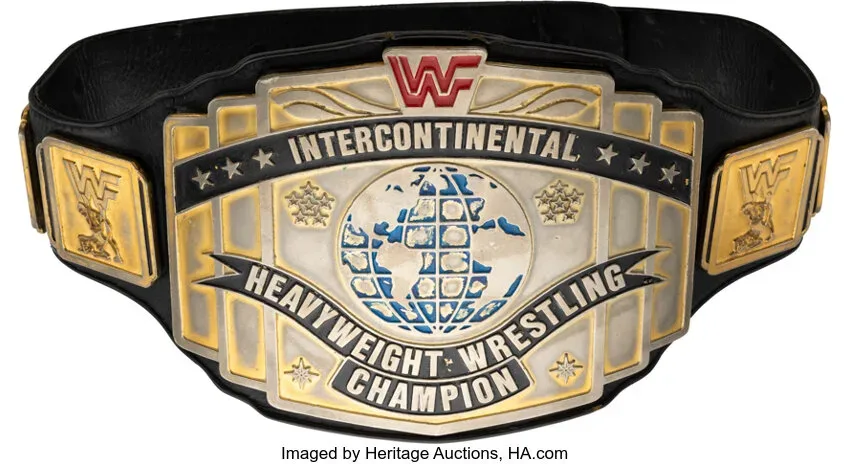
A WWF Red Letter Intercontinental Championship belt has set a new record for the most valuable wrestling title belt ever sold, bringing $716,750 at Heritage Auctions on October 24.
The sale eclipses the previous championship-belt record of $414,800, established by Hulk Hogan’s photo-matched WrestleMania II WWF Championship belt in August 2026. The new figure further underlines the growing collector demand for authenticated artifacts from WWF’s 1980s national expansion, particularly items with a direct connection to multiple legendary performers.
Conrad Thompson announced the result publicly on October 25, identifying the Red Letter Intercontinental belt as the new record holder. Its significance is rooted not only in its distinctive design, but also in an extraordinary documented history that spans a defining stretch for the Intercontinental Championship and the company itself.
View the referenced post on X
The belt was used during a period between 1985 and 1988 in which the Intercontinental title was elevated by a remarkable sequence of champions. Tito Santana, Randy “Macho Man” Savage, Ricky “The Dragon” Steamboat and The Honky Tonk Man all carried the championship during the belt’s active run. Each man brought a different identity to the prize, helping make it one of the most recognizable championships in professional wrestling history.
For more background on this topic, read The Miz Reflects on WrestleMania 27 Title Win, Concussion and a Career-Defining Main Event.
A Record Sale for a Championship Belt
The $716,750 price establishes a clear distinction in the market for wrestling collectibles. Hogan’s WrestleMania I boots, photo-matched to his appearance in the landmark event’s main event alongside Mr. T, sold for $1,037,000 in February 2026. That remains an enormous sale for wrestling memorabilia. However, the Red Letter Intercontinental Championship is now the highest-priced title belt to ever reach the auction block.
For collectors, championship belts occupy a special category. A ring-worn boot, robe or piece of gear can be tied to a single iconic night. A belt, on the other hand, can tell the story of an entire era, moving from champion to champion while appearing in arenas, television segments, magazine photographs and major matches. This particular belt’s years of service and the number of top names associated with it made it an especially rare offering.
The auction listing described the piece as a Reggie Parks-inspired belt, measuring 48.5 inches from end to end and 9 7/8 inches from top to bottom. It bears visible wear consistent with the life of a title that traveled extensively during the territory-to-national era of WWF expansion. The belt also has a 6.5-inch section of black tape on its reverse, with peeling visible at the upper and lower edges of the left side.
Those details are not flaws to be dismissed in a historical piece of this kind. They are part of the belt’s story. The signs of use reflect the hundreds of thousands of miles it traveled while appearing at live events and being carried by champions who were central to WWF’s rise as a national entertainment force.
The Intercontinental Title’s Defining Era
The WWF Intercontinental Championship has long been regarded as more than a secondary championship. During the 1980s, it was frequently the title associated with wrestlers expected to deliver on the ring’s biggest stages. The championship represented athletic credibility, personality and reliability, particularly at a time when WWF was building its identity around both larger-than-life stars and memorable in-ring performances.
Santana held the title with the crisp, energetic style that made him a trusted performer in the company. Savage then added a new sense of grandeur and intensity to the championship. With his flamboyant presentation, volatile character work and acclaimed matches, Savage helped make the Intercontinental title feel like a prize worthy of main-event attention.
Steamboat’s connection to the belt is inseparable from WrestleMania III. On March 29, 1987, Steamboat defeated Savage to win the Intercontinental Championship in a match that remains among the most celebrated in wrestling history. Although Hulk Hogan and Andre the Giant headlined the event in front of a historic audience, Savage and Steamboat delivered the contest that many fans and wrestlers continue to identify as WrestleMania III’s in-ring masterpiece.
The match’s influence remains substantial nearly four decades later. Its pace, structure, urgency and attention to detail have been studied by generations of performers. The Intercontinental Championship was essential to that drama: Savage’s reign had made the prize feel vital, while Steamboat’s pursuit gave the audience a clear and emotionally satisfying objective. When Steamboat left the Pontiac Silverdome with the title, the belt became part of one of the enduring images from WWF’s breakthrough period.
The Honky Tonk Man later carried the championship through a famously lengthy reign built around arrogance, evasive tactics and persistent attempts to avoid losing the belt. His run presented another side of the title’s value. It was not merely a prop for great athletic contests; it was a central storytelling device, capable of generating sustained heat and defining a character’s entire presentation.
That combination of champions is a major reason the auction result reached such a historic number. Santana, Savage, Steamboat and The Honky Tonk Man are all WWE Hall of Famers, and the belt was not simply linked to them in a promotional sense. It was carried through their championship tenures during a relatively concentrated, hugely important window in WWF history.
Why This Belt Stands Apart
Many championship belts are used for limited periods before a company introduces a redesign, retires a physical belt or replaces it with a newer version. That makes a belt with multi-year use and a succession of major champions particularly desirable. The Red Letter Intercontinental Championship remained in circulation across four Hall of Fame reigns, giving it an unusually deep connection to the company’s most influential decade.
Its visual identity also matters. For fans of the 1980s product, the Red Letter Intercontinental belt is immediately recognizable. It evokes an era of packed buildings, syndicated television, colorful personalities and a championship scene where the Intercontinental title could be the centerpiece of a major rivalry. Its presence brings to mind Santana’s athleticism, Savage’s intensity, Steamboat’s precision and The Honky Tonk Man’s defiant swagger.
Thompson’s historical analysis of the offered belt traced its path and examined its condition, use and relevance within the championship’s lineage. That level of documentation is essential when an item carries a six-figure price tag. In an expanding memorabilia market, provenance and photo matching can be the difference between a compelling collectible and a historically important artifact.
The recent Hogan sales illustrate the scale of that market. The WrestleMania I boots worn during Hogan and Mr. T’s main-event victory became a seven-figure item in February. Hogan’s WrestleMania II title belt then brought $414,800 on August 23. The Intercontinental belt’s $716,750 result now surpasses that championship sale by more than $300,000 and sets a new standard for title belts.
The result also demonstrates that collectors are placing immense value on items beyond the traditional focus of world-championship memorabilia. The Intercontinental title has always carried prestige, but this sale recognizes the championship’s place in the larger WWF story. During the period represented by this belt, the title was held by performers who regularly operated at an elite level and whose work helped convert casual viewers into lifelong fans.
A Piece of WWF History Preserved
Wrestling artifacts are often valued for what they represent as much as for their physical makeup. This belt represents a touring championship that was seen night after night by audiences across North America. It represents the transition of WWF into a mainstream cultural phenomenon. Most importantly, it represents the performers who gave the Intercontinental Championship its lasting reputation as a title for stars capable of carrying the show.
The $716,750 sale is therefore more than a new auction statistic. It is a reflection of the sustained importance of the championship and the era attached to it. Savage versus Steamboat at WrestleMania III continues to inspire discussion. The Honky Tonk Man’s record-setting reign remains a cornerstone of Intercontinental title history. Santana’s work helped establish the championship’s athletic standard. Together, those stories are contained in one heavily traveled, visibly worn piece of gold and leather.
With its record-breaking price, the WWF Red Letter Intercontinental Championship belt has become one of the most significant wrestling artifacts ever sold. It now stands as the benchmark for championship-belt memorabilia, while also serving as a tangible reminder of the stars and matches that made the Intercontinental title legendary.

Darryl Polo
Darryl Polo is a passionate wrestling fan covering WWE, AEW, TNA and beyond. He loves great rivalries, breakout stars and the moments that keep fans talking long after the bell. How we work.