
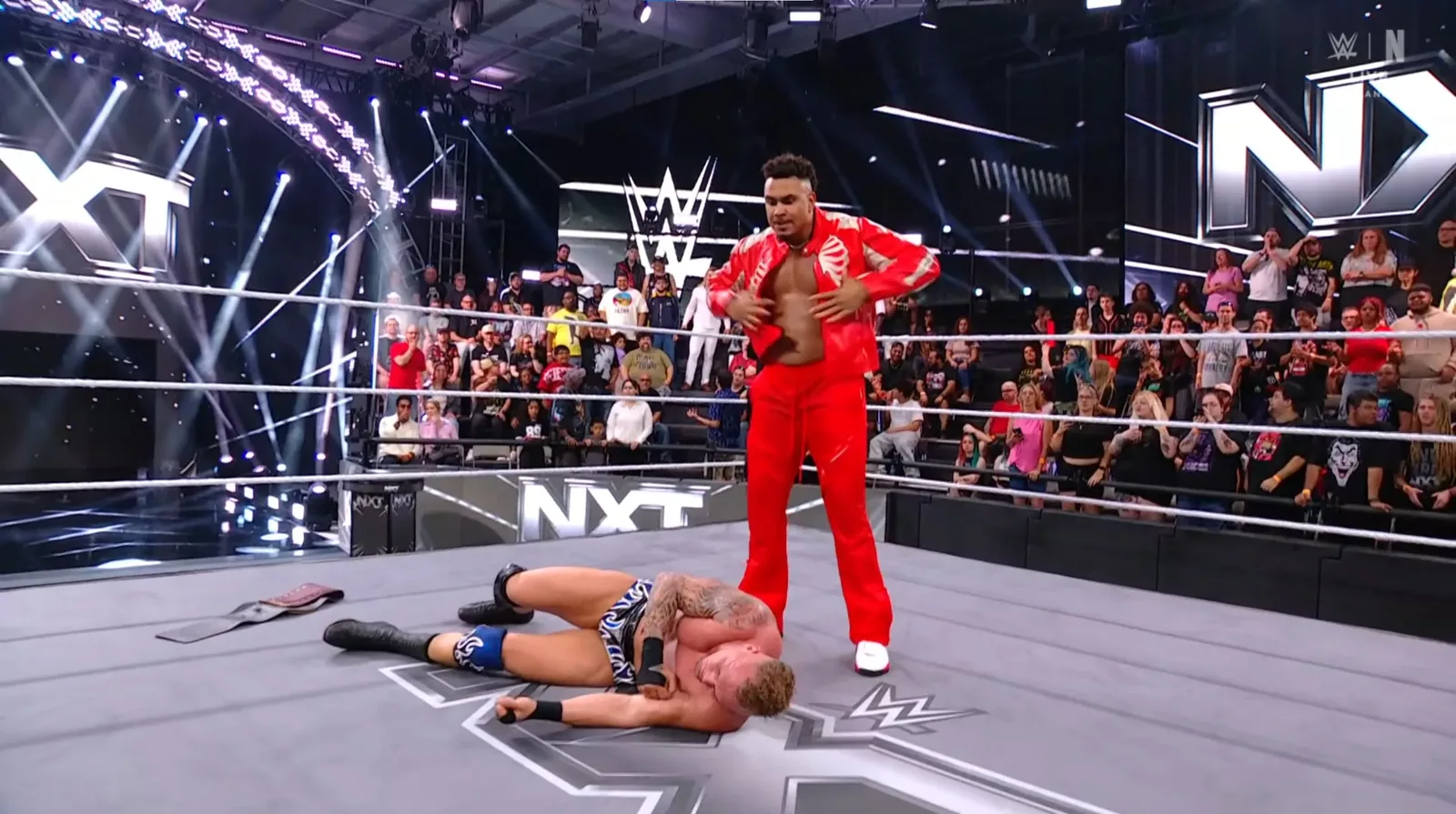
Kam Hendrix does not view his path from football to WWE’s NXT brand as a dramatic career reinvention.
For Hendrix, the common ground between the two worlds is straightforward: both require an athlete to perform under pressure, command attention when the moment arrives, and deliver when the spotlight is pointed in his direction. The former football player, now a member of the NXT roster after entering WWE through its recruitment of NIL athletes, recently addressed the transition and made clear that he believes the mentality has remained the same.
“I mean, there’s not that much of a transition. I’ve always been a superstar I’ve been always Showtime so like when I go in I step up in that and that plate, you know, I gotta show out. So it’s the same thing as football. It’s the same thing wrestling next week.”
It is a confident assessment from a performer whose WWE journey is still developing, but it also reflects the philosophy behind the company’s continued interest in athletes from other sporting backgrounds. Football, in particular, has supplied WWE with talent for decades, and the modern NIL recruiting approach has created another route for athletes to enter the system and learn professional wrestling from the ground up.
For more background on this topic, read Jeff Jarrett Reflects On Never Getting A Shawn Michaels Rematch After WWE In Your House 2.
Hendrix sees performance as the shared foundation
Hendrix’s answer centers less on the technical differences between football and wrestling and more on the mindset required to succeed in a high-profile environment. Football players must execute in front of large audiences while working within a team structure, absorbing physical contact, studying preparation, and responding immediately when a game changes. Professional wrestling asks for its own specialized training and skills, but it similarly puts a premium on presence, timing, confidence, conditioning, and the ability to make a moment matter.
By describing himself as “Showtime,” Hendrix positioned the move as an extension of an identity he already carried in football. His focus is on stepping into a role and showing out once the opportunity is there. That kind of self-belief is hardly unusual among athletes attempting to establish themselves in WWE, especially in NXT, where newer talent are tasked with translating their prior competitive experience into an in-ring persona and a sustainable wrestling career.
The comment does not suggest that football and wrestling are identical pursuits. They are not. Wrestling demands specialized ring awareness, match structure, safety, character work, and the ability to connect with an audience in a way that is distinct from any traditional team sport. Still, Hendrix’s point is that the pressure of performing and the drive to excel in front of a crowd are familiar territory.
That familiarity can be significant for recruits who arrive at WWE after years of organized athletics. The transition to a new sport can be demanding, but competitors who have already spent time in demanding training environments may have experience with schedules, coaching, repetition, film study, physical preparation, and the need to stay composed in public settings. Hendrix’s remarks indicate he sees those elements as helping make the move feel natural.
NXT remains a key development environment
Hendrix is currently part of the NXT roster, placing him in WWE’s developmental environment as he continues to build his foundation in professional wrestling. NXT has long been a destination for performers entering WWE through varied routes, including independent wrestling, international promotions, collegiate athletics, and other sports.
For NIL athletes, the process presents a particularly different starting point. Rather than arriving with extensive wrestling match experience, recruits are trained from the beginning within WWE’s system. The goal is not simply to turn an athlete into someone capable of taking part in a match. It is to develop a well-rounded performer who can work in the ring, communicate a character, deliver in live settings, and adapt to the expectations of WWE television.
That makes the confidence Hendrix expressed important. A recruit can possess athletic ability, but comfort in the spotlight is another essential piece of the equation. Hendrix’s statement suggests he does not see the attention that comes with wrestling as an obstacle. Instead, he sees it as part of the job he has always embraced.
There is also a practical reality to the NXT experience. Development takes time, and every athlete’s timetable differs. Some adapt quickly to the demands of wrestling, while others require a longer period to refine the skills that cannot be fully replicated in another sport. Hendrix did not place a timetable on his development or make any specific claims about what comes next. His comments were focused on the broader transition and his confidence in handling it.
Football has a long connection to WWE
Hendrix joins a lengthy list of wrestlers with football backgrounds. Roman Reigns is among the most prominent examples of a former football player who went on to become one of WWE’s defining stars. The connection is easy to understand: football can foster physical toughness, explosiveness, body control, discipline, and a willingness to compete in intense environments.
Those traits alone do not guarantee a successful professional wrestling career. The craft requires a different kind of athletic communication, where two or more performers work together to create a compelling match while protecting one another and telling a story for the audience. The microphone and personality side of the role can be equally crucial. But prior football experience has repeatedly given athletes a base from which to begin that learning process.
WWE’s recruitment of NIL athletes has broadened its talent pipeline by identifying people who have already demonstrated the ability to compete at a high level in college sports. The initiative is built around potential as much as immediate experience. Some athletes arrive with clear physical gifts, while others stand out because of their charisma, confidence, or adaptability. Ideally, a successful prospect combines those attributes and turns them into a complete wrestling presentation.
Hendrix’s answer captures the confidence that can be valuable in that environment. He did not frame football as something he had to leave behind in order to become a wrestler. Rather, he presented the two pursuits as connected by the expectation that he will rise to the occasion.
Confidence will be part of Hendrix’s presentation
In professional wrestling, a performer’s own outlook can often become part of how audiences perceive them. Hendrix’s insistence that he has “always been a superstar” immediately communicates ambition and an understanding that WWE is a stage as much as it is an athletic competition. Whether that confidence ultimately shapes his on-screen character, his approach in the ring, or simply his personal motivation remains to be seen.
What is clear is that Hendrix is not approaching the move from football with a public sense of hesitation. His words indicate that he expects himself to perform when his number is called. That attitude is especially relevant in NXT, where opportunities to stand out can come in many forms, from training and live events to televised appearances and evolving character work.
Hendrix has also previously addressed the on-screen pairing involving his wife, Maxxine Dupri, and Austin Theory. That subject is separate from his comments about his own athletic background, but it has placed him in conversations surrounding WWE programming beyond his individual NXT development. His latest remarks, however, put the attention back on his own path and how he views his place in the wrestling world.
The next stage is the same challenge facing any developing wrestler: turning confidence, athletic experience, and training into a consistent presence that audiences recognize. Hendrix believes he already understands the performance aspect of that challenge. The work ahead in NXT will determine how that belief translates into his professional wrestling career.
For now, Hendrix’s message is simple. In his view, the move from football to WWE is not a leap into an unfamiliar spotlight. It is another opportunity to step up, perform, and show out.

Darryl Polo
Darryl Polo is a passionate wrestling fan covering WWE, AEW, TNA and beyond. He loves great rivalries, breakout stars and the moments that keep fans talking long after the bell. How we work.