
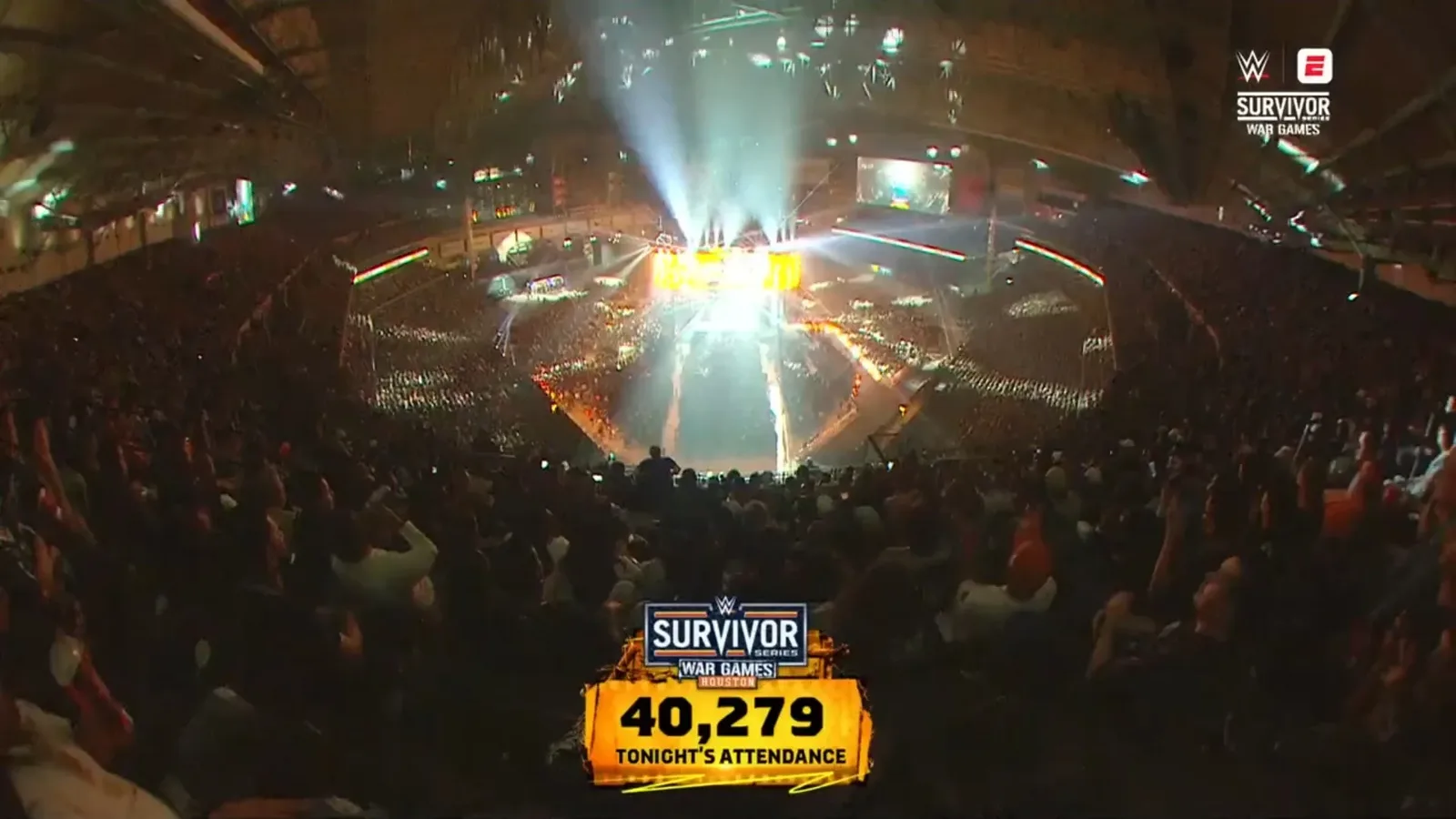
WWE announced an attendance of 40,279 for its 2026 Survivor Series premium live event at Daikin Park in Houston, Texas. Ring announcer Alicia Taylor delivered the figure to the crowd after The Rock’s segment, putting a number on a stadium show that featured two WarGames matches and a return to the traditional five-on-five Survivor Series elimination format.
The elimination match pitted Team USA against Team Mexico, while Becky Lynch and Liv Morgan met in a Women’s World Title match. John Cena and The Rock also appeared on the show. The lineup gave WWE several ways to sell the Houston event: the spectacle of WarGames, a match built around the original Survivor Series rules, a singles championship bout and appearances by two of the promotion’s most recognizable names.
What WWE’s announced attendance tells us
The 40,279 figure is WWE’s announced attendance, as delivered by Taylor during the event. It should not be read as a count of paid tickets or described as a sellout. The announcement did not include a breakdown of paid and complimentary tickets, a separate turnstile count or a ticket revenue figure. It also did not specify how many seats were available in the configuration used for Survivor Series.
That last distinction matters at a ballpark. Daikin Park is home to Major League Baseball’s Houston Astros, but a seating layout for wrestling is different from one for baseball. A ring and floor seating can put fans in parts of the building that are not used for baseball seating, while a stage, production equipment and sightline restrictions can take other sections out of use. The ballpark’s baseball capacity therefore is not a reliable shortcut for determining whether WWE filled every seat it could sell.
For more background on this topic, read WWE and Marvel Launch Five Signature Championship Belts, Four Priced at $700.
WarGames adds another consideration to the floor plan. The match uses two rings side by side inside a single cage, so it takes up more space on the floor than a standard wrestling ring. That makes the Houston setup a useful reminder that even two wrestling events held in the same building would not necessarily have the same capacity. For comparisons with other WWE stadium shows, the cleanest starting point is to compare announced attendance with announced attendance, rather than mixing that figure with paid-ticket or turnstile numbers.
WarGames and traditional Survivor Series rules on the same card
Two WarGames matches gave the Houston card a double dose of the format that has become closely associated with the modern Survivor Series. The staggered entrances are central to the match: one team can have a temporary numbers advantage before the next wrestler enters, and those shifts shape the action until everyone is inside. Despite the emphasis on teams, wrestlers are not picked off one at a time in the manner of a classic Survivor Series match.
Team USA against Team Mexico brought that older structure back into the mix. In a traditional five-on-five Survivor Series match, an elimination takes a wrestler out of the contest while the remaining team members carry on. A team can start with five wrestlers and find itself depending on one survivor against several opponents. Where WarGames builds toward getting both full teams inside the cage, the elimination format steadily strips both sides down. The two formats can create a numbers disadvantage, but they get there in opposite ways.
That contrast gave the Team USA–Team Mexico match a purpose beyond adding another team contest to a card with two already on the schedule. Survivor Series originally built its identity around elimination matches, and the five-on-five format still gives the event something distinct from a regular tag team bout. Houston’s lineup made room for that history without setting aside WarGames, which remained the night’s most prominent match format by appearing twice.
Becky Lynch and Liv Morgan provided a singles title attraction
With so much of the lineup organized around teams, the Women’s World Title match offered a different point of focus. Becky Lynch and Liv Morgan met one-on-one for the championship, giving the Houston event a singles title program alongside the cage matches and the five-on-five elimination bout. The attraction did not rely on which side could keep more wrestlers in the match; it rested on two established WWE names and the championship at stake.
The title match also illustrates why the attendance figure is best understood as a number for the whole event. WWE promoted a card that offered several different kinds of matches, not a standalone WarGames show or a single championship attraction. There is no breakdown showing which match prompted fans to buy tickets, and the announced crowd figure cannot establish how much of the turnout any one wrestler or match accounted for.
The Rock’s segment set up the attendance announcement
The timing of Taylor’s announcement was part of its presentation. Rather than releasing the figure only after the show, WWE had its ring announcer share it with the live audience following The Rock’s segment. The placement turned the crowd count into a moment within the event itself and tied the number to the building where those fans had gathered.
Cena’s appearance gave the show another recognizable name outside the list of advertised match formats. The significance for the attendance story is that both Cena and The Rock were part of the overall lineup. Their presence broadened the show’s appeal on paper, but it does not establish how many people came to see either of them. The Rock’s segment is directly relevant for a narrower reason: it was the moment immediately preceding Taylor’s announcement.
For WWE, the figure gives the Houston edition a clear benchmark for future comparisons with other stadium events. Those comparisons will be more meaningful if they account for venue layout and use figures measured on the same basis. A larger baseball capacity elsewhere, for example, would not automatically mean more seats were available for wrestling, just as a larger announced crowd would not by itself establish a higher ticket gate.
The takeaway from Daikin Park is straightforward: WWE put its Survivor Series crowd at 40,279, with Alicia Taylor announcing the number after The Rock’s segment. The figure belongs to a Houston card that combined the two-ring scale of WarGames with the five-on-five elimination rules that gave Survivor Series its identity, while making room for a women’s world championship match and appearances by Cena and The Rock.

Darryl Polo
Darryl Polo is a passionate wrestling fan covering WWE, AEW, TNA and beyond. He loves great rivalries, breakout stars and the moments that keep fans talking long after the bell. How we work.